
Plan the IP schema around the work
Connect address ownership, IPv4 and IPv6 coverage, access boundaries and monitoring with checked changes and current records.
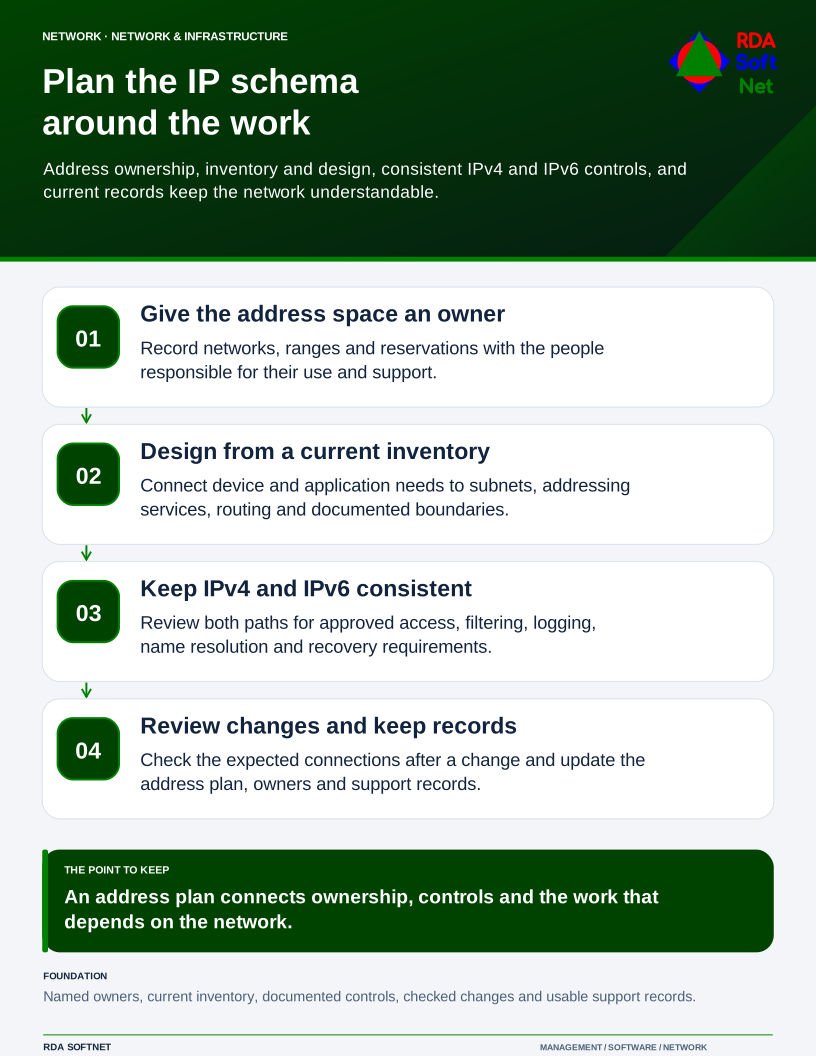
Start with a usable address plan
An IP schema records how network addresses and segments support the organization's locations, devices and services. It connects the intended design with the people responsible for maintaining it, including address assignments, routing, name resolution and the permitted connections between networks.
Automatic network addressing carries out the approved client-address assignment. The broader schema explains the design that process follows and how changes are checked. Keep it connected to network access boundaries and current operating records.
IPv6 is already part of the environment
IPv4 and IPv6 can both be active in the equipment and services an organization uses. A network described as IPv4-only can still contain devices communicating locally over IPv6. The operating question is which paths exist, who manages them and whether their protections and monitoring match the intended design.
An overlooked path can leave an access boundary, filtering rule or monitoring arrangement incomplete. It can also make a connection problem harder to diagnose when one protocol works and the other fails. Our network access guidance explains what needs attention across both protocols.
We review the inventory, addressing and routing, name resolution, firewall and VPN coverage and the evidence available to the monitoring team. Provider changes, new equipment and application changes need the same review. Planning now gives the next change an owner, a test and a way to recover if the result differs from what was agreed.
Connect the review to network monitoring, internal name resolution and VPN services. Findings become actions in the service review.
Check the paths actually available
IETF operational security guidance explains why both protocols need consistent security policy. It also describes how unauthorized or misconfigured IPv6 router announcements can disrupt or redirect local traffic.
Establish which devices and services use each protocol and who is responsible for the design. Review permitted connections, routing, name resolution, DNS and web filtering, VPN paths and monitoring coverage. Confirm that required services work and intended restrictions hold across the paths actually available.
Keep the schema connected to change
Use the schema when reviewing a provider change, new equipment, an application dependency or a different working location. Record the affected services, responsible owners and acceptance checks before the change becomes a support problem. Bring unresolved findings into the service review and the next planning decision.
Public guidance explains the approach. Detailed addressing records and organization-specific procedures follow the appropriate approved access arrangements.