
“Move it to the cloud” is a location proposal. It does not yet explain how an application will work for its users, how it will recover, or who will maintain it. Keeping a server on site needs the same explanation. The right decision begins with the service, not a preference for one hosting model.
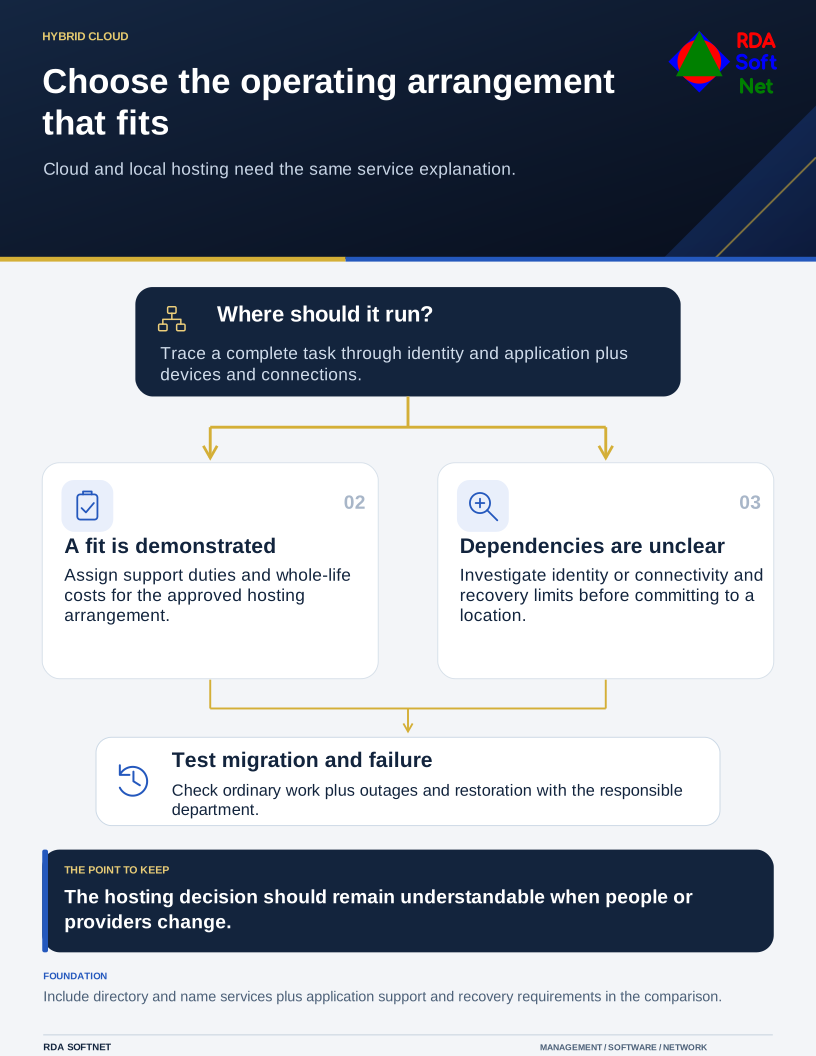
Choose the operating arrangement that fits
Cloud and local hosting need the same service explanation.
Some organizations will do well with mostly cloud applications. Others have local equipment, specialized software, connectivity limits, or data handling requirements that justify a mixed arrangement. Hybrid infrastructure is useful when those needs are understood. It can also add unnecessary complexity if adopted without a clear reason.
Follow a complete transaction
Take one important task and trace it from start to finish. Where does the user sign in? Which application and database are involved? What other services must respond? Does a scanner, printer, voice system, or operational device participate?
That exercise often exposes dependencies that a server list misses. An application moved successfully to a hosted platform can still fail because its directory, name resolution, file connection, or local interface was overlooked. Include those dependencies in the technology plan before estimating the move.
Ask the department to define acceptable performance and outage consequences in ordinary terms. “The application must support the morning intake period” gives an engineering team something to test. “The cloud should be faster” does not.
Compare responsibilities and whole costs
Price the service across its expected life. Include support, connectivity, backup, licensing, management, migration effort, and eventual replacement or exit. Check the provider's actual charging model rather than assuming every cloud service has the same costs.
Microsoft's shared responsibility explanation shows that customer duties change with the service model while data, identities, and access still require management. A hosted virtual machine and a finished cloud application are different operating commitments.
The cloud governance guide helps identify those duties. NIST's public cloud security guidance also frames outsourcing as a decision requiring security and privacy consideration, rather than an automatic transfer of accountability.
Test the failure as well as the migration
Work through loss of internet access, loss of an identity service, a damaged database, and an unavailable provider. Avoid assuming that a local server guarantees continued operation or that a second cloud location automatically supplies recovery. Both need an implemented and tested design.
Use backup and recovery planning to establish restoration order and continuity arrangements to agree how staff will work while restoration is underway. A fallback that depends on the same failed sign-in service may not be available when required.
RDA coordinates these decisions with the department, internal IT, and application providers. Record why the chosen arrangement fits, what its limits are, and when it should be reviewed. A sound hosting decision remains understandable when personnel, providers, or business needs change.