
A successful backup notification answers a limited question: a job completed according to its own checks. It does not establish how quickly the department can resume work or whether every dependency can be recovered.
A copy becomes useful through recovery
Design for the work the department must resume rather than a successful job notification.
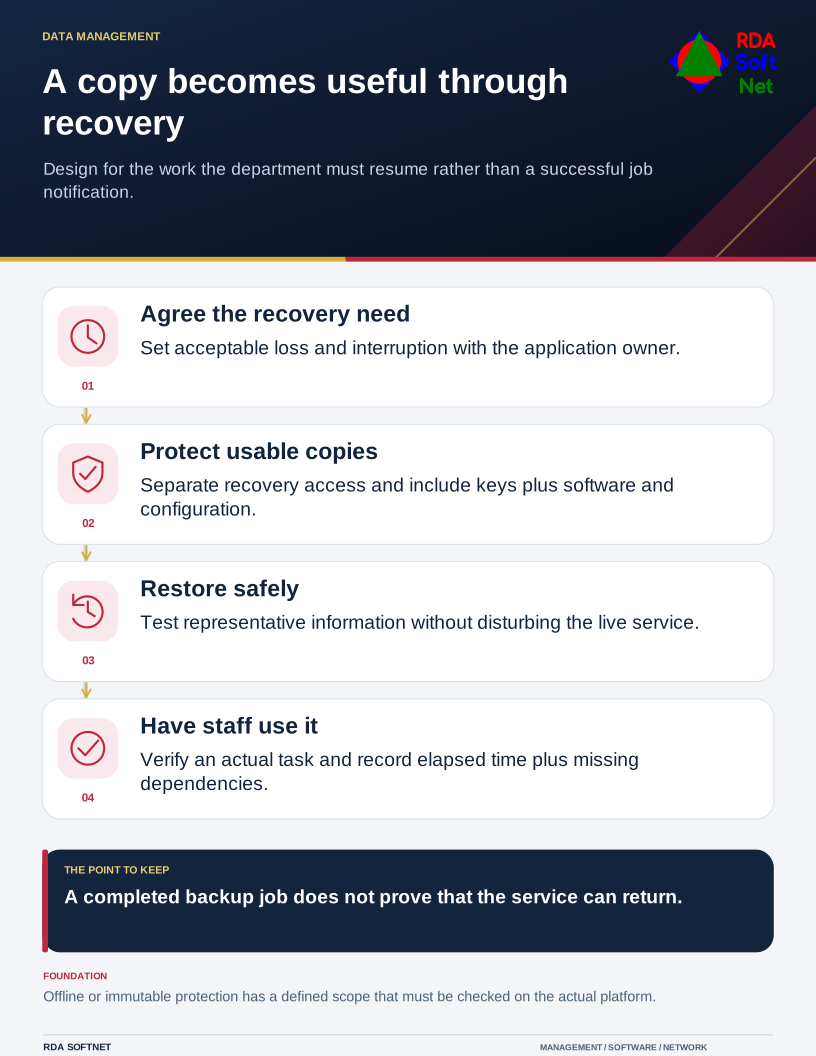
Agree what recovery must achieve
Work with the application owner to identify important information, acceptable data loss, and tolerable interruption. Include configuration, identities, encryption keys, software, licensing, and provider support where the application needs them. An exported database may be of little use without the application that understands it.
Keep the recovery administration and copies appropriately separated from ordinary production access. Review retention, off-site arrangements, offline or immutable protection, and the permissions that could alter or delete copies. Immutability has a defined configuration and retention period; the label alone does not describe every administrator’s powers.
CISA’s ransomware guidance recommends protected backups and regular recovery testing. Select controls for the actual platform rather than assuming a cloud service, file sync, or recycle bin provides the required backup arrangement.
Test enough of the service to expose the gaps
Restore representative information into a safe test location. Have the responsible staff check that it opens correctly and supports the intended task. Where justified, test a fuller service recovery with the identity, network, and application dependencies included. Record the restore point, elapsed time, missing items, and remaining work.
Choose a test scope that protects live information and avoids accidentally reconnecting an old system to production. Repeat appropriate tests after material application, storage, or security changes.
Compare the test results with continuity priorities, the incident plan, and the cloud exit arrangement. Record what can be recovered, by whom, and under which conditions. Give any shortfall an owner and a funding decision.