
An order placed through an employee's own shopping account can leave its invoice, refund history, saved payment details, and recovery instructions outside the organization's control. Prepare an approved purchasing arrangement before a department needs an urgent order.
Keep payment authority through account changes
The supplier account and payment method are connected records with separate responsibilities.
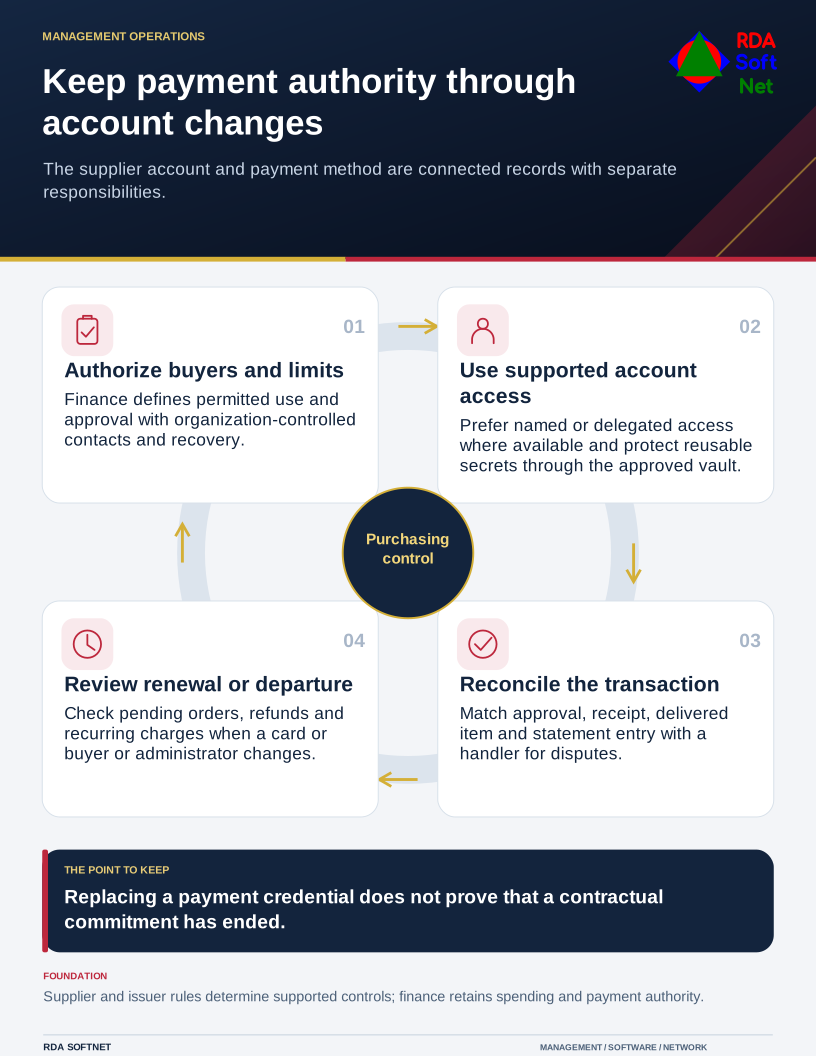
Begin with two connected records: the account used with the supplier and the payment method authorized by finance. Establish who administers each, who may buy, who approves the expense, and where the resulting records belong.
Give the account an accountable owner
Use organization-controlled contact and recovery arrangements, with named buyer or delegated access where the service supports it. Check the supplier and issuer's rules before sharing an account or credential. Where delegation is unavailable, finance may need to place the order through an approved process rather than circulate a common login.
Apply user credential management and MFA to the supplier account, administrator, and supported banking access. Store reusable secrets through the approved vault. Keep full card details and recovery secrets out of ordinary tickets, email chains, and general asset records.
GSA's federal SmartPay program assigns account-holder responsibilities for safeguarding accounts, respecting limits, retaining transaction evidence, and reconciliation. That provides a useful responsibility model. The organization's own purchasing policy and issuer agreement determine its actual authority and conditions.
Match the payment controls to the purchase
Have finance establish suitable limits and permitted use. Confirm which restrictions the issuer actually supports and how changes are approved. A limit should reflect the authorized work, with a documented exception route when a legitimate purchase cannot proceed.
Virtual payment credentials need their own operating check. GSA's payment-solutions guidance describes examples with amount, time, or merchant controls in that program. Other issuers and products differ. Ask how the proposed arrangement handles delayed shipment, separate charges, refunds, expiration, and subscriptions before relying on it.
Keep the supplier check and purchase approval in place. A payment restriction cannot establish whether the item is suitable or whether the seller will deliver it. The online purchasing review covers those decisions and the technical requirements around an order.
Keep recurring charges and departures visible
For a subscription, record its purpose, service owner, billing account, renewal, notice requirements, and authorized commitment. Someone should review the continuing need before renewal. Link the charge to cloud service administration where applicable so the billing record and application record agree.
When a card, buyer, or administrator changes, review pending orders, refunds, saved credentials, and recurring payments. Coordinate issuer changes with merchant billing and any contract cancellation, then confirm the outcome. Do not treat replacement of a payment credential as proof that every commercial commitment has ended.
After delivery, match the approval, receipt, item received, and statement entry. Assign disputed charges and missing refunds to a person following the issuer's current process. For suspected misuse, finance should contact the issuer promptly through a verified route while the technical team coordinates any account incident.
Test the handover: can another authorized person recover access, locate the order evidence, and identify the next recurring charge? RDA can coordinate the identity and service records; finance retains spending and payment authority. Resolve the missing step while the normal account owner is available.