
A password manager becomes useful when staff can generate a different password for each account and retrieve it without keeping a spreadsheet of secrets. CISA recommends this use in its password-manager guidance. For an organization, the purchasing decision also needs to cover administration, recovery, and departures.
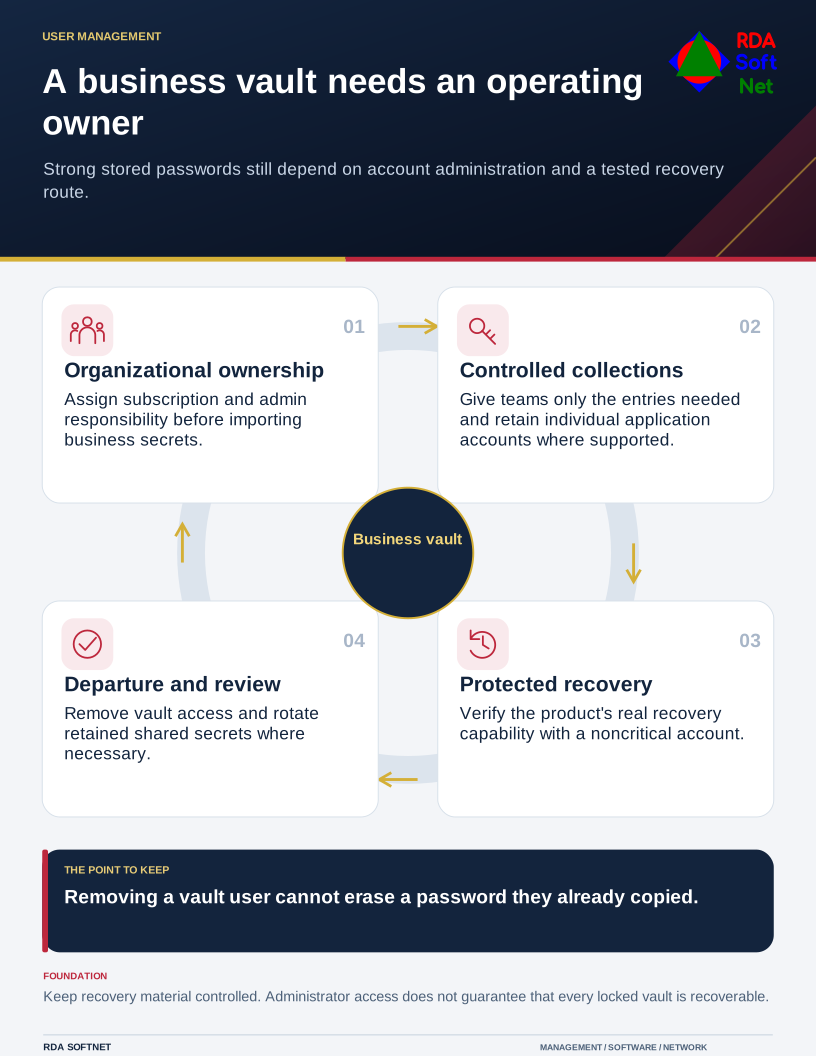
A business vault needs an operating owner
Strong stored passwords still depend on account administration and a tested recovery route.
Establish ownership before importing passwords
Use an approved business account and assign responsibility for the subscription, administrator roles, user enrollment, and support. Check what the product actually permits an administrator to recover. Recovery arrangements differ; the existence of an administrator account does not establish that every locked vault can be restored.
Protect the vault sign-in with the strongest supported authentication appropriate to the environment. Keep emergency recovery material controlled and available to authorized people during an outage. Test the documented recovery route with a noncritical account before relying on it for essential access.
Separate personal entries from business records. Give teams access only to the collections needed for their work. Where an application supports individual accounts and delegation, preserve those identities. Storing a shared password securely does not make the application's activity attributable to one person; the User Credentials guide explains that distinction.
Treat the vault as an operating service
Enrollment should include the approved application or extension, practical training, and a way to report an unexpected prompt. Endpoint compromise and phishing still matter even when the saved passwords are strong.
For a departure, remove vault access, review sessions and shared collections, and change secrets the person could have retained when necessary. Removing a vault user cannot erase a password already copied elsewhere. Connect that work to offboarding, with an owner for unresolved applications and recovery dependencies.
At review, ask someone other than the primary administrator to follow the emergency procedure. Resolve any step that depends on that administrator's memory or personal device.