
A password manager can help an employee use separate credentials across many services. An organization needs more than that individual convenience. It must know who controls the business accounts, how access is recovered, and what happens when the employee leaves.
Separate personal convenience from business custody
A vault arrangement must keep essential organizational accounts recoverable through a staff change.
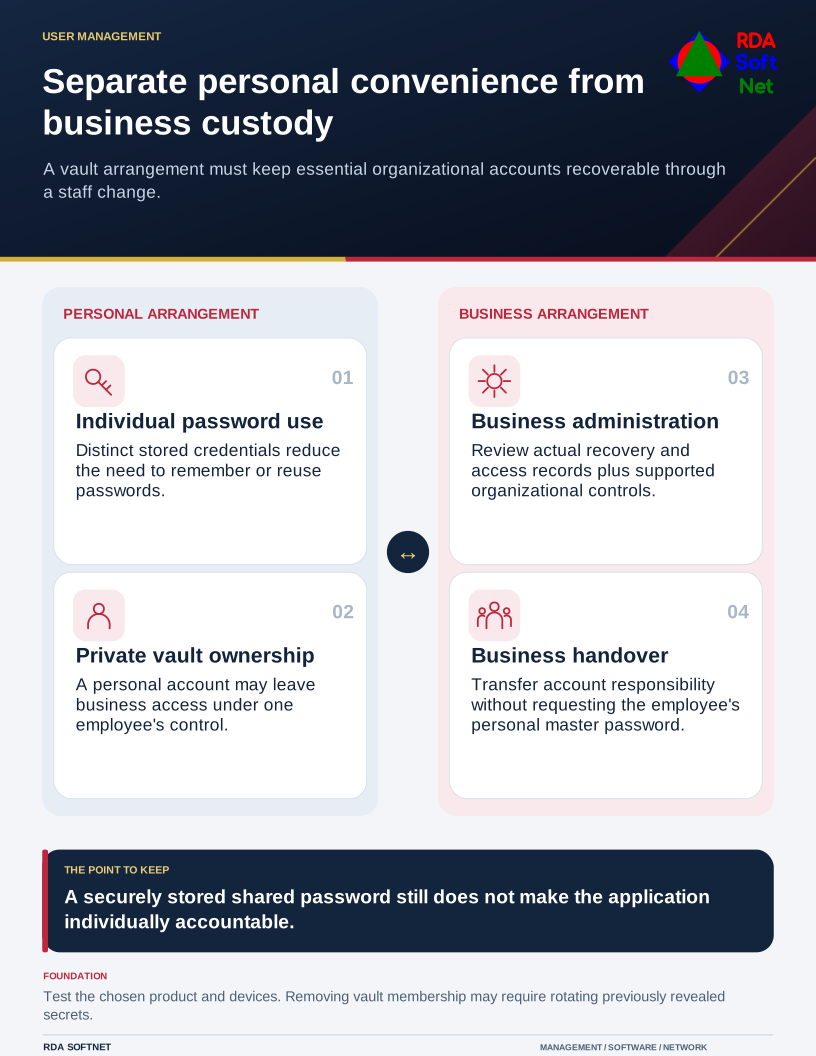
Begin by separating personal information from organizational credentials. A private vault owned by an individual may be unsuitable as the only home for a business-critical supplier account. The right arrangement depends on the account, its permitted use, and the product's supported administration.
Choose capabilities for the working environment
CISA's password guidance explains how a manager can create and store distinct passwords. That is a useful capability, alongside an appropriate unlock method and protection for the devices using the vault.
Compare the actual options for account administration, organizational recovery, authentication, access records, sharing controls, supported devices, and export. Do not assume that a browser-based manager is always less secure than a standalone product, or that a paid plan automatically supplies every business control.
The password vault guide connects those choices with the organization's operating needs. Have representative users test the approved sign-in and recovery process before a wider rollout. Include mobile use, shared workstations, and accessibility requirements.
Set a strong, unique unlock credential where the design requires one, enable suitable additional authentication, and protect recovery material. Explain how staff recognize and reach the genuine application. A convincing imitation login can target the manager as well as the websites whose credentials it stores.
Share the work through identities where possible
An application supporting individual users and delegated access should ordinarily be used that way. Storing a shared password in a vault does not turn the underlying application into an individually accountable system.
For unavoidable shared secrets, record the business owner, authorized audience, reason, and review date. Check how access is removed and whether a previously revealed secret must be changed. Removing someone from a vault collection cannot make them forget a password they already saw.
Use credential management to keep those exceptions alongside the broader account lifecycle. Administrative and service identities also need a defined purpose and supported access arrangement; they should not become a miscellaneous folder nobody reviews.
Practice recovery and departure
Understand what organizational recovery can do and what powers it gives the people administering it. Protect those roles and require an authorized process. A recovery arrangement should be tested under controlled conditions, not discovered for the first time after an absence or lockout.
Connect license assignment, vault membership, business account ownership, and issued devices with offboarding. Preserve required records and transfer responsibility without asking the departing employee to disclose their personal master password.
Keep software maintained and teach staff how to report suspected exposure. A password manager reduces particular risks; it does not make an unlocked, compromised computer trustworthy. Review the complete arrangement with endpoint security, and keep another authorized person able to explain how essential accounts remain available.