
The ransom note is a visible event. The intrusion that led to it may have started elsewhere: a stolen account, exposed remote access, an unpatched service, or a malicious download. Protecting only the final moment leaves too much of the problem unanswered.
Create several chances to interrupt an intrusion
The visible ransom note may follow earlier access and movement.
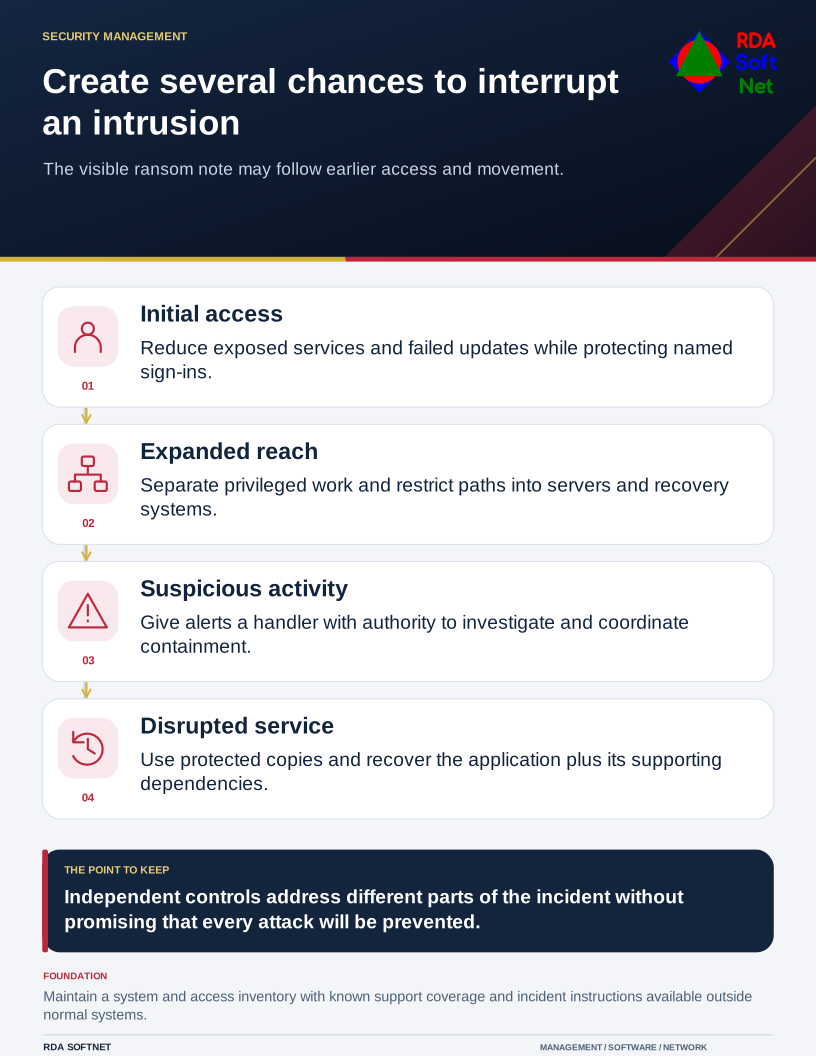
For a smaller organization, the practical question is whether several independent controls can interrupt the incident. No single product should carry every expectation for prevention, detection, response, and recovery.
Reduce the opportunities to get in
Start with an accurate inventory and the systems reachable from outside. A remote access service nobody recognizes cannot have an accountable owner or a sensible patching process. Remove unnecessary exposure and give the remaining services an approved support arrangement.
Staff need named accounts, appropriate access, and a dependable way to report suspicious activity. Use phishing-resistant sign-in methods where supported and suited to the environment, while also planning recovery. Protecting authentication does not remove the need to manage devices or review active sessions after a suspected compromise.
Patching and endpoint security need follow-through. Someone should know which devices are missing protection, which updates failed, and who is resolving the exceptions. A dashboard that nobody owns is merely another place to leave unfinished work.
Limit what one compromised system can reach
Review administrative privileges and the paths between user devices, servers, backups, and operational systems. A workstation used for ordinary email should not provide unrestricted administration of the whole environment. Separate privileged work and protect the accounts that perform it.
CISA's StopRansomware guide includes segmentation, access restrictions, backup protection, and incident planning among its recommendations. These controls need a design that reflects actual applications and dependencies. Adding a VLAN name does not prove that traffic is restricted.
For each important service, ask what happens if its user account or its host is compromised. Which other systems remain reachable? Which copies remain recoverable? Who would see an alert? That discussion gives technical changes a business purpose and helps prioritize the work.
Practice the handoff from detection to action
Security tools may raise an alert, but people still need authority to investigate, isolate a device, disable access, and involve specialist responders. Document the responsible team and the escalation route. Check what support coverage actually includes rather than assuming that monitoring automatically includes every response action.
Keep the incident response instructions available outside the main email and file systems. Include a way to reach management and the insurer, where applicable. Exercise an incident involving a key service and observe the gaps in communication and decision-making.
Recovery should be tested with users who understand the application. Restoring files is not enough if the database, directory, license, or network connection needed to use them is missing. Identify those dependencies in the recovery plan.
RDA works through these questions with the organization and its other providers. The result is a set of assigned, verified controls and a workable response, not a prediction that a particular attack will never succeed. Review the arrangement when the environment or the work changes.