
The subscription list in finance and the application list in IT often answer different questions. One shows what is paid for. The other shows what is centrally managed. Neither necessarily includes a free file-sharing tool, a trial bought on a departmental card, or a connector somebody authorized while completing a project.
Bring three app lists into one service record
Purchasing visibility and technical visibility each miss part of the work.
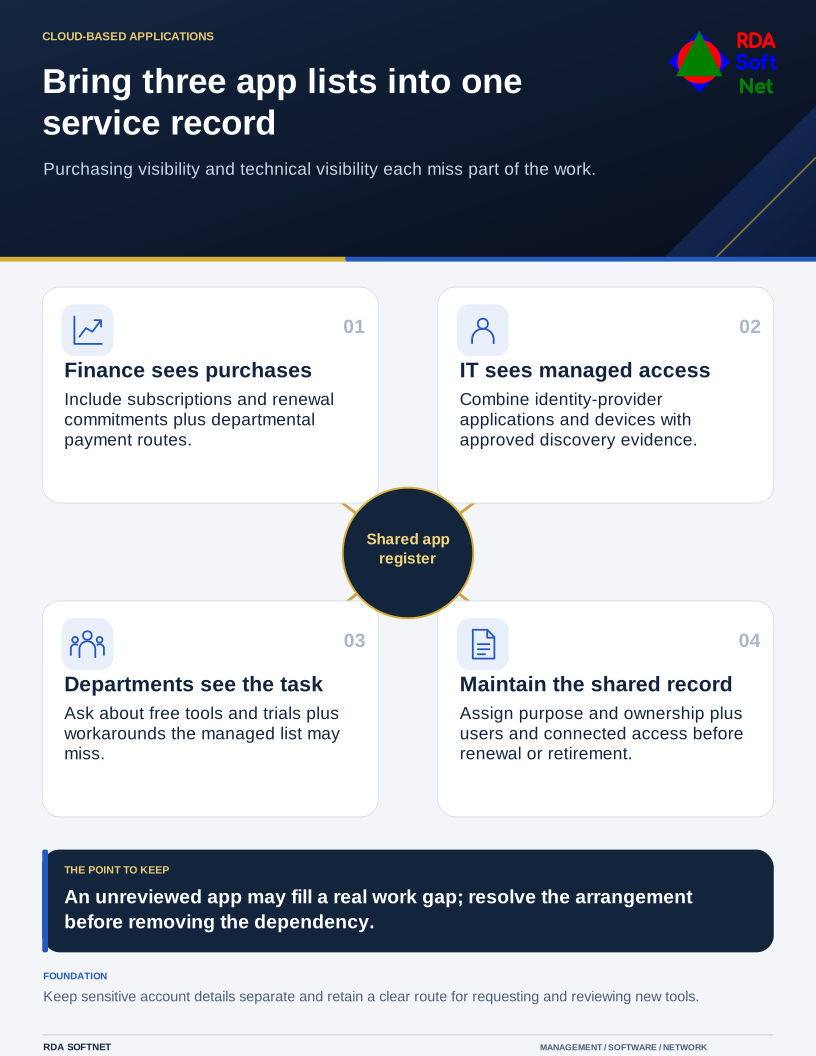
Bring the lists together before deciding what to remove. An unreviewed application can create a real information risk, but it may also be doing work that the approved environment currently fails to support.
Build a useful first inventory
Combine purchasing records, identity-provider applications, managed device information, and authorized network or cloud discovery reports. Ask department leads which tools they rely on and which accounts are controlled by individual staff members.
For each service, record its purpose, business owner, administrator, users, billing contact, and renewal date. Include what information it stores and which other services it can access. The cloud governance guide helps connect the service to organizational ownership rather than one person's credit card or email address.
Microsoft's shadow IT tutorial describes discovery, evaluation, and management as connected activities. Discovery tools have coverage limits. An application missing from a report should not be treated as evidence that nobody uses it.
Separate a useful tool from an acceptable arrangement
A department may have a legitimate need for the function while the account setup is unsuitable. Perhaps there is no organization-controlled administrator, departure process, usable activity history, or clear way to recover records. Those are operating issues that a product demonstration may never reveal.
Review vendor responsibilities and the applicable information requirements. Check the actual subscription and contract, including restrictions that matter for the proposed use. A supplier's assurance claims do not automatically establish that your configuration or workflow meets every obligation.
Look closely at application connections. A small tool with permission to read mail or edit files can affect a much larger environment. Record who approved that permission, whether it remains necessary, and how it will be removed.
Retire services with a handover
Where a service cannot be approved, plan the replacement or fallback with its users. First establish which data and ongoing tasks must be preserved. Exporting a spreadsheet may not capture attachments, comments, permissions, or history needed later.
Use the cloud exit guide to cover export checks, ownership transfer, connection removal, cancellation, and deletion requirements. Blocking access and stopping billing are different steps; neither alone proves that information has been handled appropriately.
Give purchasing and department leads access to the maintained register, with sensitive account details kept separately. At the next renewal, check the owner, users, permissions, and approved need before committing again. Provide one clear route for requesting a new tool so the inventory can stay current.