
Dividing an annual IT total by twelve can hide the decisions finance needs to make. A subscription may renew in one month, equipment may arrive in another, and migration work may require two services to overlap temporarily.
Put payment dates beside delivery work
An annual total divided by twelve can hide renewals and project dependencies.
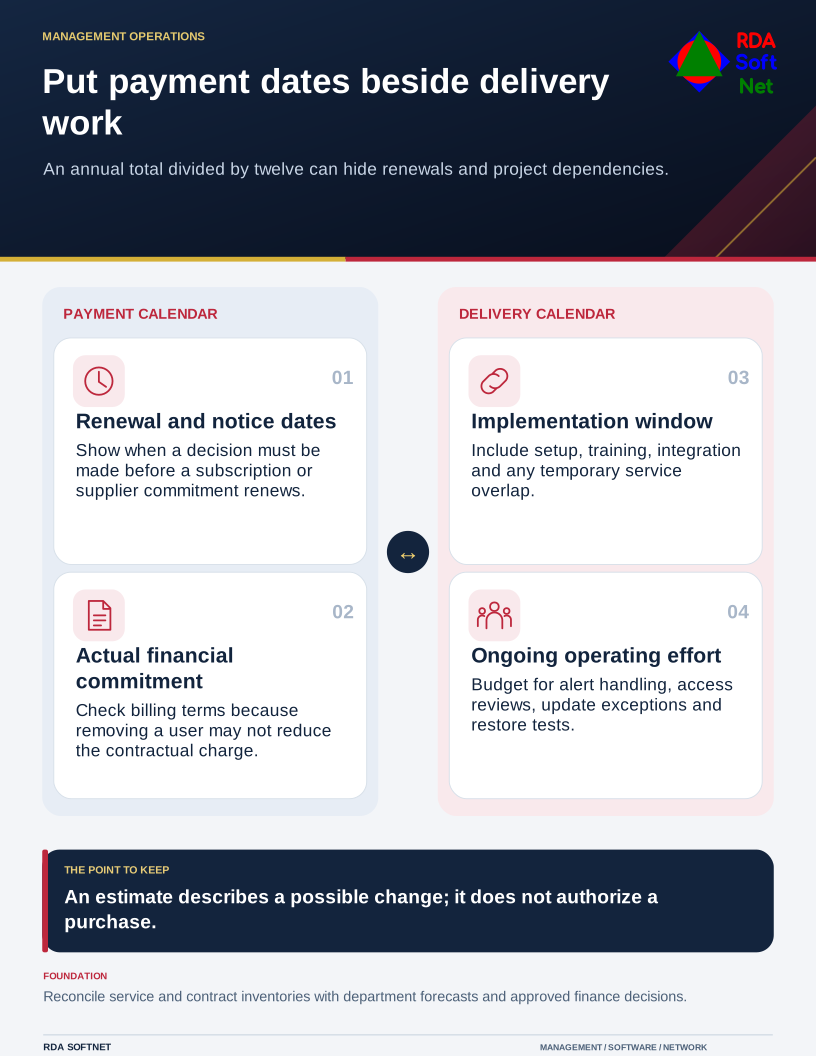
Put those commitments on a calendar. Then compare the payment dates with the work that creates them. This gives management time to approve, defer, or revise a change before a renewal notice becomes an urgent decision.
Reconcile the services and the invoices
List current devices, applications, cloud services, communications, suppliers, and contracts. Identify the owner, term, billing route, renewal, and notice period. Include departmental purchases and small recurring charges, which can be absent from central IT records.
NIST's small business quick-start guide connects technology inventories with the organization's mission and risk decisions. Use that as a reminder to record what a service supports, not simply its price. A rarely used service may still provide an important seasonal or recovery function.
Check apparent duplication with users before canceling a tool. Similar feature names do not establish that two applications perform the same workflow or retain the same records. A low sign-in count is a prompt to investigate, not automatic permission to terminate.
The cloud exit guide covers data, connections, retention, and cancellation. Removing an account or license assignment may not reduce a contractual commitment, and ending billing does not prove that all records have been handled.
For significant purchases, calculate the operating effect: installation, configuration, licensing, support, training, integration, backup, and eventual retirement. An attractive product quote is only one part of the service the organization will fund.
Add the changes departments already know about
Ask managers about hiring, departures, locations, new services, and contractual obligations. A new employee may need several applications, a phone service, equipment, and setup work. A planned office change can involve connectivity lead times and provider coordination well before moving day.
Use the roadmap to separate approved projects from ideas awaiting investigation. For each proposed change, show the requirement, expected cost range, dependencies, decision point, and ongoing owner. Do not treat an estimate as a purchase authorization.
Maintain an asset lifecycle plan for known replacements. Keep planned work separate from the reserve for genuinely unplanned failures. The reserve should reflect plausible events and the organization's priorities rather than a universal percentage.
Include the effort behind protection and recovery: handling alerts, resolving update exceptions, reviewing access, testing restores, and preparing staff. A feature bundled into a subscription still needs people to configure and operate it.
Review actual commitments against the forecast during the year. Explain variances, revise assumptions, and assign follow-up. Finance and the technical team should be able to use the same record without translating separate lists each time.
Bring the operating picture and outstanding decisions to the next service review. There, look ahead to the next significant renewal or project decision while there is still time to make a considered choice.