
Last year's invoices are a useful starting point for an IT budget. They are not a complete forecast. They show what was paid, but may omit a replacement that was deferred, a new department requirement, or the support effort hidden inside an employee's day.
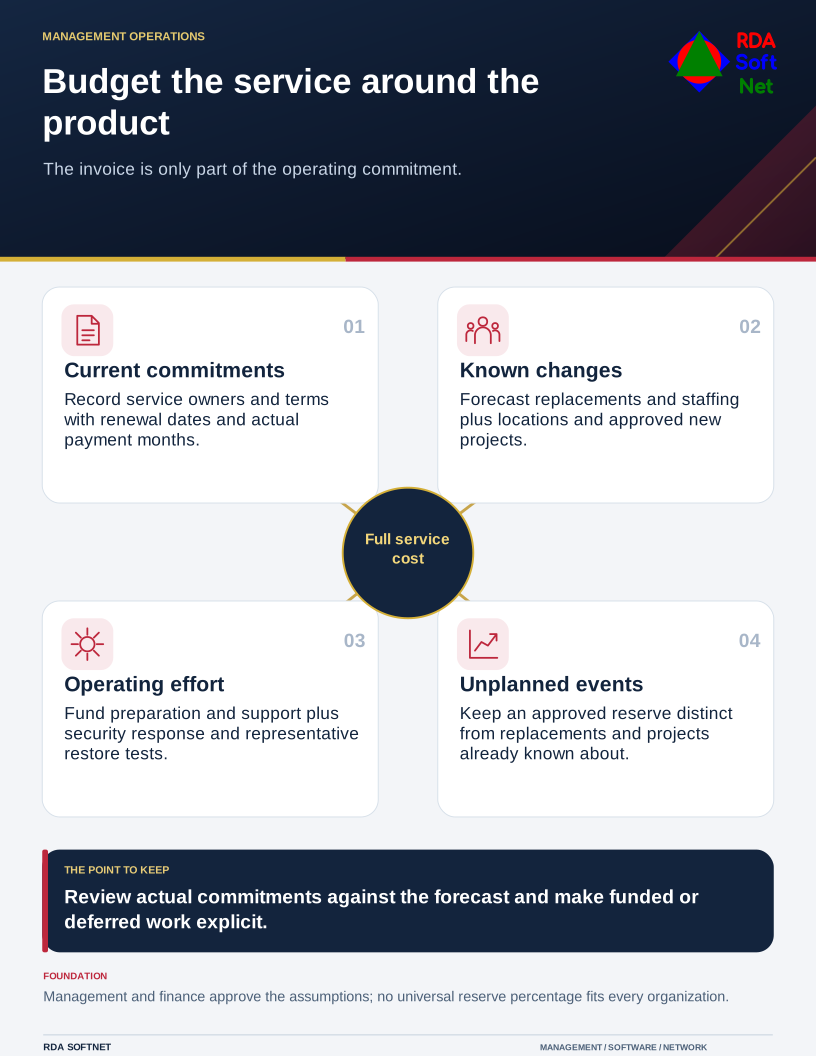
Budget the service around the product
The invoice is only part of the operating commitment.
RDA starts with the services the organization needs to deliver. The question is what it takes to operate, maintain, change, and eventually replace the technology supporting that work.
Establish the current commitments
Build or reconcile an inventory of devices, applications, cloud services, communications, domains, providers, and contracts. Identify the owner, renewal date, notice period, and purchase commitment for each significant service. Include subscriptions paid through departmental cards rather than assuming the central ledger captures every tool.
The NIST small business quick-start guide connects technology inventories with business importance and cybersecurity governance. That is a useful basis for prioritization: know what a service supports and what its loss would mean before deciding how much attention it deserves.
Separate recurring operating costs from planned changes. Also show annual renewals in the months when payment is due. A monthly equivalent helps comparisons, but it can conceal a large cash requirement at a particular point in the year.
Check the cost of the work around a purchase. A laptop needs preparation and handover. A new application may need integration, permissions, staff training, and support. A phone change may require number porting and a temporary overlap. The quoted product is often only part of the approved outcome.
Put lifecycle and staffing changes into the forecast
Use the asset lifecycle plan to identify supported equipment that can remain in service and systems that need replacement. Planned retirement should include migration, verification, and secure disposal, not just a box on the purchasing list.
Ask departments about hiring, departures, changed roles, locations, and new obligations. User management includes account setup and removal, licenses, devices, and records handover. A new service can also require additional capacity in the network, application support, backup, or communications arrangements.
For a project, define the business requirement before selecting the tool. Develop scope, dependencies, approval, implementation, testing, and ongoing ownership together. The roadmap guidance follows that sequence so a project is assessed on its full operating effect.
Fund the less visible work
Security and recovery need identifiable operating effort. Include alert response, update exceptions, access reviews, restore testing, policy maintenance, and staff learning where required. A license containing a feature does not supply the people and process needed to run it.
Set aside a reserve based on plausible unplanned events and the organization's risk decisions. Keep it distinct from known replacements and approved projects. There is no single percentage that makes a budget suitable for every organization.
Have management and finance review assumptions with the technical team. Record what is funded, what is deferred, who accepted the remaining exposure, and when the decision will be revisited. Procurement and accounting requirements should be handled by the people responsible for them.
Use the service review to compare actual commitments and changes with the forecast during the year. The budget then becomes a working plan for reliable services, rather than an annual estimate detached from the decisions employees and departments make.