
A technology wish list becomes a plan when the organization can explain which work comes first, why it matters, and who can authorize it. Buying the requested items in order of arrival rarely answers those questions.
Put prerequisites ahead of commitments
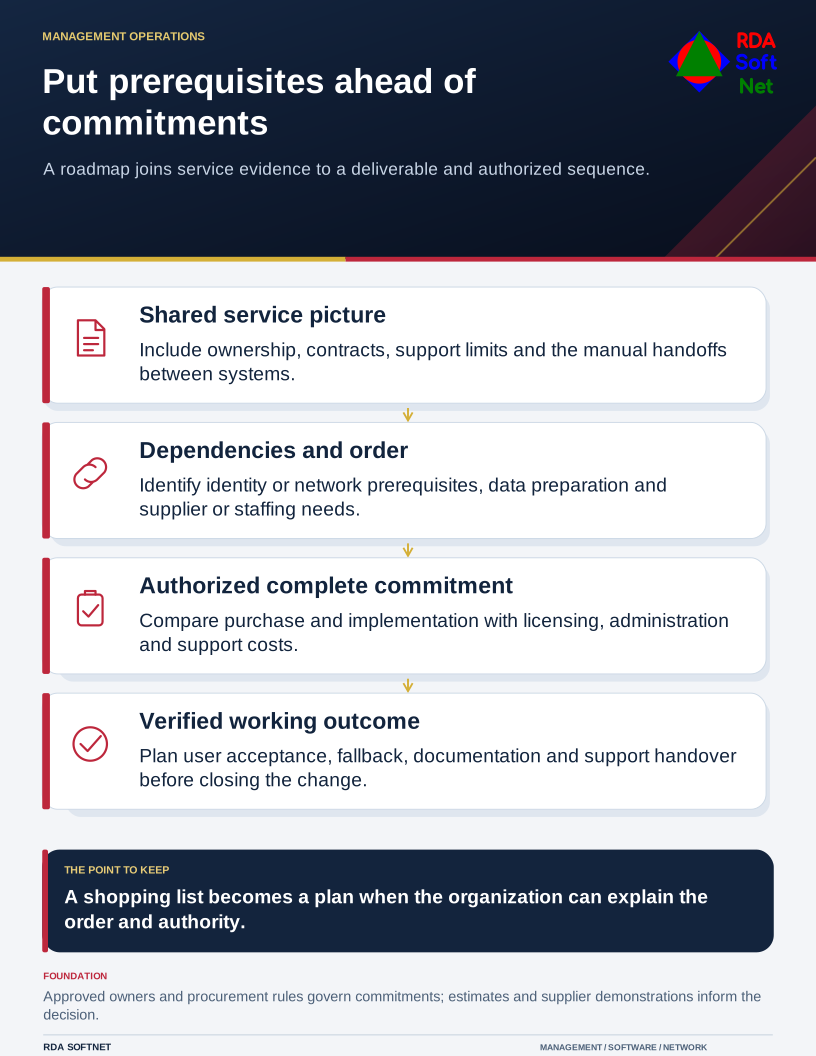
A roadmap joins service evidence to a deliverable and authorized sequence.
Start with the organization's goals and the services people depend on. Then review the existing arrangement with staff, department owners, and providers. Include what works well, what repeatedly fails, and what is approaching a support or capacity limit.
Build a shared picture of the work
Record the current systems, ownership, contracts, support dates, information, and important connections. Include manual handoffs and workarounds. A replacement application can fail to improve a process if nobody has understood the spreadsheet or approval step connecting it to the next department.
NIST's small-business CSF 2.0 guide connects cybersecurity work to organizational context, responsibilities, and an understanding of assets and risk. Use that planning discipline alongside operational, financial, and service requirements, without treating a framework as a substitute for the organization's decisions.
Ask each proposed change to identify a problem or requirement. Faster hardware, a new cloud subscription, and a revised workflow should each have a reason tied to the work. Record the consequence of waiting as well as the expected benefit of proceeding.
Put dependencies ahead of commitments
Use the roadmap guide to turn proposals into a sequence. Some work can proceed independently; other changes depend on identity, network, data preparation, staffing, or supplier support. A short acknowledgement of those dependencies is often enough to reveal that the proposed order needs changing.
Review operating costs alongside purchase and implementation. Licensing, administration, training, support, recovery, and eventual transition need owners and funding. Bring hardware and software support deadlines from the asset lifecycle review into the same planning calendar.
For a larger purchase, agree requirements and evaluation criteria before comparing suppliers. Follow the organization's approval and procurement rules. RDA can coordinate discovery, technical assessment, and implementation work while the designated authorities retain their spending and business decisions.
Use vendor review to clarify responsibilities, access, incident contact, service limitations, and exit arrangements. A demonstration or proposal is only part of that assessment. Confirm what is included and which prerequisites the organization must supply.
Define what completion will mean
An approved item needs an accountable owner, scope, expected result, dependencies, and acceptance method. Plan testing with the people doing the work, communication, training, and a practical way to reverse or recover from a failed change.
Keep progress visible without turning every review into a new shopping exercise. Record decisions, changed assumptions, and blocked prerequisites. If priorities move, revise the sequence and explain the effect on already approved work.
After implementation, verify the promised working outcome and hand over instructions, configuration records, and support responsibility. Bring the evidence into the service review so later planning uses what actually happened.
Leave room for new needs and unexpected failures. A maintained plan should help the organization make those decisions with context, rather than becoming a document that is opened only when the next budget is due.