
A passkey changes how a person proves access to an account. The public-key sign-in is bound to the intended service, so a lookalike website cannot simply collect a reusable password or code in the same way. It still needs a sound account lifecycle around it.
Choose the passkey arrangement deliberately
Device-bound and synchronized credentials bring different custody and recovery questions.
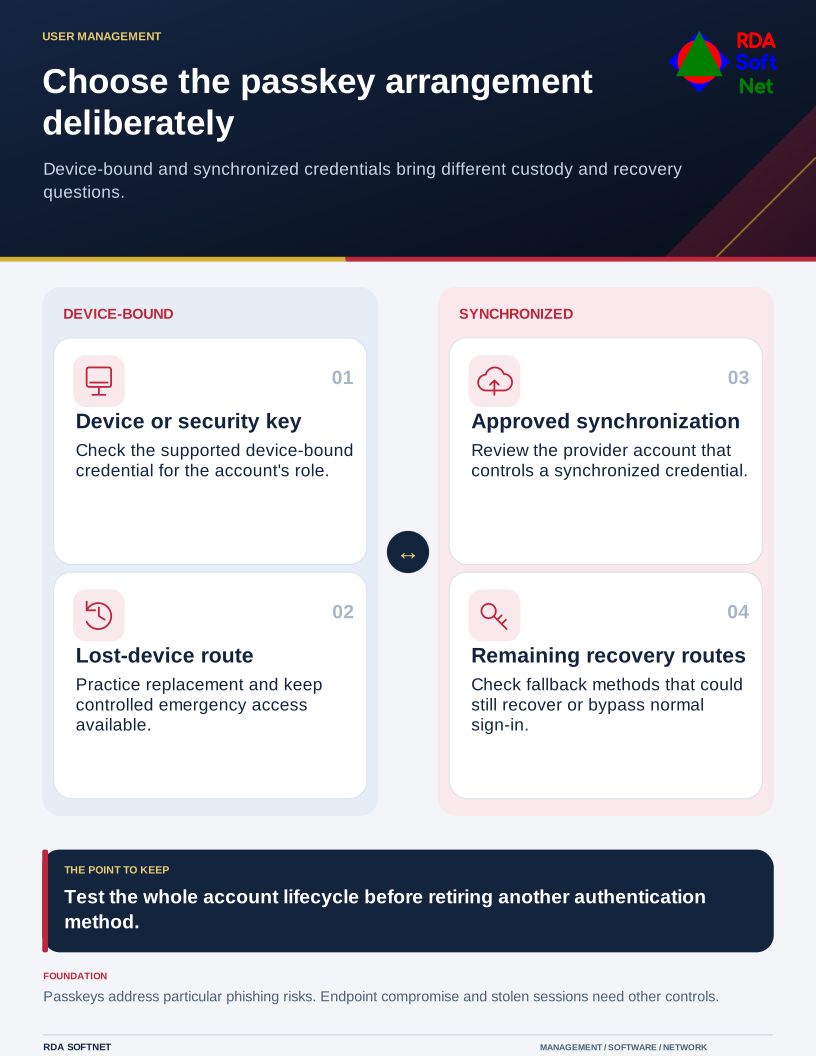
Choose the arrangement for the account
Check the application, device, browser, and identity-provider support. Understand whether the credential is tied to a particular device or security key, or can synchronize through an approved provider. Decide which arrangement is appropriate for ordinary work, administrators, shared workstations, and any applicable assurance requirements.
NIST’s authentication guidance distinguishes authentication strength, phishing resistance, and authenticator lifecycle. A biometric gesture may unlock an authenticator locally; that does not mean the organization should collect employees’ fingerprints in a central account record.
Test recovery before retiring another method
Pilot enrollment with representative staff. Confirm how a person signs in on a replacement device, handles a lost key, proves identity to the help desk, and removes an old authenticator. Review the provider account that controls synchronization and the methods that can still recover or bypass the normal sign-in.
Keep an approved emergency arrangement available for administrators and test it under controlled conditions. The fallback must be considered in the design, not quietly reduced to a shared password or an unverified telephone request.
Have the directory administrator, application provider, and device-management team agree the enrollment and support instructions. Connect rollout to MFA policy, onboarding, and offboarding. Passkeys improve resistance to particular sign-in attacks; they do not prevent an already compromised endpoint, stolen live session, or an authorized person from misusing information. Those risks still need endpoint controls and a working response process.