
An unexpectedly large cloud invoice needs an explanation before it needs a reduction target. A migration may temporarily run two environments. A records requirement may increase storage. An unfamiliar charge may also belong to a test resource nobody remembered to retire.
Connect each significant charge to work
Explain the invoice before choosing a cost reduction.
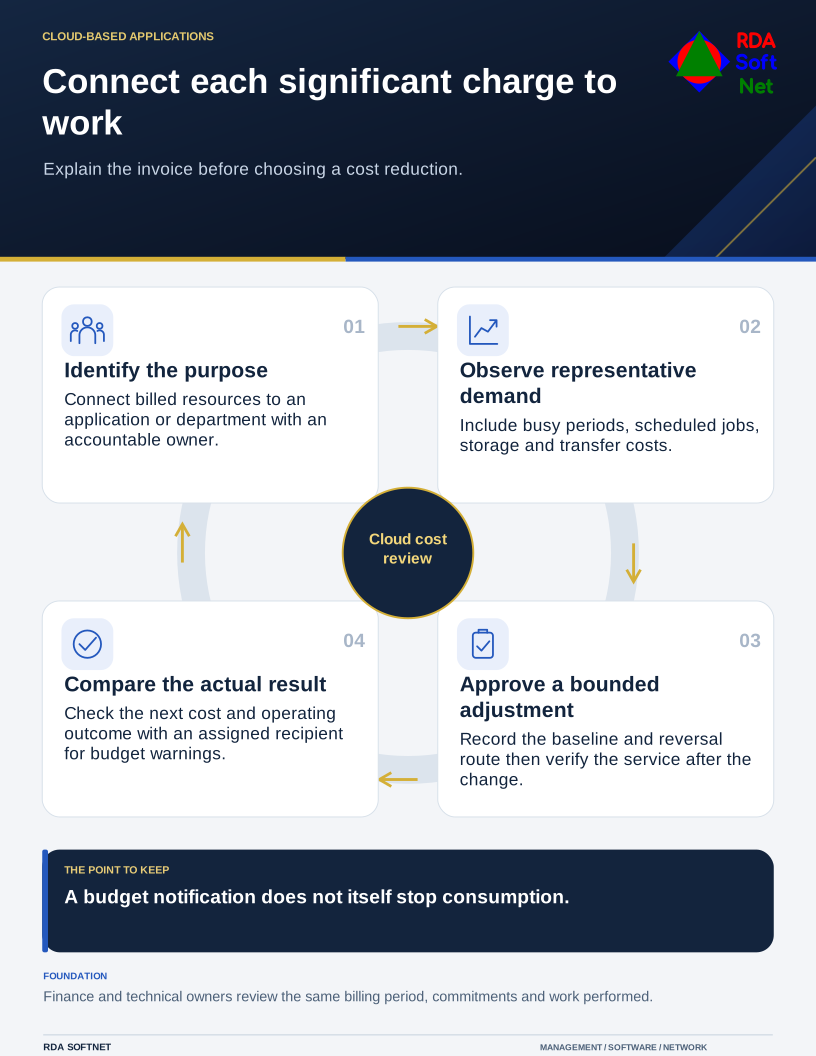
Bring finance and the technical owner together around the same billing period. Compare quantities, rates, commitments, credits, and the work performed. A change in total cost does not establish which part of the service changed.
Connect the charge to a purpose
For significant resources and subscriptions, identify the application or department, technical contact, approved use, and next review. Use tags or an equivalent register where supported. Include accounts bought outside the main tenant or provider agreement.
The cloud governance guide connects ownership with licensing and configuration. An owner should be able to explain whether a resource remains necessary and who can approve changing it. A naming convention without that responsibility will not resolve a disputed invoice.
Look across computing, storage, data transfers, backup, logging, and application licenses. Stopping one component may leave others billed. A lower storage tier may introduce access delay or retrieval costs. Check the relevant provider terms and actual usage before estimating the saving.
Make a controlled adjustment
Measure a period that includes busy work and scheduled jobs. A resource quiet during office hours may be essential overnight. An average utilization figure can conceal a short but important peak, or a different constraint such as memory or storage performance.
Choose a bounded change, record the baseline, and have users verify the service afterward. Keep a recovery or reversal route appropriate to the change. The roadmap and change process should identify who approves it and what counts as a successful result.
Avoid buying a long commitment solely because it offers a discount. Forecast the supported need, consider foreseeable changes, and confirm the financial implications with the people responsible for the purchase. Resources that can be interrupted are also a different proposition from an essential application that cannot.
Give the warning a recipient
Microsoft's Azure budget guidance states that budget notifications do not themselves stop consumption. Decide who receives alerts, how quickly they should investigate, and how they will distinguish authorized growth from an error.
If an alert triggers a shutdown or other automatic action, treat that as an operational change. Test dependency handling, restart, permissions, and the consequences of a false trigger. The automation guide addresses the need for an owner and a safe failure path.
At the next review, show the measured outcome alongside the original estimate. Did the cost change as expected? Did the application, backup, and support obligations remain satisfied? Record what must be watched over a longer period.
Keep the cost review tied to the service. Finish with a short list of explained charges and approved actions, with somebody responsible for checking that the saving lasts.