
An MFA project can look complete while important questions remain unanswered. Does the requirement apply to every intended sign-in route? Can a person register safely? What happens when their phone is replaced? Who verifies the recovery request?
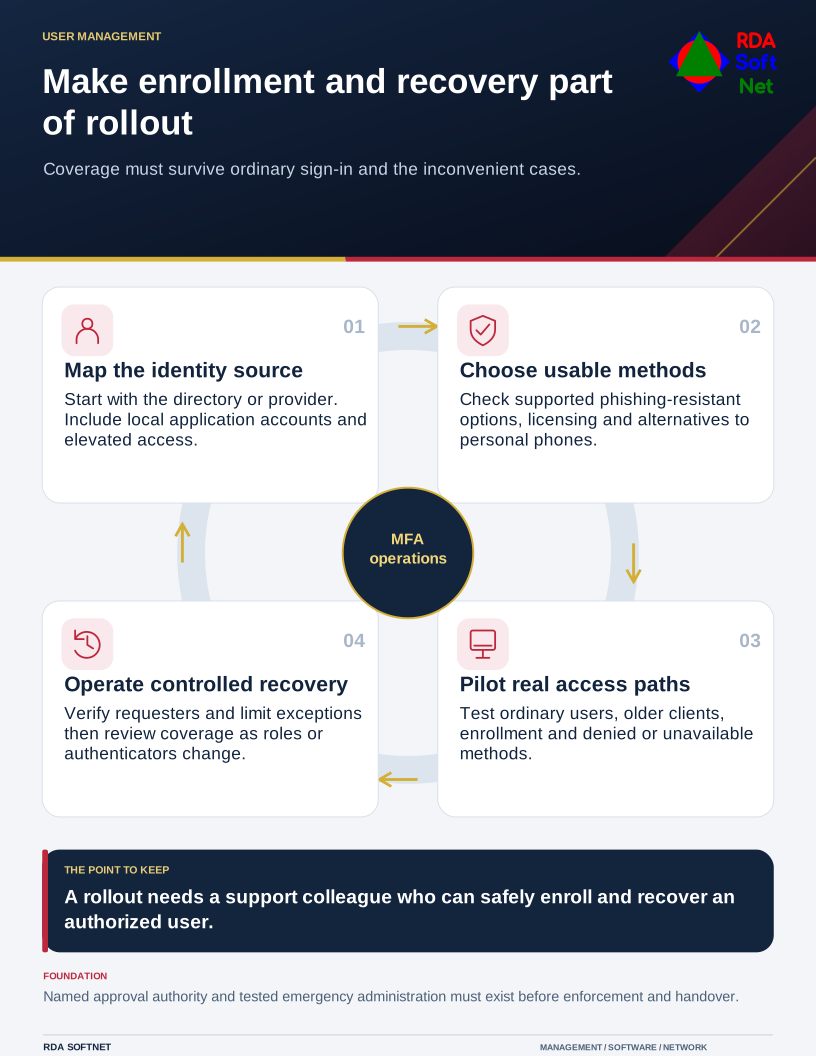
Make enrollment and recovery part of rollout
Coverage must survive ordinary sign-in and the inconvenient cases.
Answer those questions before the enrollment message goes out. Stronger authentication needs a process that staff and support can operate on an ordinary working day, including the inconvenient cases.
Map accounts and access paths
Start with the organization's identity source and the applications it serves. Include administrators, remote access, financial services, and applications with their own local accounts. Directory integration may simplify the design, but it does not prove that a policy covers every service.
The user credential guide establishes the ownership and lifecycle behind the account. Determine who authorizes access and how staff changes reach IT. A well-protected account that should have been removed still needs the departure process.
MFA combines different categories of evidence. A password and a second knowledge answer do not become two factors merely because they appear on separate screens. NIST's authentication guidance distinguishes authenticator types and assurance requirements. Select supported methods appropriate to the service and its obligations.
Choose methods people can actually use
Consider phishing-resistant options such as supported passkeys or security keys, while planning compatibility and recovery. Authenticator codes and approval prompts have different properties; number matching should not be described as equivalent to origin-bound phishing resistance. Our passkey guide covers the deployment choices.
Account for shared workstations, mobile work, accessibility needs, and employees who cannot or should not use a personal phone. Provide an approved alternative rather than letting each supervisor invent a bypass. Confirm licensing and provider support before making a promise about the rollout.
Pilot with representative users. Test normal sign-in, enrollment, a denied or unavailable method, older clients, and a controlled recovery case. Verify enforcement with an ordinary user account rather than relying on an administrator's successful sign-in.
Protect the recovery decision
Write down who may replace an authenticator and how they verify the person. An urgent message claiming to be from a manager is not sufficient evidence by itself. Use an established communication route and keep an appropriate record of the action.
Have a controlled arrangement for emergency administration, and test it separately. Exceptions need an owner, a reason, protections, and a review date. A permanent exemption created during a difficult enrollment can quietly become the weakest route into the service.
The MFA operating guide connects those arrangements with support instructions. Staff should know what legitimate enrollment looks like, how to report an unexpected prompt, and what to do after losing a device. Never ask them to send sign-in codes through an ordinary support message.
After deployment, review the actual coverage and remaining exceptions. Verify changes when roles, applications, or authenticators change. MFA is part of account operations: the project is ready for handover when another authorized support colleague can enroll, assist, and recover a user safely.