
A vulnerability report can grow every week while the same important issue remains unresolved. More findings do not necessarily mean the organization is reducing exposure. The useful measure is whether a relevant problem reached the right owner and was addressed or deliberately accepted.
Close exposure findings with evidence
The relevant measure is whether an owned risk reaches an approved and verified outcome.
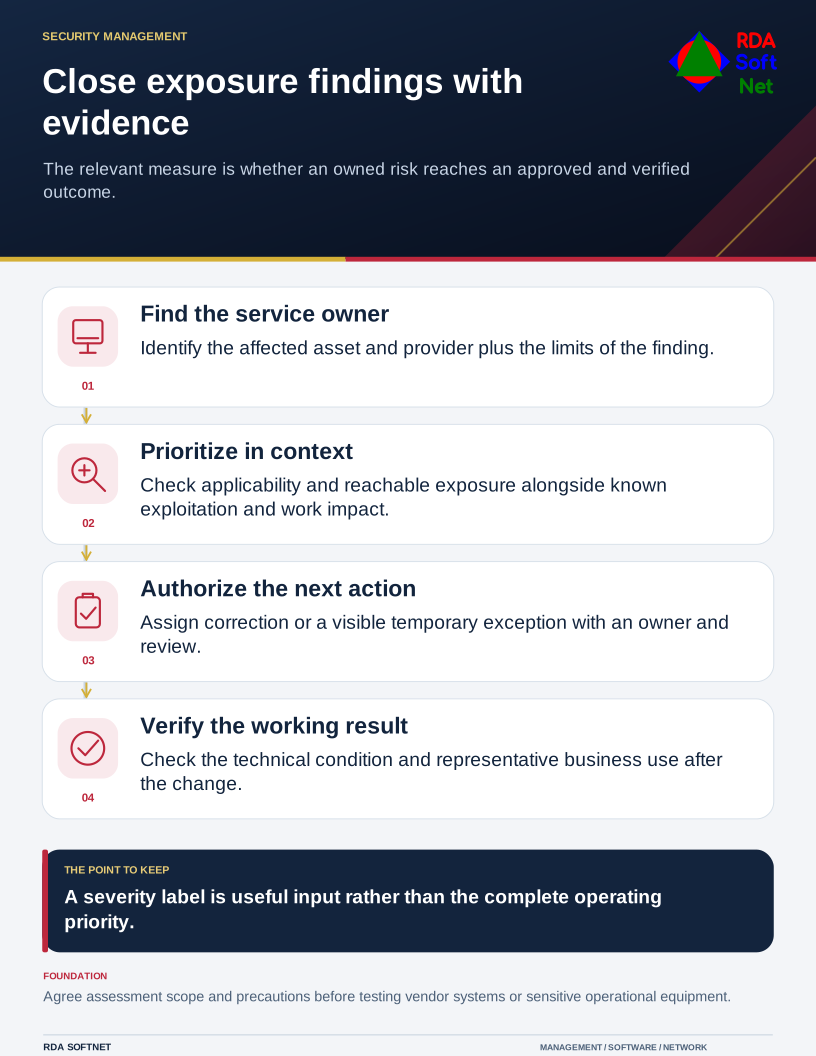
Threat exposure management describes a continuing process for understanding where the organization may be exposed and deciding what to do. A tool can supply information, but it does not automatically establish operational priorities or authorize changes.
Know what the finding belongs to
Begin with an inventory of devices, applications, cloud services, external connections, and the people responsible for them. Include systems maintained by other providers. An internet-facing service nobody recognizes is an ownership problem before it is a scanning problem.
Agree on the scope and methods of assessment. Scanning a workstation environment, a vendor-hosted service, and operational equipment can require different authorization and precautions. Do not run an intrusive test against sensitive equipment simply because a tool offers the option.
Our security operations guide connects assessment results with asset identity, available evidence, and response responsibilities. Record limitations, such as an inaccessible service or an application whose version cannot be determined reliably.
Prioritize with the people who understand the service
Consider whether a finding is applicable, whether exploitation is known, what exposure exists, and which work could be affected. A severity label is useful input; it is not the entire decision.
CISA describes its Known Exploited Vulnerabilities Catalog as an input to vulnerability prioritization. Combine that evidence with the installed system, reachable paths, operational importance, and available mitigations. A catalog entry elsewhere does not establish that a particular device has been compromised.
Assign an owner and a target suited to the risk and applicable obligations. If immediate correction is not feasible, document the temporary controls, approving authority, and next review. An exception should remain visible rather than disappearing from the report.
Close the action with evidence
NIST's patch management planning guidance treats updates as preventive maintenance involving identification, prioritization, implementation, and verification. The important handoff is from finding to an approved change, followed by confirmation that the intended result occurred.
Use the endpoint process for device updates and exceptions. Other issues may require a provider configuration change, reduced access, replacement equipment, or a scoped application project. The roadmap gives larger work a place for design, authorization, and funding.
After the change, verify the technical condition and representative business use. A successful deployment message may leave a restart pending or an application broken. Record what was checked and any remaining limitation.
Review recurring issues with service owners. Ask whether missed inventory, unclear support responsibility, or a repeatedly deferred replacement is generating the same exposure. RDA's contribution is to connect the technical evidence with the work required to resolve it. Buying another scanning subscription is useful only when it improves that operating process.