
A customer sends an email, calls for an update, and then repeats the details in a web chat. Adding another channel has not necessarily improved the service. The organization may still lack one person responsible for seeing the request through.
Carry one request across the channels
The customer should not need to rebuild the case each time a new person or tool receives it.
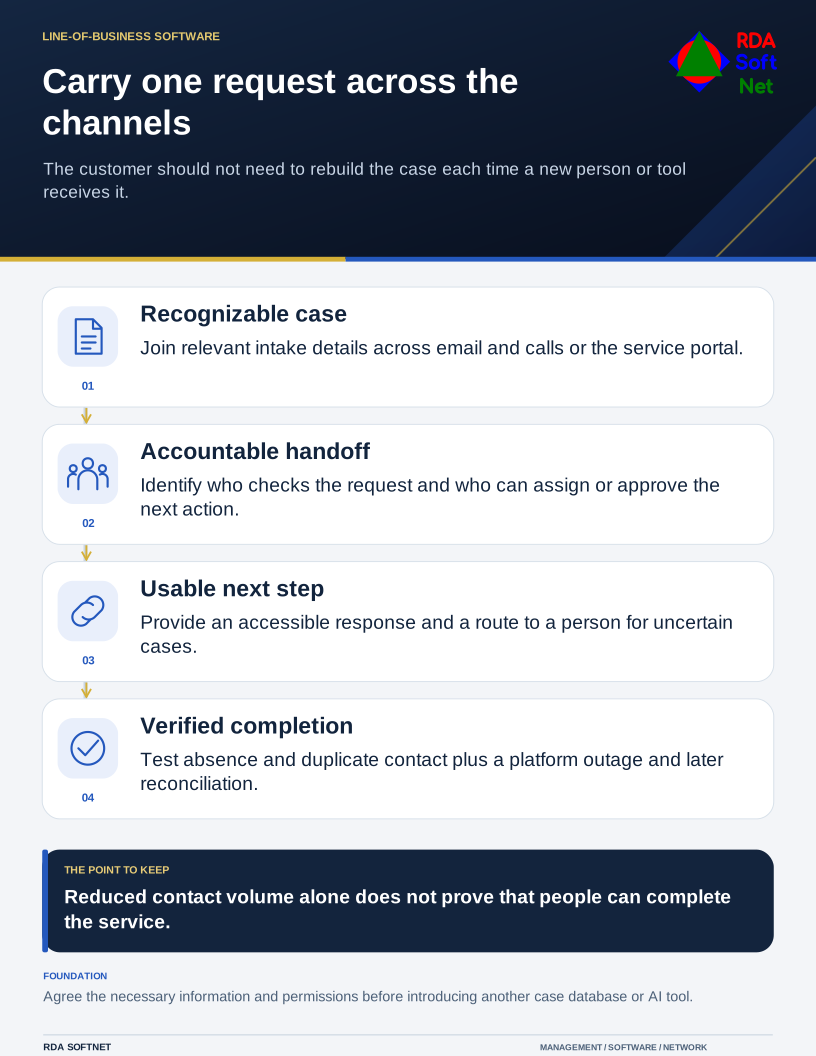
Before comparing platforms, follow a representative request from first contact to completion. Include an ordinary case and one that needs an exception. Ask where information is repeated, where work waits, and how the customer learns what happens next.
Fix the handoffs the customer cannot see
Identify who receives a request, checks the information, assigns the work, and confirms completion. Decide what a case record must contain and who may see it. A technical system can route a record, but the department must define responsibility and authority.
If email, phone, a portal, and in-person service remain available, decide how their records meet. Staff need enough context to continue the work without collecting unrelated personal details. The data governance guide helps establish the purpose, access, and retention for that shared history.
Check the relationship with existing line-of-business software. A second customer database can create duplicate records and reconciliation work. Use integration review to examine information exchange, permissions, failures, and the ownership of corrections.
Choose assistance that fits the request
A maintained knowledge page may answer common questions without creating a new account. A well-designed form can collect required details. A chatbot may help people find approved information, provided there is a clear route to a person when the answer is uncertain or the situation is sensitive.
Do not judge success only by reduced contact volume. People may stop contacting the organization because they cannot complete the process. Review unresolved requests, repeat contact, errors, and staff feedback alongside response times.
Accessibility needs to be part of the task. W3C's WCAG overview explains the technical criteria used to evaluate accessible web content. Test the actual form or portal with appropriate methods, including keyboard use, clear instructions, and understandable errors. Our accessibility guide covers the broader publishing and procurement responsibilities.
If AI prepares a response or suggests a classification, define who checks it and which information it may use. Do not allow a confident answer to become a substitute for an authorized decision about eligibility, refunds, or another consequential matter.
Test completion and interruption
Have staff carry several representative requests through a proposed arrangement before launch. Include reassignment during an absence, an incorrect submission, a duplicate contact, and a request requiring another provider. Confirm that the customer receives a usable answer.
Plan how intake continues when a platform or connection is unavailable. Record the temporary process and how those requests will be reconciled when service returns. The continuity guide connects that fallback with operational priorities.
The purchase should follow the findings. Agree on scope, implementation, training, operating costs, and acceptance checks with the people doing the work. A better service system makes ownership and progress clearer to staff and customers across the channels they actually use.