
A meeting assistant may produce a useful recap while misunderstanding the decision that mattered. A tentative suggestion can appear as an assigned task, or a condition attached to an approval can disappear from a short summary. Someone still needs to own the record.
A meeting recap still needs a record owner
Captured material and proposed actions need review before they become organizational instructions.
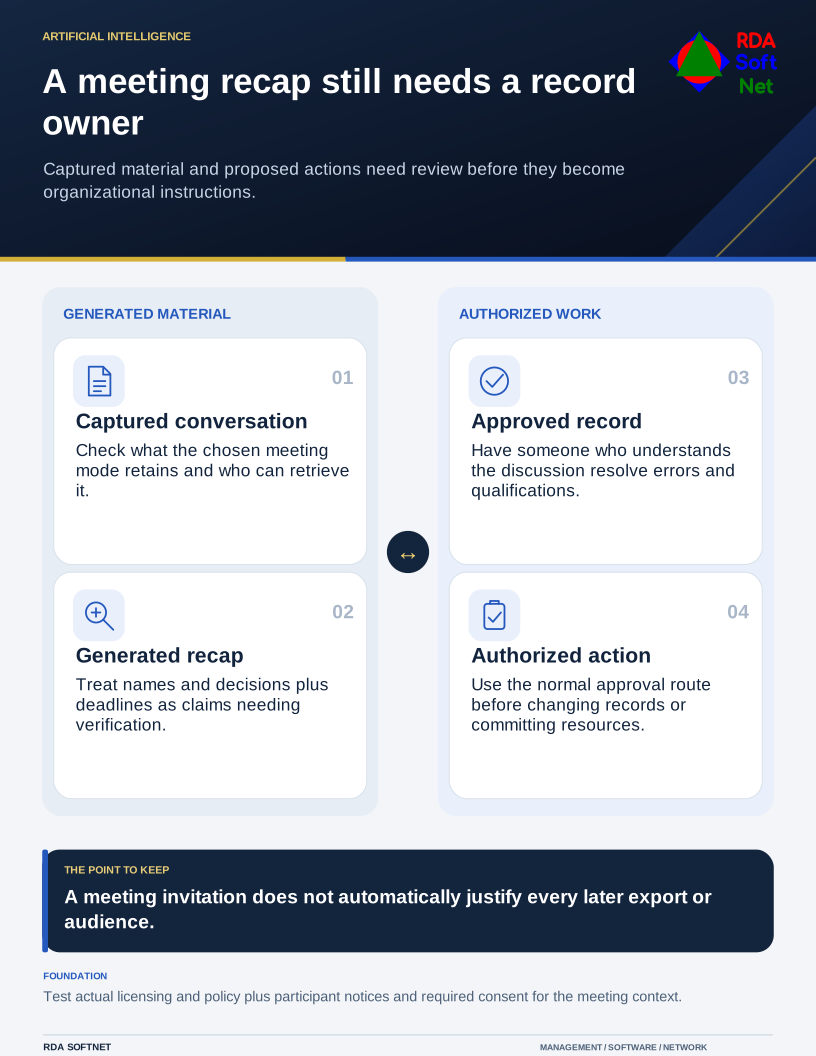
Before enabling AI features for a team, decide which meetings are suitable and what the resulting material is for. Capturing routine project coordination is a different information decision from transcribing a personnel or legal discussion.
Check the meeting arrangement you actually have
Microsoft's Teams Copilot administration guidance describes different meeting modes, licensing, transcription, and policy dependencies. Do not assume that every participant or subscription has the same experience, or that a feature shown in a demonstration is enabled in your tenant.
Have an organizer and administrator test a harmless meeting. Check what is captured, which participants can use the feature, where the resulting records appear, and how settings affect later access. Include guests and the devices staff normally use.
Establish appropriate notice and any required consent with the organization's responsible advisers. Product notifications do not establish a universal legal answer. The AI governance guide connects the permitted use with information handling and review responsibility.
Review before turning a recap into work
Give a person who understands the discussion responsibility for checking the summary against the approved record or source material. Verify decisions, named people, deadlines, qualifications, and unresolved questions. Correct errors before distributing instructions or copying actions into another system.
Keep the distinction between a proposed action and an authorized one. A meeting assistant identifying a possible task does not approve purchasing, grant access, or accept a change in scope. The normal planning and approval process still applies.
If an agent can act on an application's records, examine that authority separately. Identify the owner, connection, permissions, approval step, and way to stop it. Use integration review rather than treating all AI capability as another meeting option.
Decide where the records belong
Recordings, transcripts, prompts, responses, summaries, and task records may have different storage and retention behavior. Check the specific configuration. Turning off one form of capture should not be assumed to remove every related record.
Agree who may receive the result and how corrections are communicated. Being invited to a meeting does not automatically mean a person needs every later export or a permanent copy of sensitive notes. Apply the records retention arrangement to the material the organization keeps.
At the end of a pilot, ask participants to demonstrate the complete workflow: prepare the meeting, use the approved feature, review the result, distribute it correctly, and locate it later. Count the checking effort as well as the convenience. Keep the feature where it improves that workflow, with an owner able to explain its limits and support the next organizer.