
A monthly IT review is useful when it changes what happens next. If the meeting consists of reading green dashboards aloud, it misses the knowledge that department managers and technical staff each bring to the table.
Make the meeting produce the next decision
Technical evidence gains meaning when departments explain the work behind it.
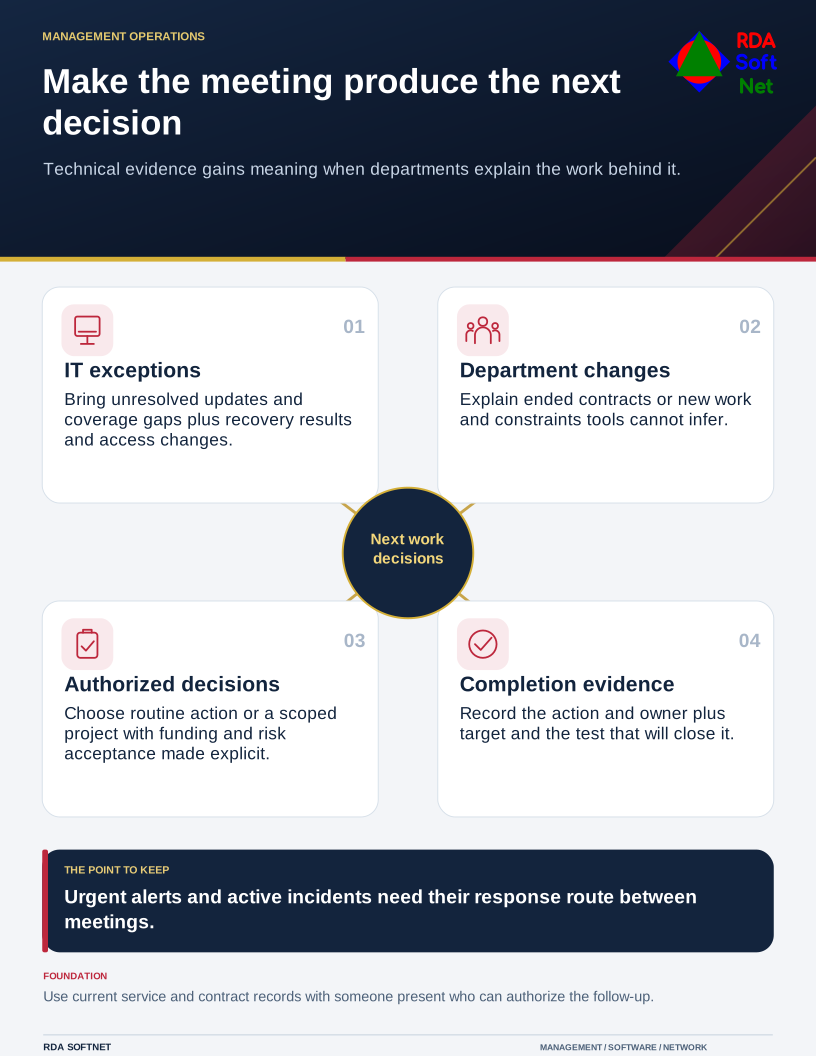
Keep the discussion focused on exceptions, changes, and decisions. The underlying monitoring and maintenance continue between meetings. A short management review should not become the only time anyone notices a failed backup or an urgent security alert.
Bring evidence and business context together
Ask IT for a concise view of unresolved update failures, devices missing protection, backup exceptions, access changes, and recurring support problems. Each item should have an owner and a current status. A percentage without the affected systems can conceal the one device that matters most to an essential service.
Managers add the context technical tools do not supply: a contractor's work has ended, a team is moving, a new application is being considered, or a process cannot tolerate the proposed maintenance window. Compare that information with the user, device, and application records.
The NIST small business quick-start guide encourages an inventory of organizational technology and attention to its business importance. Use that principle to choose which exceptions deserve the first part of the meeting. The most visible support ticket is not always the greatest operational risk.
Our service review guide sets out the participants and evidence that make this conversation repeatable. Include a representative who can authorize work, rather than repeatedly producing a report for nobody with a decision to make.
Ask questions that lead to action
For backup and recovery, ask what remains unprotected and what the last representative restore proved. For user access, ask which departures and role changes were verified. For devices, ask which unsupported systems or recurring failures need a planned replacement.
Review licenses against actual approved use and contractual commitments. Removing a user assignment does not necessarily reduce the next invoice, and removing a license without considering records retention can create a different problem. Coordinate those changes with the relevant application owner.
Look for patterns in support requests. Repeated printing trouble may indicate a workflow, training, application, or network issue. Repeating the same temporary fix is a reason to investigate, not evidence that the process is under control.
Keep urgent concerns out of the monthly queue. If the evidence suggests an active incident, use the incident response route. If a change needs design and funding, put it on the roadmap with enough information for an informed approval.
End with a short decision record: action, owner, target, and what will count as completion. Carry unresolved items forward visibly. An accepted risk should identify the person who accepted it and the date it will be reconsidered.
RDA uses the review to work with the organization's computer department and management, connecting day-to-day support with lifecycle planning. Some months need a brief check-in; a major change may need a separate working session. The calendar slot is a discipline, not a promise that every environment can be assessed in thirty minutes.