
When several people keep asking how to complete the same routine task, another reminder may not solve the problem. The process, access, application, instructions, or equipment may be working against them.
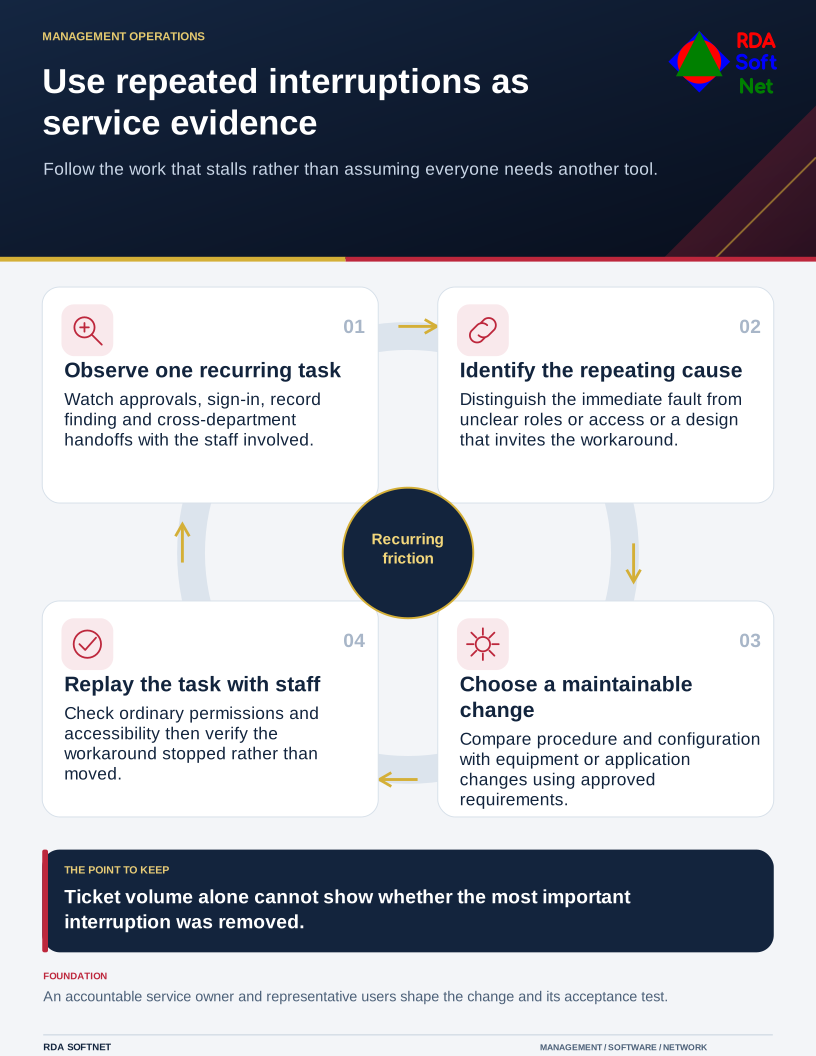
Use repeated interruptions as service evidence
Follow the work that stalls rather than assuming everyone needs another tool.
Treat those reports as service evidence. Employees can explain where the work stops, what workaround they use, and which handoff becomes unclear. That conversation is more useful than assuming everyone needs a newer computer or another collaboration tool.
Follow one task through the service
Choose a recurring problem and observe the working sequence with the people involved. Include approvals, sign-in, finding records, application steps, and communication with another department. Ask what a successful result looks like and where delays occur.
Separate a one-time fault from a repeated design problem. A missing permission may reflect a failed request, an unclear role, or an application that cannot represent the required access safely. Fixing the individual account helps today; understanding the cause helps prevent the next request.
Use the service review guide to group related issues and assign an owner. Record impact in terms of work delayed, repeated effort, or an unavailable service. A ticket count by itself does not show whether the most important problems have been addressed.
Include accessibility in the investigation. W3C's accessibility business case describes the relationship between accessible design and broader usability. A process should be tested with the people and interaction methods it needs to support, rather than judging readiness from one confident user's demonstration.
Choose a change the organization can maintain
The answer may be a corrected configuration, clearer request, improved procedure, different equipment, or a better application fit. Compare options against the task and approved requirements. A new subscription can add another place to search and another account to manage if ownership is unclear.
Bring changes needing funding or coordination into the technology roadmap. Identify the decision maker, cost, dependencies, support arrangement, and acceptance test. Include the people who will operate the new process after the project team moves on.
Plan communication and training around actual work. Show the revised procedure, explain what changed, and provide a reachable support route. The accessibility guide helps check whether instructions and the resulting experience are usable by the intended audience.
Ask whether the interruption has been removed
After implementation, repeat the original task with representative users. Check permissions and ordinary working conditions rather than relying on an administrator's test. Ask whether the workaround has stopped or simply moved somewhere less visible.
Update onboarding and operating instructions so a new employee receives the improved arrangement. Record unresolved items with an owner and review date. Where the old approach must remain temporarily, make its limits clear.
Reliable tools and responsive support can make the working day easier. They do not guarantee employee retention or resolve every organizational concern. The achievable commitment is more concrete: listen to repeated interruptions, make an authorized improvement, and verify with staff that the work is easier to complete.