
An AI tool that prepares a reply leaves someone to decide whether to send it. An agent connected to a mailbox or business application may send the reply, change a record, and start another task. That changes the question from whether the writing is useful to whether the organization has authorized the action.
Draw the AI agent's authority boundary
Preparation and consequential actions need explicitly different permissions.
The first conversation should be with the people who own the work. Ask them where a mistake would be inconvenient, where it would expose information, and where it could create a financial or legal commitment. A useful pilot starts with those distinctions already settled.
Write down the authority
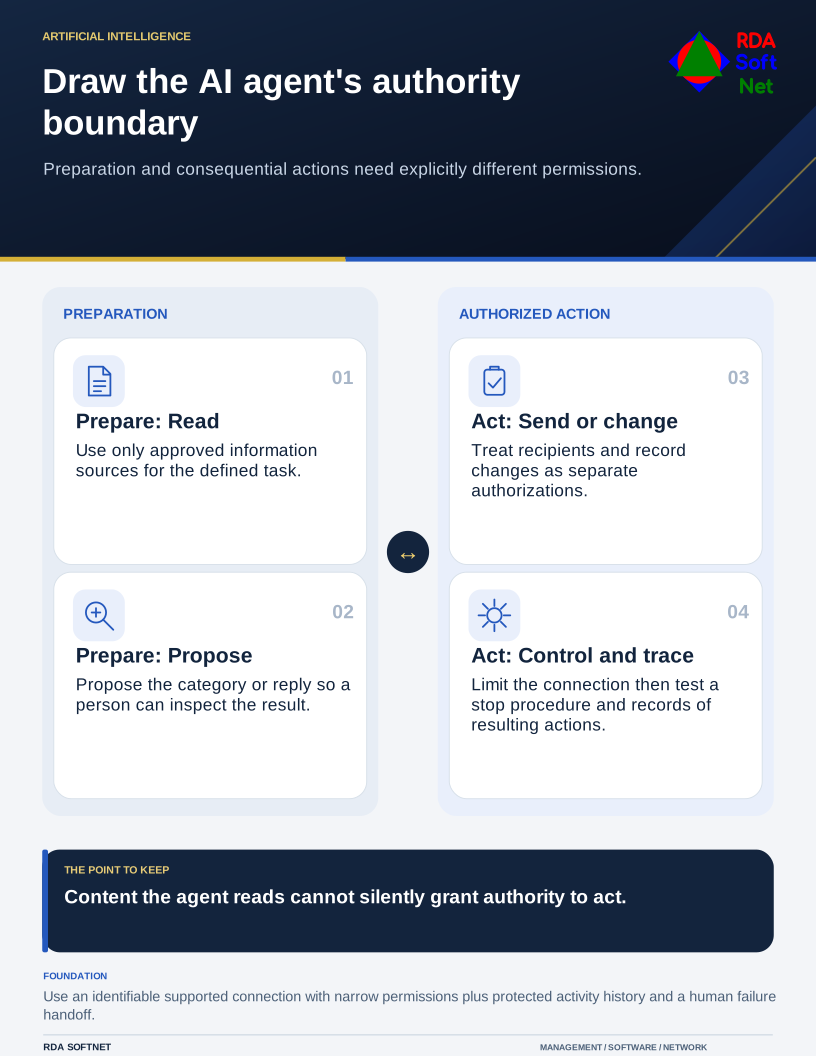
Consider an agent helping process service requests. Reading an approved knowledge base, suggesting a category, and preparing a response may be reasonable first steps. Closing a request, changing a customer's access, or making a purchase needs a separate decision. Do not let a broad instruction such as “handle incoming requests” silently include all of them.
Define permitted inputs, systems, actions, and recipients. Specify what requires a person's approval and what must stop for review. The AI use and approval guide provides a starting point for that discussion. Approval should show the actual proposed action, including its destination and any important changes, before it takes effect.
Microsoft's AI agent responsibility guidance identifies tools, actions, identity, and persistent state as additional responsibilities in agent systems. Buying a managed platform does not settle those operating decisions for the customer.
Limit the connection before expanding the task
Give the agent only the access its approved task needs. A tool that summarizes open requests does not need permission to delete them. Where supported, use an identifiable application or service identity rather than a staff member's broadly privileged login. Review the application connection and permission arrangements before the pilot reaches business data.
Treat documents, messages, and web pages read by the agent as source material. They may contain misleading instructions as well as inaccurate information. A message requesting a payment change should not become authorization merely because the agent read it while completing another task.
Test the awkward cases
Normal examples are only part of acceptance testing. Include an incomplete request, conflicting instructions, an unavailable application, a duplicate submission, and an attempted action outside the agreed scope. Check whether retries create duplicate work and whether a person can stop the process without losing the record of what happened.
Keep enough activity history to identify the initiating request, the connection used, approvals, and resulting changes. Protect that history because it may itself contain sensitive information. Agree how failed work returns to a person and who reviews unexpected behavior.
RDA approaches this as a workflow change involving the department, IT, and application provider. The controlled automation guide helps connect testing, handover, and rollback. A pilot earns a wider role when the team can explain its decisions, correct its mistakes, and operate it confidently after the demonstration ends.