
Opening an AI tool is not the same as getting useful work from it. Before renewing or expanding a Copilot purchase, ask departments what changed in their actual process: time spent, quality of the result, review effort, and the work staff can now complete.
Compare usage signals with useful work
Renewal needs both an understood report and evidence from complete tasks.
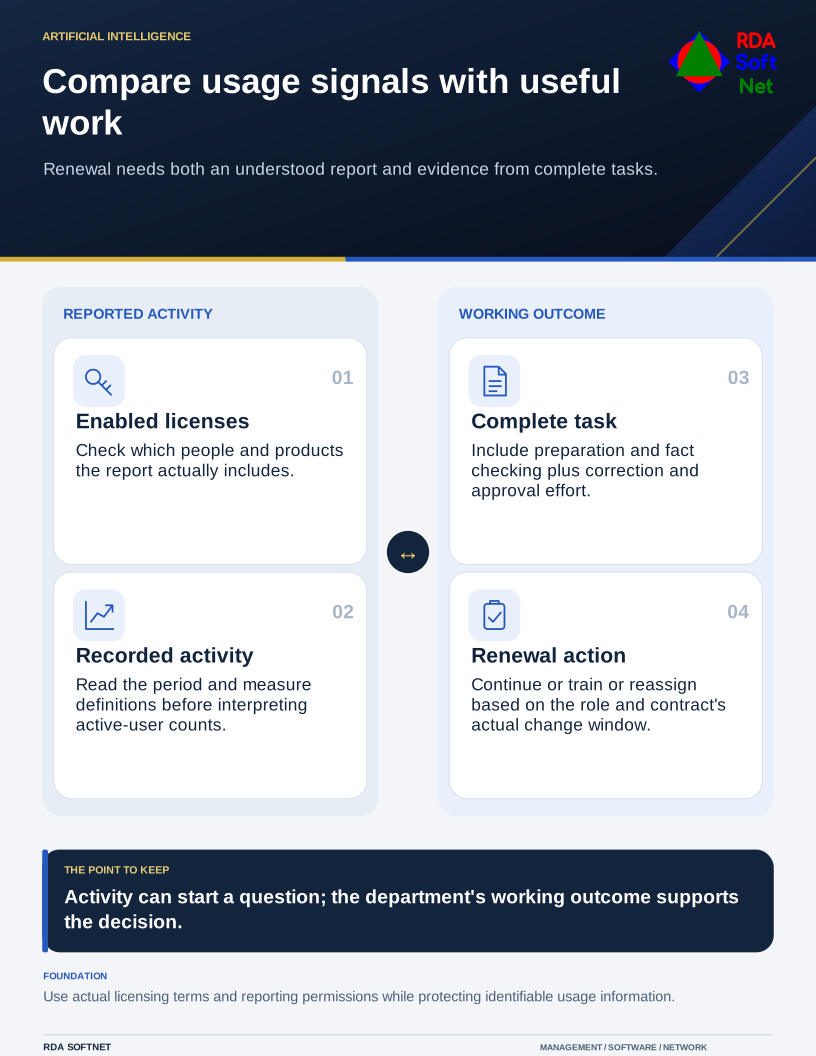
The review should be fair to the people using the service. Low activity can mean the role has no suitable use, the employee needs help, access is not working, or the trial was never given a defined purpose. A report alone cannot distinguish those situations.
Read the report's definition
Microsoft's Copilot usage report documentation distinguishes enabled users from active users and describes what contributes to the activity measures. Review those definitions and the selected period before drawing conclusions.
Compare the report with license assignments and the contract. Verify which products are included, the reporting delay, and whether the people interpreting the data have the appropriate role. Handle identifiable usage information under the organization's approved process rather than distributing a staff ranking.
Our cloud governance guide connects reporting and license administration with service ownership. Record the renewal date and the real window for changing quantities. Reassigning a seat and reducing the current contract cost are separate decisions.
Look at a few complete tasks
Ask a representative group to demonstrate approved work. A useful example might be preparing an initial version from permitted source material, followed by a subject expert checking the result. Include correction and verification time in the comparison.
Discuss why staff choose or avoid the tool. A short training session on a relevant task may help more than a general feature demonstration. Another department may reasonably decide that its work does not justify a separate license. Do not assume a particular job title is automatically a good or poor fit.
Check whether the workflow respects the AI use rules, including permitted information, connections, and review. Faster access to an inappropriately shared file is not a productivity improvement the organization should accept without addressing the permissions.
Make a decision that can be revisited
For each group of licenses, choose an action: continue, provide targeted training, reassign, run a further limited pilot, or change the next purchase. State the expected outcome and the date for checking it. Keep the reasoning understandable to the department and the purchasing authority.
Include the ongoing effort to support the service, maintain permissions, teach new staff, and review changes. The service review guide gives those actions a place alongside other operating commitments.
RDA's interest is whether the technology supports the work at an understood cost. An adoption percentage can point to a question, but it should not become the answer. A smaller, well-supported deployment may be appropriate; expansion may also be justified when the evidence shows a useful, controlled process. Either decision should rest on more than enthusiasm at purchase or inactivity on a dashboard.