
A license report can show who has a subscription. It cannot, by itself, show whether a department's security, records, and operational needs are being met. Cutting the quietest-looking accounts first can remove a capability that works in the background or is needed only occasionally.
Join purchased licenses to working needs
Assignment and activity reports need role requirements and actual configuration beside them.
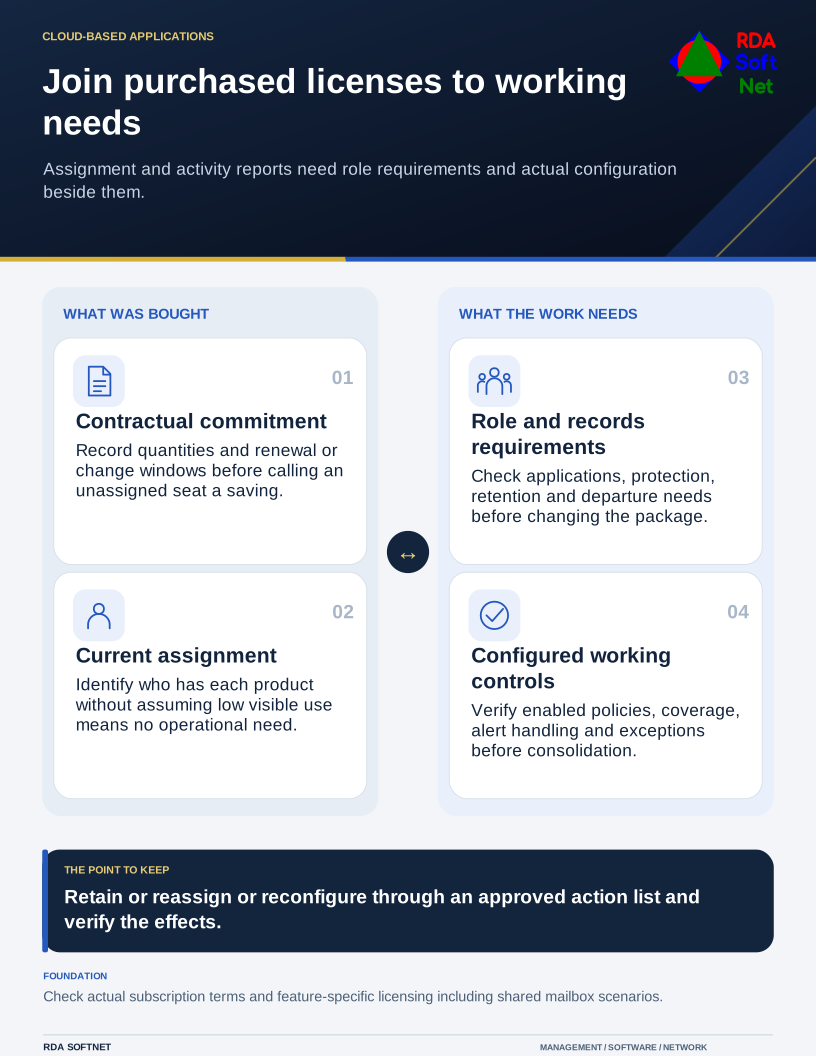
A better review joins three views: what the organization buys, what each role needs, and what is actually configured. Bring the computer department, purchasing contact, and department owners into the same conversation before making changes.
Separate assignment from commitment
Record the products purchased, quantities, assigned users, renewal dates, and contractual change windows. An available license can be reassigned without necessarily reducing the quantity the organization has committed to buy.
Microsoft's license administration guidance describes assignment and removal, and notes that cancellation opportunities depend on subscription terms. Verify the agreement before presenting an unassigned seat as an immediate saving.
Build a role-based requirement list. Consider application use, device management, identity protection, records retention, and access to regulated information. A person who sends little email may still need a particular control because of the information they handle. Our cloud governance guide connects those responsibilities with tenant administration.
Confirm the controls are doing their job
For a security feature, identify the intended outcome and who operates it. Check whether the policy is enabled, the appropriate people and devices are covered, alerts are reviewed, and exceptions have owners. Buying overlapping tools can waste money, but removing one without checking its function can create a gap.
If two products appear to provide the same protection, compare coverage and responsibilities before consolidating. Consider provider coordination, response arrangements, reporting, and the cost of a transition. Schedule a controlled change with an acceptance check rather than simply stopping a renewal.
Treat AI add-ons as a separate use decision. Identify the approved tasks, training, review time, and results. Frequent use is not automatically useful work, while low use may reflect a missing workflow or a role that does not need the product.
Handle departures and shared work carefully
Connect the review with offboarding, including data transfer, required retention, delegated access, and departure authorization. Preserve records through an approved process before changing licenses that affect their availability.
Shared mailboxes deserve a specific check. Microsoft's shared mailbox guidance identifies scenarios in which additional licensing is required. Converting a mailbox does not mean every storage, archive, hold, or advanced feature requirement disappears.
End the review with an approved action list: retain, reassign, train, reconfigure, or change the next purchase. Document expected savings separately from operational improvements, and verify the effects after the change. The useful result is a supported service at an understood cost, with enough evidence for the organization to explain why it chose that arrangement.