
A list of popular AI tools is a poor starting point for a purchasing decision. The useful question is what work needs help and whether a particular capability can perform that part acceptably.
Does this AI capability fit the job?
Purchase follows evidence about the complete task and its operating arrangement.
A writing assistant, document search tool, image generator, and forecasting system solve different problems. They also introduce different information, accuracy, integration, and ownership questions. Treating them as interchangeable makes a demonstration look more conclusive than it is.
Describe the job before comparing products
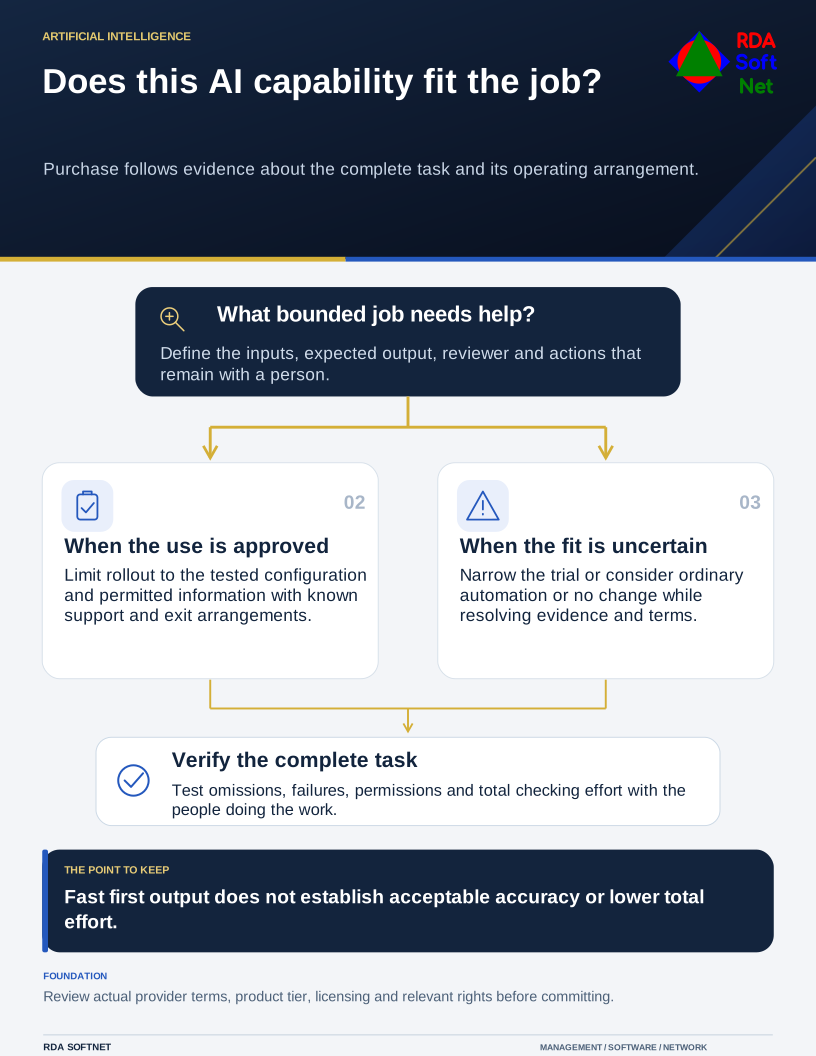
Choose a bounded activity with a clear input, output, and reviewer. Preparing an initial version from approved notes is different from issuing advice to a customer or approving a payment. Write down the decisions and actions that must remain with an authorized person.
Record the present process, including the time spent finding information, checking facts, and correcting mistakes. An AI tool that produces a working version quickly can still increase the total work if every statement needs difficult investigation. Compare the whole task rather than the time before the first output appears.
Use the AI governance guide to establish permitted uses and information. Check the provider's terms, account type, retention, training use, administrative controls, and contractual commitments for the proposed service. A setting or protection in one product tier should not be assumed to apply to another.
Ask who owns the resulting material and what review it needs. Generated images or text should not be treated as cleared for every commercial use merely because a product offers them. Route relevant rights and contract questions through the organization's review process.
Test the output and the operating arrangement
Use representative permitted examples, including an incomplete input and a case that should be declined or escalated. Define what an acceptable result contains and which errors would make use inappropriate. Let the people doing the work participate in that assessment.
NIST's generative AI risk profile addresses confident but false outputs and recommends evaluating capabilities and checking sources. A fluent answer is therefore something to assess, not evidence that the underlying task has been completed correctly.
Test the proposed permissions as well. Connecting an assistant to records or applications can extend its reach beyond the original trial. Follow the integration guide before granting access, and separate retrieving information from permission to change or send it.
Include licenses, setup, supervision, support, and exit in the cost comparison. Check how users recover work during an outage and how approved records leave the service if the organization changes providers. These questions belong in vendor review, alongside the demonstration.
Approve a limited rollout only when the owner can explain the benefit, limitations, information boundaries, and support route. Record which configuration and examples were tested, then review again when the provider or workflow changes.
The outcome may be a purchase, a smaller trial, a conventional automation, or no change. Each is a reasonable result when it follows the work. The product name becomes useful after the requirements are clear.