
Repeated failed logins against one account are easy to recognize as a possible password attack. Password spraying distributes the effort differently: an attacker tries a limited set of likely passwords across many identities. Each account may show relatively little activity while the wider pattern deserves attention.
Spraying and stuffing use different inputs
Both can target sign-in services but their starting material differs.
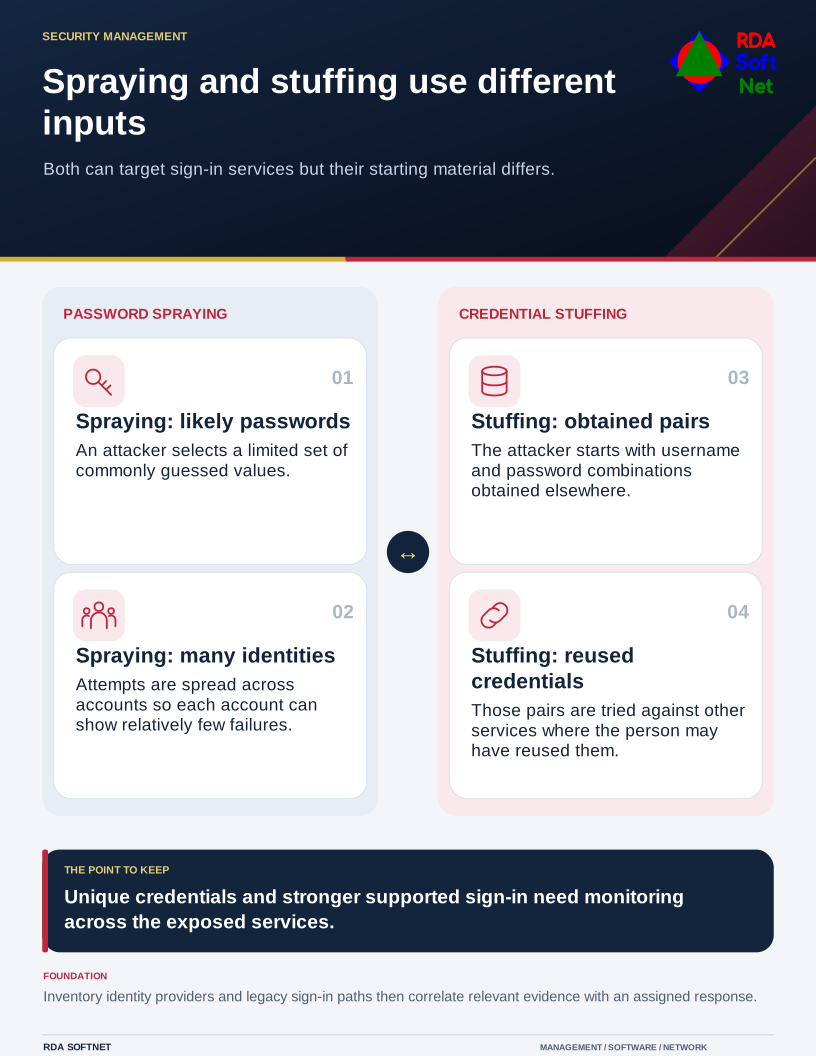
The technique depends on guessing plausible credentials, not necessarily on first stealing a particular user's password. It can target internet-facing identity services, remote access, or applications that retain their own sign-in arrangements.
Understand the pattern before choosing a control
Microsoft's password attack explanation describes common passwords being tried across accounts and services. The distinction matters because a lockout rule focused on repeated failures for one identity may not reveal the full campaign.
Credential stuffing is related but different: it tries username and password combinations obtained elsewhere. Both reinforce the value of unique credentials, protected authentication, and useful monitoring. Neither is solved by teaching people a more predictable variation of the organization's name.
Review the exposed sign-in services and accounts involved. Include dormant accounts, legacy applications, service identities, and any allowed authentication exceptions. The credential management guide connects that inventory with authorization and lifecycle control.
Combine password protection with stronger sign-in
Use the identity platform's supported protections against common or compromised passwords and suspicious attempts. Configure and test them for the actual environment. Do not copy a lockout setting blindly: a poorly chosen rule can also prevent legitimate staff from working when attackers deliberately trigger it.
Provide an approved password vault so distinct credentials are practical where passwords remain necessary. Review policy against current requirements rather than assuming frequent scheduled changes or character substitutions resolve the threat.
Require suitable multifactor authentication, with phishing-resistant methods where supported and appropriate. Check the applications and older sign-in routes that might fall outside enforcement. A strong rule on the main portal does not establish that every separate service uses it.
Investigate success as well as failures
Correlate relevant identity, application, device, and network activity through security operations. Distributed sources and slow patterns mean that one simple source-address threshold will not identify every attempt. Confirm which evidence is collected and retained, and who receives actionable findings.
Microsoft's password spray investigation guide addresses identifying and investigating the event. If access may have succeeded, examine subsequent activity and coordinate account, session, and application actions through the response process. Resetting every password without understanding the scope can interrupt work while leaving other access routes unexamined.
Use a controlled review to verify coverage: known accounts, protected sign-in paths, tested alert routing, and documented exceptions. Assign any missed application to an owner. The organization should be able to explain what happens after the first suspicious pattern is found, not simply point to a lockout policy and assume the attack has been contained.