
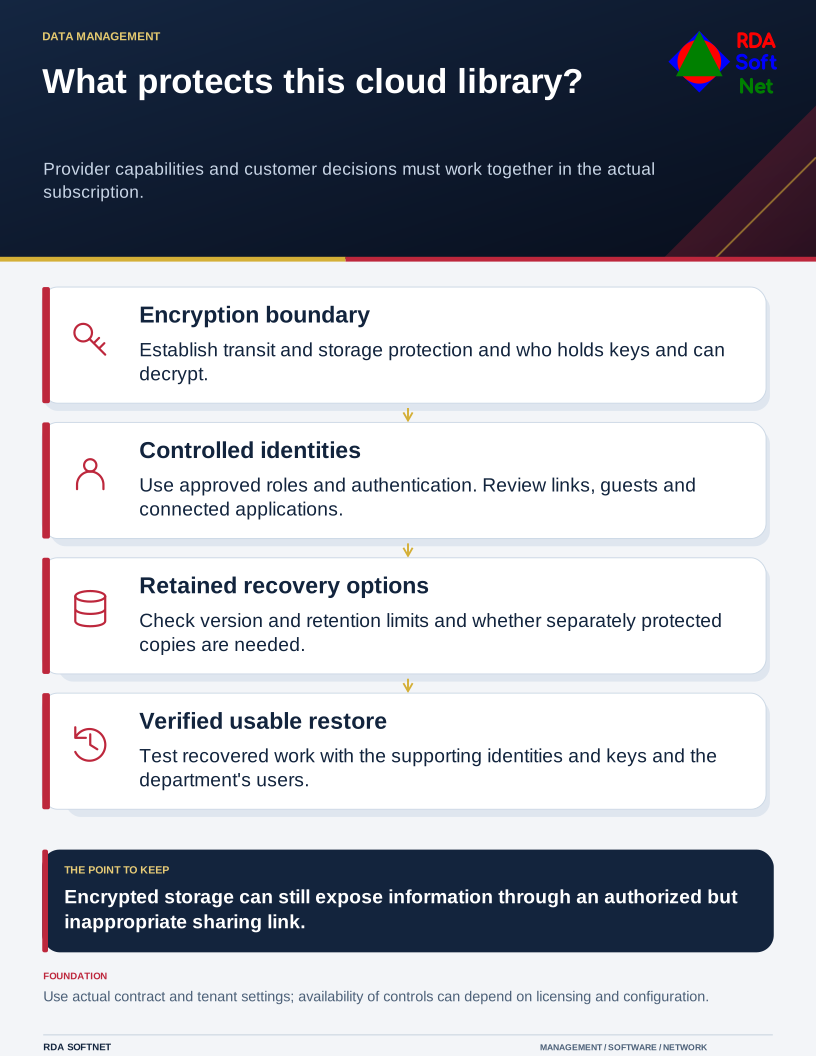
A cloud storage service can protect its infrastructure while a customer exposes a folder through an inappropriate link. It can encrypt stored files while an authorized account still downloads them. Secure storage is a combination of provider controls and the organization's decisions about information and access.
What protects this cloud library?
Provider capabilities and customer decisions must work together in the actual subscription.
Review the actual account, subscription, contract, and settings used for the work. A general product description cannot establish that a particular department has configured the service appropriately or that every information type is permitted there.
Be precise about the encryption claim
Encryption in transit protects a communication path. Encryption at rest protects stored information under the chosen key arrangement. End-to-end encryption describes a different arrangement concerning who holds the ability to decrypt. The first two do not automatically imply the third.
Ask who can access the keys, what the application decrypts for authorized users, and how recovery works. NIST's storage encryption guidance provides useful considerations for protecting stored information. The encryption guide connects those concepts with practical key custody and supported recovery.
An extra layer of client-side encryption may help some requirements but can change search, collaboration, recovery, and provider support. Evaluate that workflow deliberately. Do not give staff a tool that creates encrypted files nobody else in the organization can recover.
Make access and ownership visible
Use organization-controlled identities, suitable additional authentication, and permissions approved for the role. Review external links, guests, administrators, and connected applications. A current employee may have access from an old assignment that no longer has a business purpose.
The file collaboration guide helps define record ownership and sharing. Check how access changes when a person leaves, what activity can be reviewed, and which controls depend on a particular license or configuration.
Microsoft's shared responsibility guidance illustrates the customer duties that remain when services are hosted. The cloud governance guide assigns those responsibilities to people who can carry them out and verify them.
Prove recovery and account for copies
Test recovery from an unwanted change or deletion. Establish whether the service's retention, versions, and recycle functions meet the organization's recovery need, and whether additional protected copies are required. A synchronized second device may receive the same deletion.
Use backup and recovery planning to record the restore procedure and its limits. Include supporting identities and keys, and have a business user check representative recovered work. Successful backup messages are useful evidence but do not replace that test.
Include local downloads, exports, mobile access, and exit arrangements in the review. Record what remains unresolved and who will decide it. The acceptance check should show that the right people can use the records, unauthorized access is restricted as intended, and the organization can recover useful information when the normal workflow fails.