
A suspicious email, an unfamiliar sign-in, and an encrypted folder may look like separate problems. They can also be stages of the same incident. A useful security discussion connects the path between them instead of asking staff to memorize a yearly ranking of threats.
Interrupt the path to intrusion
Each stage creates a different opportunity to prevent harm or limit disruption.
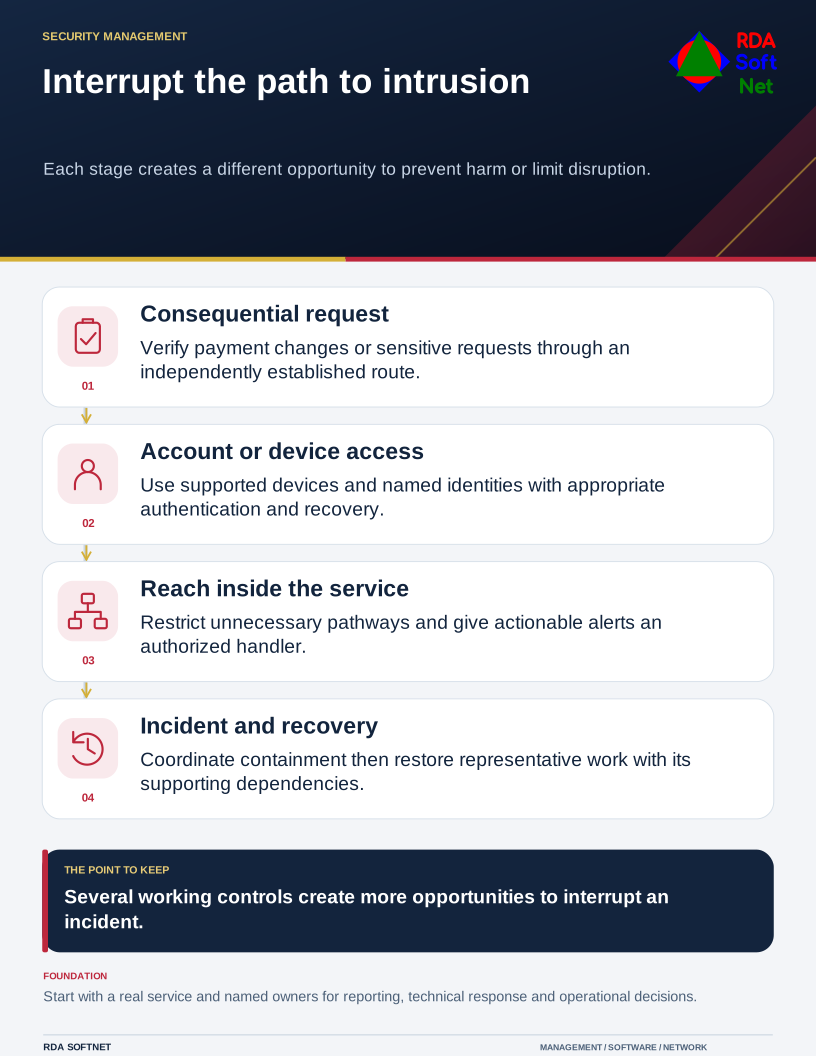
Choose an important service and consider how access might be misused. The result should identify practical controls and owners, not predict exactly which attack the organization will face next.
Start where a request becomes an action
A fraudulent message may ask for a password, a payment change, or a file. It can be well written and come through a real account that has been compromised. Staff need an independently verified route for consequential requests, alongside email authentication and filtering.
The awareness guide focuses on those decisions and reporting. The safe payment process gives finance a check that does not depend on judging whether a message or voice sounds genuine.
A harmful download can begin with an ordinary search for software. Provide an approved source and installation route. Keep the device supported and managed, and restrict administrative authority to the work that needs it. A user should be able to request help without searching publicly for a support number while a warning is on screen.
Review what a stolen account or device could reach
Use named identities, appropriate permissions, suitable multifactor authentication, and controlled recovery. Check application grants and active access when compromise is suspected. A password reset may be necessary without being sufficient to remove every route back in.
Limit unnecessary access between user systems, administration, operational equipment, and backups. Include connected devices in the inventory rather than assuming only computers need maintenance. An unsupported gateway or forgotten remote support service can create exposure even when workstations are well maintained.
CISA's StopRansomware guide brings access control, maintenance, segmentation, protected backups, and incident preparation together. Use those principles with the actual service dependencies and resources available; a product purchase does not establish that each control is operating.
The security operations guide connects alerts and vulnerability findings with a handler and an authorized response. Review failed updates and missing coverage as unfinished work, rather than allowing them to remain permanent dashboard exceptions.
Plan for the incident that prevention does not stop
Give staff a clear reporting route and an alternative if the usual account or communication service is unavailable. Ask what they observed and what they already did. Preserve useful evidence and coordinate containment with the owner of any essential operation.
Follow the incident response process for decisions about accounts, devices, providers, communications, and applicable duties. A suspected financial loss may require immediate contact with the institution involved while the technical investigation continues.
Test recovery with the application and its users, including the identities, keys, software, and connectivity needed to work. Assign gaps to owners and revisit them. The aim is several opportunities to prevent, detect, limit, and recover from an intrusion, supported by people who know their part of the process.