
A report that a password manager was compromised does not describe one universal event. The exposure might involve account records, encrypted vault copies, a software flaw, a sharing function, or a device with an unlocked vault. Those cases require different investigation and response.
A vault incident reaches beyond its current login
Determine what was exposed and which business credentials could still carry authority.
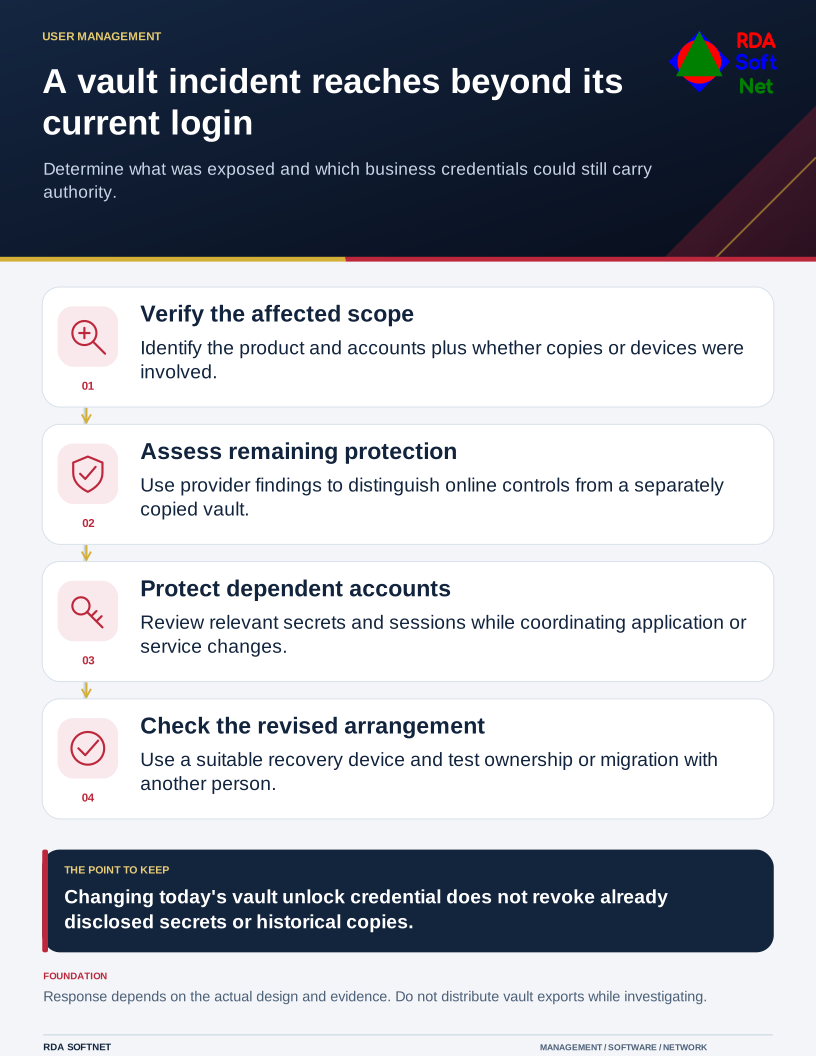
Start by verifying the provider's notice through an established route and identifying which service, accounts, versions, and information are affected. Preserve the notice and relevant administrative records. Avoid distributing exported vault contents while trying to determine the scope.
Understand what protection remained
Encryption can reduce exposure without making every incident harmless. If an attacker obtains a vault copy, the assessment must consider its format, protected and unprotected fields, key derivation, and the strength of the material needed to unlock it. Authentication controls on the online service should not be assumed to prevent every attack against a separately copied dataset.
Research presented at USENIX Security 2024 demonstrated vulnerabilities in particular password-manager designs and reported vendor mitigations. It supports examining implementation and sharing behavior rather than claiming all managers are unbreakable or all are equally unsafe. The study is not a current ranking of products.
For the deployed product, obtain the provider's current findings and supported response instructions. Use an appropriate technical specialist when the notice does not explain the effect on the organization's arrangement.
Protect the accounts, not only the vault login
Follow the incident response process. Changing the vault's current unlock credential may be necessary, but it should not be treated as revoking secrets already disclosed or re-protecting every historical copy an attacker holds.
Identify relevant business credentials and prioritize according to the evidence and the consequences of misuse. Email, identity administration, remote access, financial services, and recovery accounts can have important dependencies. Coordinate changes with the owners of applications and automated processes so the response does not silently break essential work.
Use credential management to review sign-in activity, recovery methods, active sessions, registered authenticators, and application access where applicable. Replacing a password is one possible action within that wider review.
If a device may have been compromised, changing secrets through the same untrusted device can create further exposure. Have support establish a suitable environment for recovery and maintain the evidence needed to investigate.
Review the operating arrangement after containment
The password vault guide covers ownership, recovery, sharing, and staff changes. Revisit administrator access, unlock protection, software maintenance, exports, and the separation of personal and organizational information.
A migration may be appropriate after the assessment, but exporting to another product also creates sensitive material that needs protection and disposal. Validate the destination and the continuing access arrangements before deleting the old service.
Document what was confirmed, what remains uncertain, and which credentials or systems were addressed. Then test the revised process with another authorized person. Password managers can still help reduce reuse and support unique credentials; their value depends on a maintained product and an organization able to respond when its assumptions are challenged.