
The statement “it is encrypted” is incomplete. The organization needs to know which information is protected, where it becomes readable, who can obtain access, and what happens if the key or controlling account is unavailable.
Trace where encrypted information becomes readable
A protection choice needs a clear exposure and usable recovery rather than an encryption checkbox.
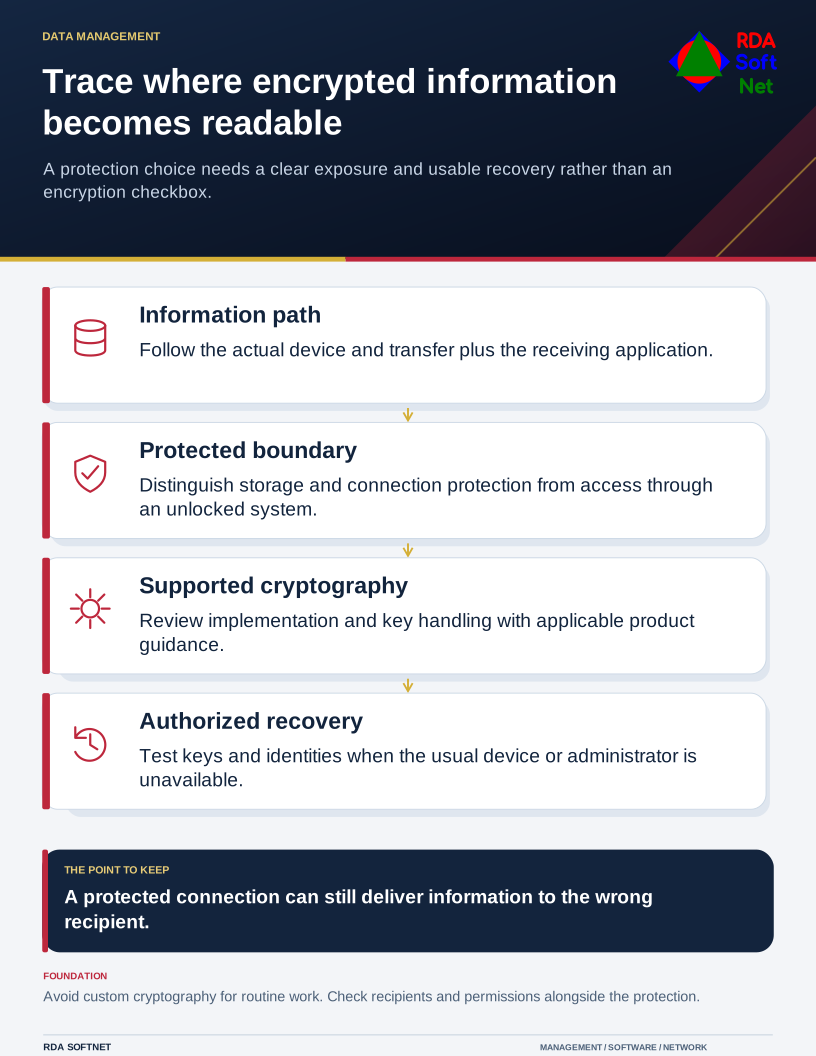
Begin with a specific information path: a document on a laptop, a file uploaded to a service, or a message sent outside the organization. Different stages may use different protections, with different people responsible for them.
Understand the boundary being protected
Encryption at rest protects stored information under a particular design. Encryption in transit protects information moving across a connection. Neither statement alone tells you whether the service receiving the information can read it or whether an authorized account has excessive access.
Microsoft's BitLocker overview describes volume encryption intended to address exposure from lost, stolen, or improperly retired devices. It is not a replacement for account permissions or protection of a running, unlocked computer.
Likewise, an encrypted connection to a website does not prove the site is legitimate. Information can be protected during transport and then delivered directly to the wrong recipient. Staff still need the approved service address and a suitable sharing process.
The encryption guide connects these boundaries with devices, cloud services, and message handling. Test what an ordinary recipient or user can actually do, rather than relying on a feature name.
Let supported products handle the cryptography
Symmetric methods use secret key material for protection and recovery. Public-key systems use related public and private keys for operations such as establishing protected communications or verifying signatures. These approaches often work together within a supported protocol.
A longer key or a different algorithm name is not, by itself, a complete product assessment. Implementation, configuration, key handling, supported protocols, and the intended use matter. Avoid designing a custom encryption scheme for a routine business application.
NIST's key management guidance addresses the protection and management of key material. Use applicable requirements and supported vendor guidance to establish the arrangement, with qualified assistance where the design requires it.
Make recovery and access supportable
Identify who can recover protected information and how their authority is verified. Store recovery material in an approved location with restricted access and appropriate separation. A key kept only on the encrypted device may be unavailable at the moment it is needed.
Practice recovery with harmless representative information. Include an absent administrator, a replaced device, and the loss of the usual account or service. Record the result without putting recovery secrets into a broadly readable support record.
The backup plan needs its own protected copies and usable key arrangements. The data governance process determines authorized recipients, retention, and disposal; encryption does not make unnecessary copies or excessive access appropriate.
Review the design when devices, accounts, providers, or staff change. The useful outcome is a clear account of what is protected, against which exposure, and how authorized work continues. That is more informative than treating an encryption checkbox as an answer to every information risk.