
A department can buy a writing assistant, a meeting assistant, a scheduling service, and an analytics tool, then discover that nobody has time to support their connections or check their output. A collection of capable products is not yet a workable process.
Buy the task's complete operating result
The useful cost comparison includes checking and support alongside the assistant's output.
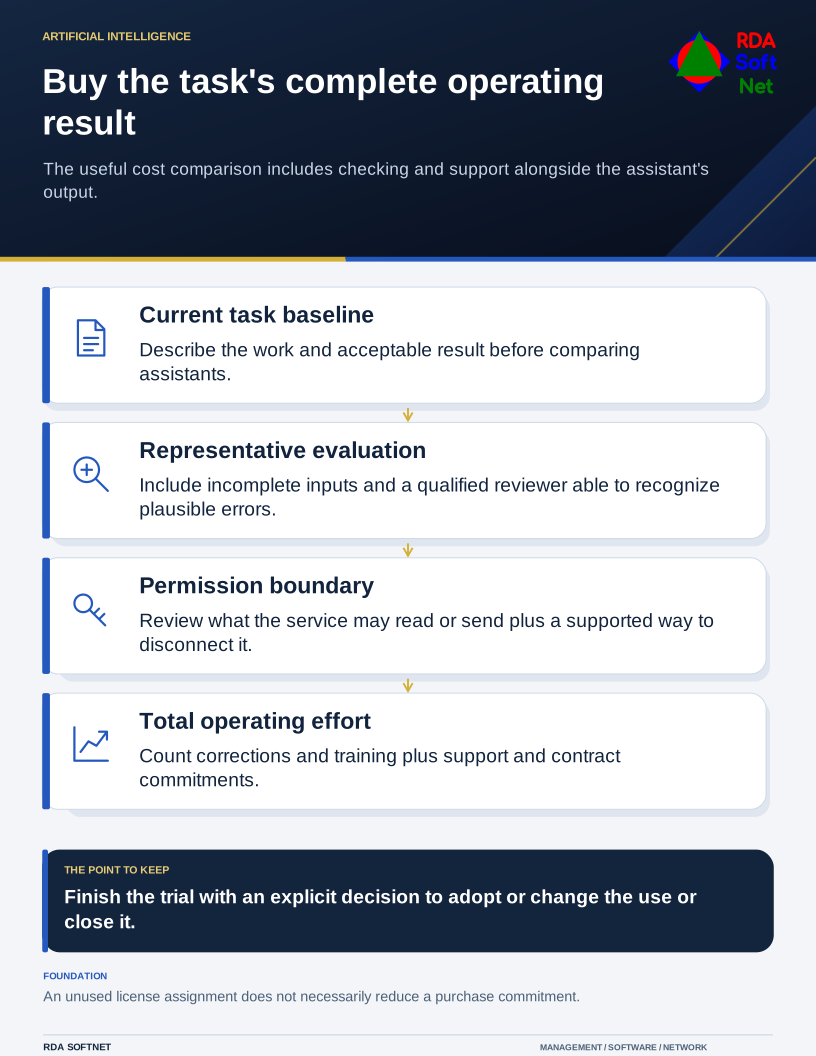
Choose one task worth improving. Describe what happens now, where the difficulty lies, and what an acceptable result would look like. Compare an AI option with simpler changes such as a maintained template, a form, or a rule-based workflow.
Use the current process as the baseline
For drafting, start with approved source material and identify who checks the answer. For a meeting, decide what may be captured and who owns the resulting record. For analysis, establish what the inputs mean and how someone will verify the calculations and interpretation.
Avoid buying on the assumption that all text, conversation, or spreadsheet work needs the same assistant. A tool may be suitable for preparing an initial version without being suitable for a personnel decision or an unattended change to business records.
NIST's AI RMF Playbook offers voluntary suggestions for managing AI risks that can be tailored to a use case. Our AI governance guide connects that review with an owner, permitted information, verification, and a date to revisit the decision.
Agree on a small test set and an acceptance check before beginning the trial. Include awkward but ordinary cases, such as an incomplete source document or a question the approved material cannot answer. The person checking output needs enough knowledge to recognize a plausible error.
Review the permissions as part of the purchase
List what the service can read, create, send, change, and retain. A calendar assistant and a tool that can send mail on someone's behalf have different consequences. Check the actual account terms, retention behavior, and optional connections.
Use application integration review for permissions and background access. Prefer a supported arrangement with organizational ownership over a trial tied indefinitely to one employee's personal account.
Ask how the process stops. Can permissions be revoked without interrupting another service? What output must be exported or retained? How will staff continue if the assistant is unavailable? Those questions belong in the trial plan rather than becoming a cleanup task after renewal.
Count checking and support in the result
Measure the complete task, including corrections, review, training, and the effect on the next employee. A fast summary that needs extensive fact checking may have a different value from a drafting aid used against a reliable template.
Review licensing and contract commitments through cloud governance. An unused assignment can be a reason to reallocate access, but it does not necessarily change the current purchase commitment.
At the end, make an explicit decision through the planning process. Adopt and document the workflow, narrow the use, extend a justified experiment, or close it. Staff should understand what has been approved and how to get help. The organization should understand what it is paying to operate, rather than accumulating tools whose usefulness has never been demonstrated.