
A proposal says a blockchain will make records trustworthy. The first question is which disagreement or operational problem the organization needs to solve. A shared ledger may suit a particular arrangement among participants, but it does not make inaccurate source information correct.
Four questions before choosing a shared ledger
A shared record still depends on truthful inputs and an agreed operating arrangement.
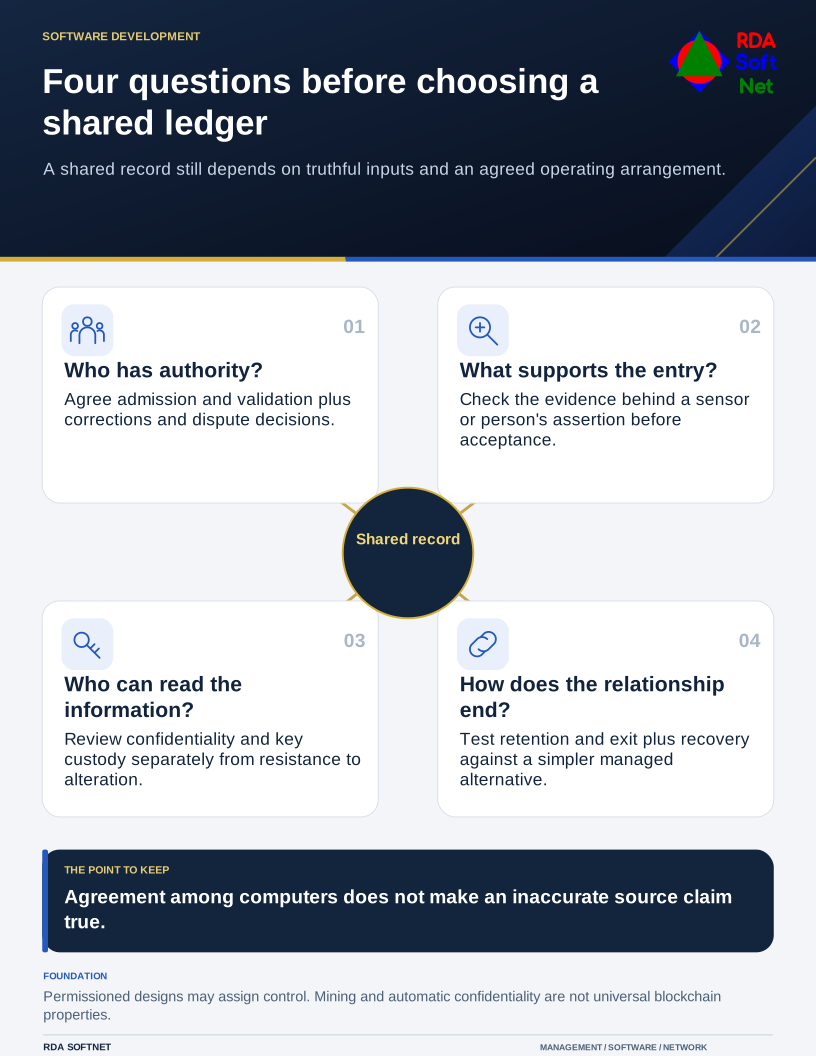
Begin with the parties, the record, and the decision the record supports. Identify who is permitted to submit information, who needs to read it, and why an ordinary managed application or database would be insufficient.
Understand the design before its claims
NIST's blockchain technology overview describes distributed ledgers whose records are designed to resist and reveal alteration under the system's operating assumptions. It also discusses different ways participants agree on accepted records. Mining is one approach associated with some networks, not the mechanism used by every blockchain.
The term does not establish that no organization controls the system. Permissioned designs can restrict participants and assign administrative roles. Those choices need clear ownership and operating rules just as other shared applications do.
Cryptographic linking and agreement on records do not automatically provide confidentiality. Determine what participants and outside observers can see, what information is stored elsewhere, and how keys and accounts are protected. A tamper-evident record and an encrypted record answer different questions.
Use the encryption guide for those protection boundaries and the data governance process for information ownership and permitted disclosure. Avoid placing sensitive personal records directly into a lasting shared ledger without a specific, reviewed need and an appropriate design.
Put governance around the shared record
Agree how participants join, submit records, correct mistakes, resolve disputes, update software, and leave. Decide what happens when an administrator or signing key is compromised, when a participant stops operating, or when the group disagrees about a change.
A record of an event is only as useful as the process establishing that the event occurred. If a sensor, employee, or external system supplies incorrect information, the ledger may preserve the wrong assertion consistently. Include validation and accountability at that entry point.
Ask how applicable retention, correction, access, and preservation duties will be met. Keep the responsible legal or records adviser involved. A technical label does not settle the organization's obligations or establish that deletion is possible in every proposed design.
Test a small case against a simpler alternative
Use test information and a bounded prototype if the requirement justifies further work. Compare it with a conventional application on administration, permissions, performance, cost, recovery, and provider dependence. Include support and exit arrangements instead of evaluating only a successful demonstration.
The planning guide makes that comparison reviewable. The integration guide covers connections to the systems creating or consuming the records, with an owner for failures and reconciliation.
Have the department demonstrate how an ordinary error is corrected and how authorized work continues during an interruption. Adopt a design only when the resulting responsibilities and benefits are understood. The useful outcome is a supported recordkeeping process, whether or not its architecture includes a blockchain.