
An organization may be discussing whether to adopt AI while employees already encounter it in writing tools, meeting invitations, search, and application updates. A useful review begins by asking what is happening, without assuming every use is either approved or harmful.
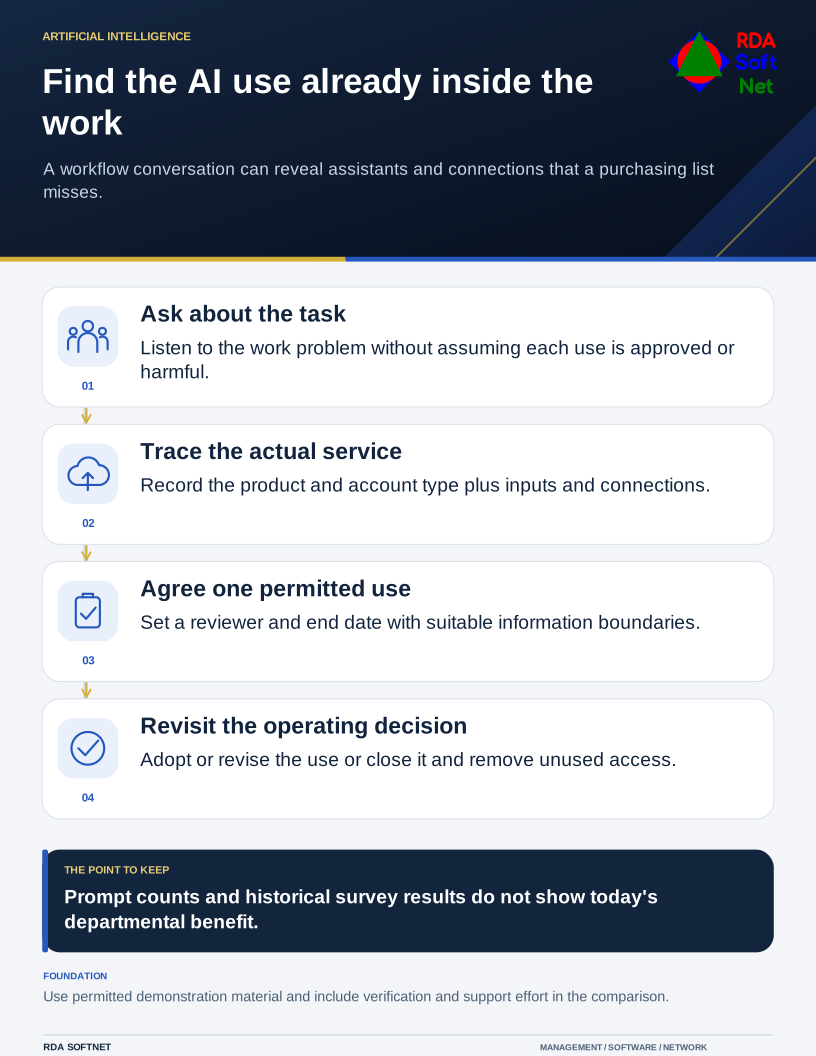
Find the AI use already inside the work
A workflow conversation can reveal assistants and connections that a purchasing list misses.
The historical 2024 Work Trend Index from Microsoft and LinkedIn drew attention to employees bringing AI into their work and the difficulty of turning experimentation into an organizational plan. Treat that report as a source of questions, not as evidence that its survey results describe your department today.
Listen to the task before judging the tool
Ask staff what they are trying to accomplish, what they enter, and what they do with the result. A useful conversation might reveal a repeated drafting task, a difficult search for procedures, or an application that added an assistant without a local decision about its use.
Have people demonstrate the workflow with test information. Avoid asking them to reproduce confidential prompts in an unrestricted meeting or survey. The goal is to understand the information path, not create another set of exposed records while investigating it.
Record the product, account type, connections, intended audience, and person responsible. A business subscription, a personal account, and a third-party browser extension can have materially different arrangements despite appearing to offer the same function.
Our AI governance guide turns those findings into specific permitted uses and review responsibilities. The data handling guide helps identify information that needs additional authorization before it leaves an approved system.
Discuss what staff find difficult. An unclear approval process can push useful experiments into personal accounts, while an unrestricted rollout can leave people unsure how to use the product responsibly. Provide a timely way to ask about a proposed use and an alternative when it is unsuitable.
Turn experience into a limited operating decision
Choose a task that can be evaluated. Agree on the input, expected result, reviewer, information boundaries, and pilot end date. Compare the complete task with the existing method, including verification, corrections, training, and support.
Let an experienced employee help develop examples and instructions, but do not make that person the only support arrangement. A colleague should be able to perform the approved workflow using the documentation. Include staff who use different devices or require accessible working methods.
If the trial needs application connections, use integration review to approve permissions and identify how they will be removed. Drafting text and changing a live record are different kinds of authority.
At review, retain the evidence needed to explain the decision. Adopt the workflow, change the experiment, or close it and remove unused access. Do not measure success only by how many prompts employees submit.
Make the next review part of the service review, especially after a product adds features or changes its terms. Staff insight is valuable when it helps the organization choose and support a defined process. It should lead to clearer work, rather than becoming a standing expectation that everyone must use AI for every task.