
Many AI proposals begin with a product demonstration. A more useful opening is a question for the department: where does work wait, get entered twice, or return for correction? That is where a carefully bounded trial may help.
Choose the handoff that is worth testing
An AI trial should resolve a visible work problem rather than fill a list of possible tools.
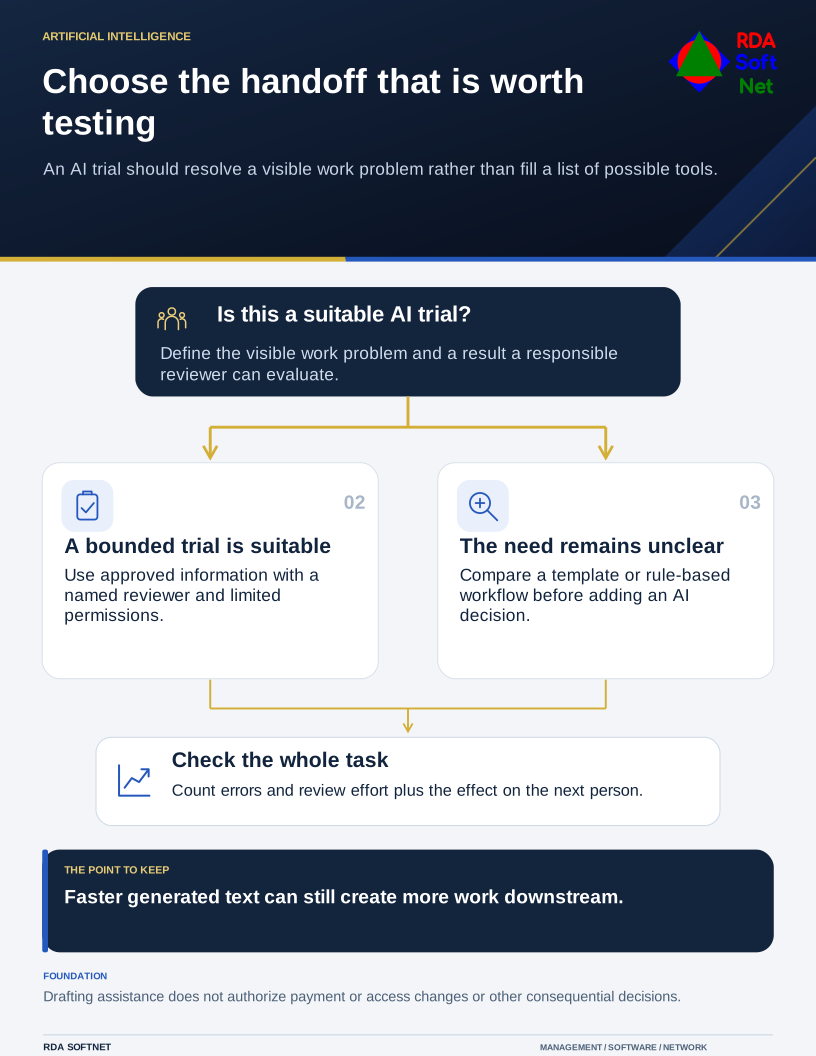
An organization does not need seven AI projects because a list contains seven possibilities. It needs a clear reason to change a process, a person who owns the result, and a way to establish whether the change helped.
Three places to investigate
A service team might use an approved assistant to prepare a reply from maintained public guidance. The employee would verify the answer, add the details appropriate to the request, and send it through the existing process. Escalations and sensitive cases would remain with the responsible person.
A finance team might test extraction of a few fields from test invoices. The trial should compare those fields with the source document and check duplicate handling. Extracting an amount is not authority to approve an invoice or change payment details.
A department preparing a routine report could test a first outline or a summary of approved source material. Someone who understands the subject would verify the facts and qualifications. Include that review time when comparing the new process with the old one.
These are possible experiments, not guaranteed savings. Other work may be better served by a template, a corrected form, or a straightforward rule-based workflow. The planning guide helps define the need before choosing the tool.
Decide what the experiment is allowed to touch
Record the approved product, account, information, connections, and audience. Use test or public material where it can answer the question. A service that prepares text from one document has a different reach from one that can search all departmental files.
NIST's AI Risk Management Framework provides a voluntary reference for evaluating AI risks. Apply it proportionately to the proposed work alongside the actual service terms and organizational obligations.
The AI governance guide covers approval and verification. Integration review is also needed when the tool can read another system or perform actions. Define what must stop if the connection behaves unexpectedly.
Be particularly deliberate about proposals affecting hiring, eligibility, safety, or other consequential decisions. A plausible prediction is not evidence that a person should receive a particular outcome. Involve the appropriate subject expert and responsible advisers before considering that use.
Measure the whole task
Choose representative work and agree on acceptable quality before the trial. Record errors, correction effort, support needs, and any effect on the next person in the process. A faster working version that creates more checking downstream may not be an improvement.
At the review date, decide whether to adopt, revise, or close the experiment. Document the permitted workflow and train another person if it continues. Remove unused connections if it ends. The valuable outcome is a decision the department can explain, including the evidence behind it.