
Management · Security Management
Web application traffic protection
Candidate protection for supported web applications, with traffic routing, rule scope, licensing and deployment to be confirmed.
Features and benefits
| Feature | Practical benefit |
|---|---|
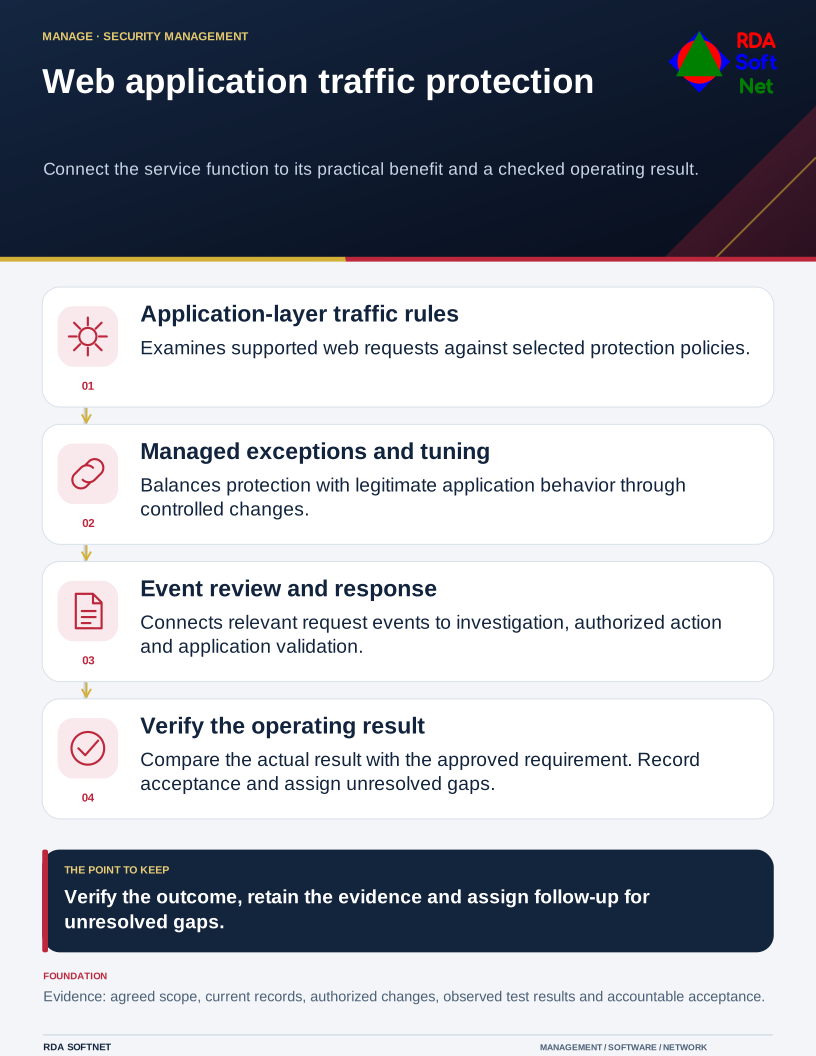
| Application-layer traffic rules | Examines supported web requests against selected protection policies. |
| Managed exceptions and tuning | Balances protection with legitimate application behavior through controlled changes. |
| Event review and response | Connects relevant request events to investigation, authorized action and application validation. |
Web application traffic protection
Connect the service function to its practical benefit and a checked operating result.
Requirements → deployment → operation → validation
Document library
Requirements and security baseline
Web application traffic protection Requirements and security baseline
Baseline alignment. Detection and traffic inspection safeguards selected for the agreed CIS IG. CIS IGs
- Application-layer traffic rules: scope, supported systems and accountable owners
- Managed exceptions and tuning: approved settings, access and dependencies
- Event review and response: acceptance criteria, retention and exceptions
Deployment and control mapping
Web application traffic protection Deployment and control mapping
- Scope and ownership: Candidate protection for supported web applications, with traffic routing, rule scope, licensing and deployment to be confirmed.
- Approved rollout and acceptance: Controlled pilot covering application-layer traffic rules and managed exceptions and tuning; acceptance test: confirm the application’s traffic crosses the intended protection point, test an approved blocked request and verify that legitimate application work still succeeds.
- Applicable requirements mapped to configuration, validation evidence and approved exceptions
Client and user guide
Web application traffic protection Client and user guide
- Using application-layer traffic rules within the approved service scope
- Recognizing failures and reporting a support request
- User responsibilities, access limits and service acceptance
Technician training outline
Web application traffic protection Technician training outline
- Application-layer traffic rules: records, configuration and diagnostic checks
- Managed exceptions and tuning: authorized administration and exception handling
- Event review and response: validation, evidence and service handoff
RDA technician workflow
Web application traffic protection RDA technician workflow
- Identify and assess the requirement; plan the scope, accountable owner and required approvals
- Implement and verify: Confirm the application’s traffic crosses the intended protection point, test an approved blocked request and verify that legitimate application work still succeeds.
- Document the configuration and result; hand off operation, review exceptions and plan lifecycle changes
Portal and access training
Web application traffic protection Portal and access training
- Named operators, role boundaries and multifactor access where supported
- Service identities, protected credentials and emergency access
- Access approval, periodic review and removal
Training module template
Web application traffic protection Training module template
- Learning objectives and prerequisites: application-layer traffic rules: records, configuration and diagnostic checks
- Authorized practical exercise: Confirm the application’s traffic crosses the intended protection point, test an approved blocked request and verify that legitimate application work still succeeds.
- Knowledge check, observed result and instructor or responsible-owner sign-off
Basic installation and acceptance
Web application traffic protection Basic installation and acceptance
- Approved platform, owner, permissions and prerequisite checks
- Controlled pilot covering application-layer traffic rules and managed exceptions and tuning
- Acceptance test: Confirm the application’s traffic crosses the intended protection point, test an approved blocked request and verify that legitimate application work still succeeds.
Advanced deployment and changes
Web application traffic protection Advanced deployment and changes
- Extend application-layer traffic rules to additional approved scope
- Change managed exceptions and tuning with impact review and rollback
- Validate event review and response after an approved change
Technical configuration and integrations
Web application traffic protection Technical configuration and integrations
- Application-layer traffic rules: configuration and dependency records
- Managed exceptions and tuning: supported interfaces and permission boundaries
- Event review and response: diagnostic collection, retention and evidence export
Operational audit and checklist
Web application traffic protection Operational audit and checklist
- Coverage and operating checks: application-layer traffic rules: coverage, health and unresolved exceptions
- Evidence sample: protected application scope, traffic path and policy mode; approved benign, blocked-request and application-regression tests
- Review date and owner; pass or fail, exceptions, corrective action and retest evidence
Tabletop exercises
Web application traffic protection Tabletop exercises
- A required dependency or responsible provider becomes unavailable
- An access or configuration change interrupts the service
- Reported success conflicts with the observed business result
Response playbook
Web application traffic protection Response playbook
- Assess the affected scope, evidence and business impact
- Authorize corrective action, escalation or rollback
- Verify service recovery, retain evidence and update the baseline
Operational runbooks
Web application traffic protection Operational runbooks
- Validate application-layer traffic rules against the approved design
- Investigate a failure affecting managed exceptions and tuning
- Collect event review and response evidence and confirm service acceptance
Evaluation and lifecycle review
Web application traffic protection Evaluation and lifecycle review
Selection and fit. Compare viable options against the business need, security requirements, existing systems and full operating cost. Record the reasons for the selection, the tradeoffs accepted and the conditions that would prompt a different choice.
Keeping the choice current. Follow supplier notices between scheduled reviews and reassess before renewal or a material change. Check ownership changes, renamed or retired products, subscription and licensing terms, pricing, capabilities and support commitments. Record the effect on security, data handling, integrations and service continuity. Assign an owner to approve adjustments or plan a transition, including data export and removal of access.
- Measured service outcome and practical acceptance results
- Supported scope, access, evidence availability and dependencies
- Licensing or provider terms, maintenance effort and lifecycle cost