
Management · Management Operations
Technical and compliance training
Role-based training connected to RDA procedures, practical exercises and evidence that the assigned work can be carried out.
Features and benefits
| Feature | Practical benefit |
|---|---|
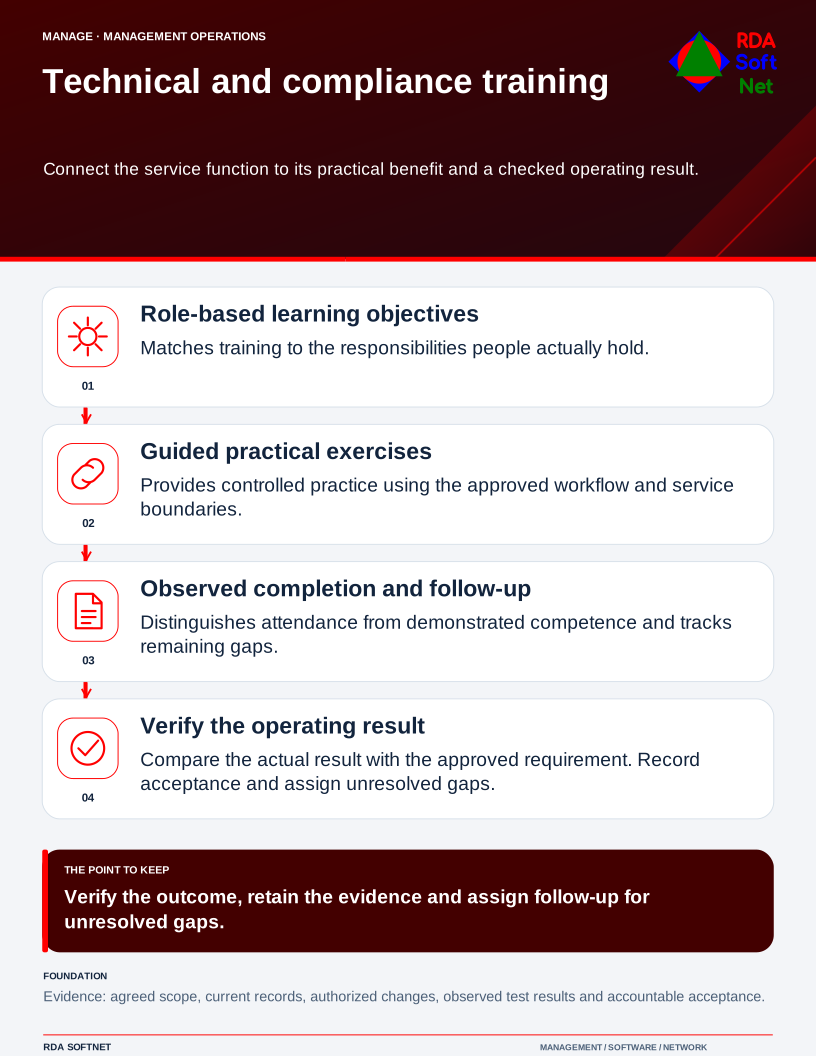
| Role-based learning objectives | Matches training to the responsibilities people actually hold. |
| Guided practical exercises | Provides controlled practice using the approved workflow and service boundaries. |
| Observed completion and follow-up | Distinguishes attendance from demonstrated competence and tracks remaining gaps. |
Technical and compliance training
Connect the service function to its practical benefit and a checked operating result.
Training for RDA people and client staff
Illustrative training examples
Training follows the person's responsibilities. RDA onboarding and cross-training prepare our people for assigned work; client training helps staff understand their systems, procedures and support arrangements. The objective is usable knowledge and a demonstrated task, with gaps carried forward.
| People and objective | Representative practice | Evidence to keep |
|---|---|---|
| RDA person learning an assignment | Use the current instructions under supervision and explain when another person needs to be involved. | Material version, observed task, reviewer and remaining training needs. |
| Client staff member joining or changing roles | Walk through the approved working task and the route for help, questions or access changes. | Assigned role, completed walkthrough and questions to resolve. |
| People handing over responsibilities | Explain the recurring work, current records and open items to the authorized receiving person. | Handover record, receiving person's check and follow-up owner. |
These examples connect to onboarding, offboarding and knowledge and continuity in both teams. Organization-specific materials and full working instructions belong in the approved member area.
Practice the decisions before they are urgent
Illustrative tabletop discussion prompts
A tabletop is a discussion using an agreed scenario, with no changes to live systems. It helps people practice their roles, identify a missing decision or handoff and assign the improvements.
| Scenario | What the people work through |
|---|---|
| A device cannot be found | Who receives the report, who can authorize the next action, what information is needed and how the affected person's work continues. |
| A person leaves or changes roles | Who authorizes the timing, who receives the work and records, and how the responsible people confirm the handoff. |
| A suspicious email or request arrives | How staff reach the known support route, which decisions need an authorized owner and how the result is communicated. |
Keep the scenario, participants, decisions, observed gaps and assigned actions. Review the result with the people who maintain the policy, instructions and response arrangements. Completing a discussion does not by itself prove that a technical control is effective.
Requirements → deployment → operation → validation
Public resource outlines
These short outlines show the resources connected to this function. Complete working documents, organization-specific procedures and access details belong in the approved member area.
Requirements and security baseline
The role, learning objective, material version and responsible instructor, connected to the applicable awareness or training requirement. Public references: CIS IGs.
Deployment and control mapping
How a learning requirement becomes assigned training, guided practice and an observed result with any remaining gap recorded.
Client and user guide
An outline for client staff explaining the task, their responsibilities, the support route and how to recognize a question or exception.
Technician training outline
An outline for supervised RDA onboarding and cross-training, with a practical demonstration before the person carries an assignment independently.
RDA technician workflow
How an authorized request becomes assigned work, a checked result and a record of the next action.
Portal and access training
The responsibilities for authorized access, role changes and departure, with individual access details kept in the approved member area.
Training module template
An illustrative module includes the objective, role, current instructions, a representative exercise, the observed result and the next learning action.
Basic installation and acceptance
The preparation and acceptance topics used when a service is introduced or its responsibilities change.
Advanced deployment and changes
How a significant change is reviewed for its effect on people, connected services and continuing support.
Technical configuration and integrations
An overview of the service dependencies and responsible parties; configuration and access instructions belong in the approved member area.
Operational audit and checklist
A review of assigned training, completion evidence, practical results and overdue or repeated learning needs.
Tabletop exercises
Short discussion exercises for a missing device, a staff departure or a suspicious request, with decisions and lessons recorded.
Response playbook
The people, decision points and review responsibilities involved when normal service is interrupted.
Operational runbooks
Descriptions of recurring operating tasks and their expected results; detailed working instructions belong in the approved member area.
Evaluation and lifecycle review
How suitability, support, licensing and operating results are reviewed as requirements or providers change.