Management · Security Management
Vulnerability assessment and validation
Authorized vulnerability scanning and remediation validation, connected to RDA’s risk and service workflows.
RDA uses this function in its ongoing work. The assigned responsibilities and coverage follow each organization’s needs and service arrangement.
Features and benefits
| Feature | Practical benefit |
|---|---|
| Asset and service discovery | Authorized scanning identifies reachable systems and exposed services so assessment coverage can be checked against inventory. |
| Vulnerability and patch checks | Plugin-based findings identify known weaknesses and missing updates for targeted remediation. |
| Authenticated configuration assessment | Credentialed checks inspect system configuration more deeply; supported audit policies help compare settings with a chosen baseline. |
| Prioritized findings | Severity and technical detail help assign corrective work, with business impact and accepted risk supplied through RDA’s assessment workflow. |
| Reports and remediation retests | Exports and repeat scans provide a record of findings and whether the specific technical issue was corrected. |
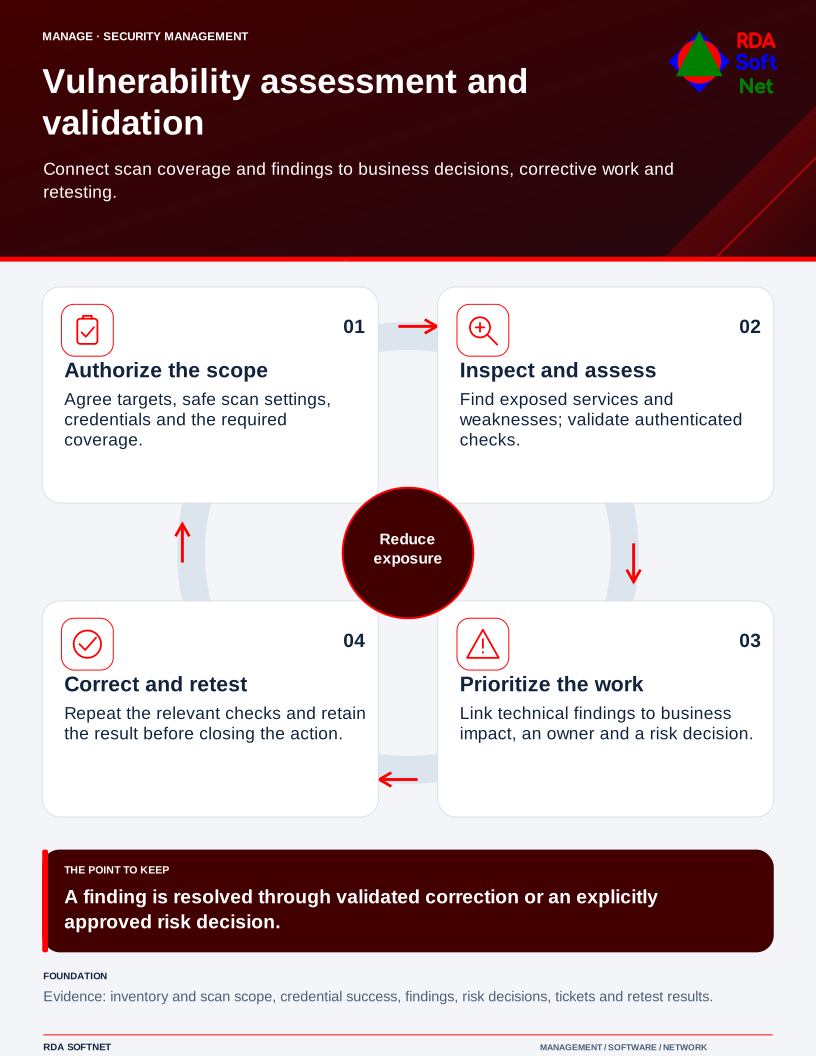
Vulnerability assessment and validation
Connect scan coverage and findings to business decisions, corrective work and retesting.
Public examples · supporting the operating service
Public resource outlines
These short outlines show the resources that support this function. Public examples omit organization-specific instructions, configurations and access information. Detailed working materials belong in the approved member area.
Requirements and security baseline
A short statement of purpose, assigned coverage, responsible owners and applicable requirements. The controlled member record connects these to the service baseline and approved exceptions.
Baseline alignment. Vulnerability assessment and remediation priorities aligned with the agreed CIS IG. CIS IGs
Deployment and control mapping
How a new or changed service is approved, tested and accepted. The member record retains the checked result, responsible people and links to the requirements it satisfies.
Client and user guide
What this function does for the people who rely on it, how to request help and which responsibilities users retain. Relevant instructions accompany the organization’s service arrangement.
Technician training outline
Role-based preparation for the assigned work, including a representative exercise and a check that the technician can explain the result and seek help when needed.
RDA technician workflow
A request or observed condition becomes assigned work, an authorized action, a checked result and a usable service record. Follow the work record.
Portal and access training
Who may use the service and how access is approved, reviewed and removed. Account details, privileged steps and recovery information stay in the controlled member materials.
Training module template
An illustrative module connects a learning objective, an authorized practical task, an observed result and follow-up. See training and exercise examples.
Basic installation and acceptance
The checks that confirm a service meets its agreed purpose when introduced or materially changed. Installation steps and acceptance records belong with the organization’s member materials.
Advanced deployment and changes
How a change is assessed and approved while the existing service continues. The working record identifies dependencies, checks, recovery arrangements and the person accepting the result.
Technical configuration and integrations
A high-level description of the service’s connections and responsibilities. Actual configuration, protected information and organization-specific operating steps are maintained in the approved member area.
Operational audit and checklist
A dated check of coverage, operating evidence and exceptions, with an owner and next action for anything unresolved. Connect findings to evidence and review.
Tabletop exercises
An illustrative discussion asks what happens if a dependency is unavailable or the expected result does not arrive. Participants identify decisions, responsibilities and follow-up without exposing live settings.
Response playbook
The response roles, decision points and escalation route for an interruption. Public examples describe coordination; live contacts and detailed response instructions stay with the organization’s controlled materials.
Operational runbooks
Short, task-specific instructions help authorized people repeat and verify the work. The full runbook and its current revision are retained with approved member materials.
Evaluation and lifecycle review
The business need, alternatives, lab checks, provider continuity and ongoing support remain connected to the choice. See how products and providers are reviewed.