
Canceling a subscription is a billing action. Leaving a cloud service is a change to information, accounts, workflows, and support. Doing the billing part first can turn the rest into a race against a provider's access and deletion schedule.
Put acceptance before the final cancellation
Ending billing must follow a usable information and workflow handover.
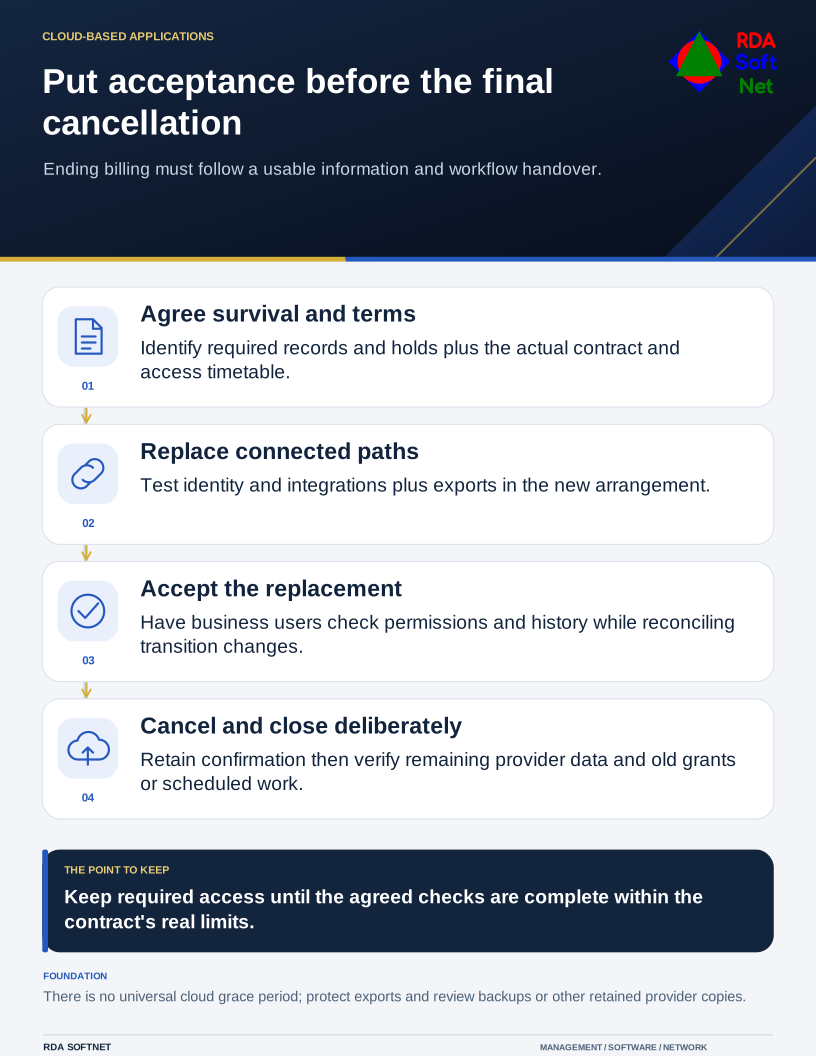
Choose an owner for the exit and find the actual contract, purchase channel, notice period, and current service terms. Do not borrow a retention period from another product, another plan, or an old article.
Define what must survive
List the records the organization needs, including attachments, comments, historical transactions, settings, and audit material where relevant. Identify the records owner and any legal hold or retention obligation before deciding what can be deleted.
A standard export may preserve the rows in a table without preserving their relationships or attachments. Test representative records, not just the download's file size. Can staff identify which invoice belongs to which customer? Can they read the attached document and understand the dates and custom fields?
The cloud exit guide connects these checks with storage and deletion. Our data governance guidance helps determine what must be retained, who may access the archive, and when those retained copies can eventually be disposed of.
Microsoft's subscription lifecycle documentation illustrates why current terms matter: access and lifecycle behavior depend on the subscription and purchase arrangement, and Microsoft advises preserving needed data before deletion. There is no universal grace period that should be assumed for every cloud service.
Find the connections that are easy to miss
Ask what sends information into the service and what receives information from it. A website form, scheduled report, automation, phone application, or payment workflow can continue to depend on a product after most employees have stopped using it.
Check sign-in dependencies too. If the account supplies identity for another application, establish and test the replacement access before closing it. A business-owned recovery method should remain available to authorized administrators.
For each integration, use the application integration process to assign an owner, test the new route, and remove the old credentials or grants at the appropriate point. Canceling a subscription should not be treated as proof that every external copy or connection has disappeared.
Set an acceptance point before the final cancellation
Have business users complete representative work in the replacement system. Confirm permissions, historical records, reports, and any transactions created during the transition. Plan how changes made after the first export will be reconciled before the old service closes.
Record who accepted the result and what remains unresolved. Keep a rollback option for as long as the plan requires and the contract permits. Temporary overlap has a cost, but so does losing access before the replacement is ready.
After cancellation, retain the confirmation and verify the agreed disposition of data. Ask what remains in backups or records the provider must retain, and under which schedule. Protect your own exports; moving information out of a service does not remove its sensitivity.
RDA coordinates the department, provider, and technical team so the exit follows the work. The final deliverable is usable information and a working process, with the old service's obligations deliberately closed.