
The awkward question in an AI trial is often not whether the tool works. It is whether the person asking a question should have been able to find the underlying information in the first place.
Check the files before expanding Copilot
Existing permissions become more consequential when information is easier to retrieve.
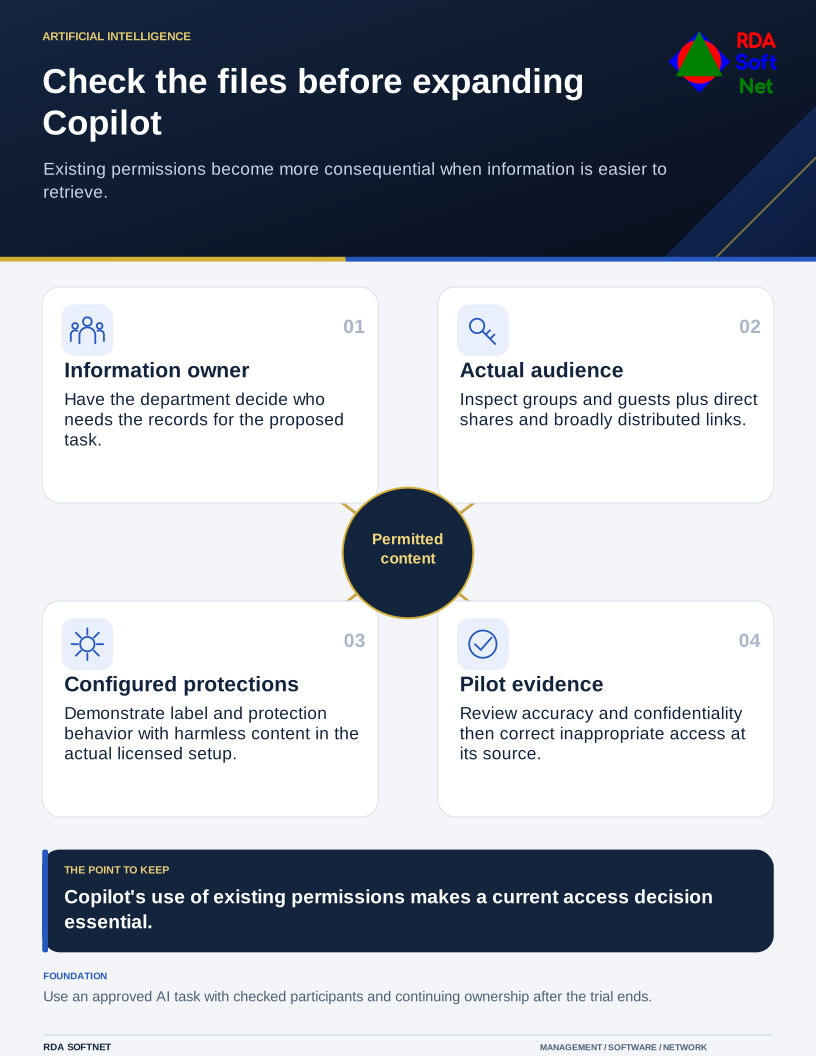
That question belongs to the department that owns the information as much as it belongs to IT. A permissions report can show who has access. It cannot decide who needs access to salary records, a closed investigation, or a confidential proposal.
Check the access already in place
Microsoft states that Microsoft 365 Copilot surfaces organizational content within the user's existing permissions. Permission to read a document may therefore become more consequential when a tool makes that document easier to retrieve and summarize. This is a reason to review access, not an assumption that Copilot bypasses it.
Choose the information involved in the proposed use case. Identify its owner, where it lives, and which people or groups can reach it. Include team membership, direct sharing, guests, and broadly distributed links. An old project site with no active owner deserves attention before a new license does.
Do not use a large membership count as the only test. Some reference material should be widely available. A small group can still contain the wrong person. Ask owners to confirm the audience against the work, then record the decision.
Make the pilot specific
A useful pilot has a defined task: preparing an initial version of a routine document, finding approved procedures, or summarizing material for an authorized team. Decide what a good result looks like and who checks it. Our AI governance guidance connects that decision with permitted information and human review.
Select participants whose actual access has been checked. Seniority does not make a trial automatically safer; it can mean a much wider set of available records. Explain what participants may submit, where outputs may be saved, and how to report an unexpected disclosure.
Labels and data protection controls can help, but their effect depends on configuration, permissions, product capabilities, and licensing. A label name alone does not prove that processing is blocked. Have IT demonstrate the intended behavior with harmless test content before applying the design to sensitive records.
Let the results change the plan
The pilot review should cover accuracy and confidentiality alongside convenience. Did staff spend less time searching? Did summaries omit qualifications? Did users discover material whose access needs to change? Keep representative, appropriately protected results so the decision to expand has a basis beyond enthusiasm.
Where access is wrong, correct it at the source. Hiding a troublesome folder from a particular search experience is not a substitute for fixing its permissions. The data governance process should also address ownership, retention, and disposal of content nobody needs anymore.
Before expanding, have the content owners and pilot lead review the findings together. Verify corrected access with representative users and record the approved next step. Retain someone who can handle an unexpected result after the trial team has moved on; the operating responsibility continues with the licenses.