
A cyber insurance questionnaire often reaches the person least able to verify all its answers. Finance has the renewal deadline, IT knows the configuration, department managers know the work, and the broker understands the application. Asking one person to guess for everyone creates avoidable uncertainty.
Make each insurance answer retrievable
The submission should describe current operation with exceptions visible.
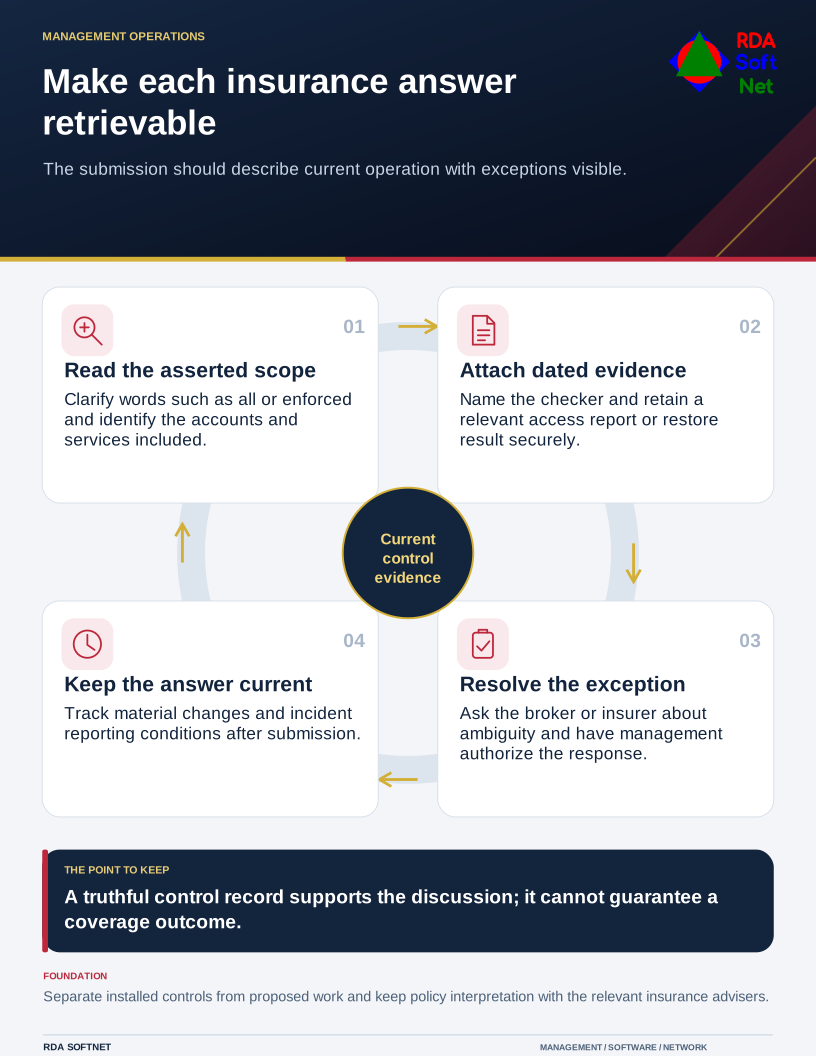
Put an owner on the submission and give each technical question to someone who can demonstrate the answer. The result should describe the organization as it operates today, with exceptions visible. The insurance evidence guide covers the record to retain and the contacts needed during an incident.
Read the question before finding a checkbox
Words such as all, enforced, monitored, and tested deserve attention. MFA being available is different from being required for the accounts and access paths named on the form. Endpoint software being installed is different from an alert being reviewed and acted on. A backup job is different from a demonstrated restore.
Write down the scope being asserted. Include remote access, servers, cloud administrators, contractors, and exceptions where the question calls for them. If a requirement does not fit a noninteractive service identity, explain the actual protections and ask for clarification rather than inventing an MFA arrangement.
The NAIC's cyber insurance guidance encourages businesses to discuss the coverage that fits their needs with their insurance agent. That conversation matters because policy wording, exclusions, reporting conditions, and available coverage differ. There is no universal technical checklist that guarantees a claim will be paid.
Keep the supporting material small and useful
An evidence folder might hold a dated access report, endpoint coverage summary, restore-test record, and incident exercise notes. Sensitive configuration exports should remain controlled; the broker may only need a summary or a secure method of exchange.
Each item should identify who checked it and what remains outside the scope. If twenty devices are managed and two are awaiting enrollment, say so. A planned purchase should be described as planned, not deployed. Carry the work into the technology roadmap with an accountable owner and a realistic target date.
Include operational controls. Finance can demonstrate the payment-change verification procedure. Management can identify who may authorize an incident response. A vendor review should show what was assessed and who owns follow-up, rather than merely collecting a certificate.
Resolve uncertainty before signing
Have IT review the technical statements, management confirm the business practices, and the broker resolve ambiguous wording with the insurer. Questions about legal representations or consequences need the appropriate adviser; do not rely on a blog's prediction of a particular coverage outcome.
The incident response plan should record the insurer's reporting contact and relevant notification conditions. Those details are harder to find when email or the file system is unavailable. Check whether the policy specifies approved response providers or consent before costs are incurred.
After submission, keep the final answers and evidence together. Use the regular service review to notice material changes, including a new remote access method, acquisition, or revised backup design. Have the application owner ask the broker which changes must be reported during the policy term, and put that instruction in the operating record.