
An export button is a promising start. It is not proof that the organization can leave a service with the information it needs. A spreadsheet may contain the main records but omit attached documents, comments, audit history, or relationships that give those records meaning.
Prove that the export remains useful
Files need their context and a destination that interprets them correctly.
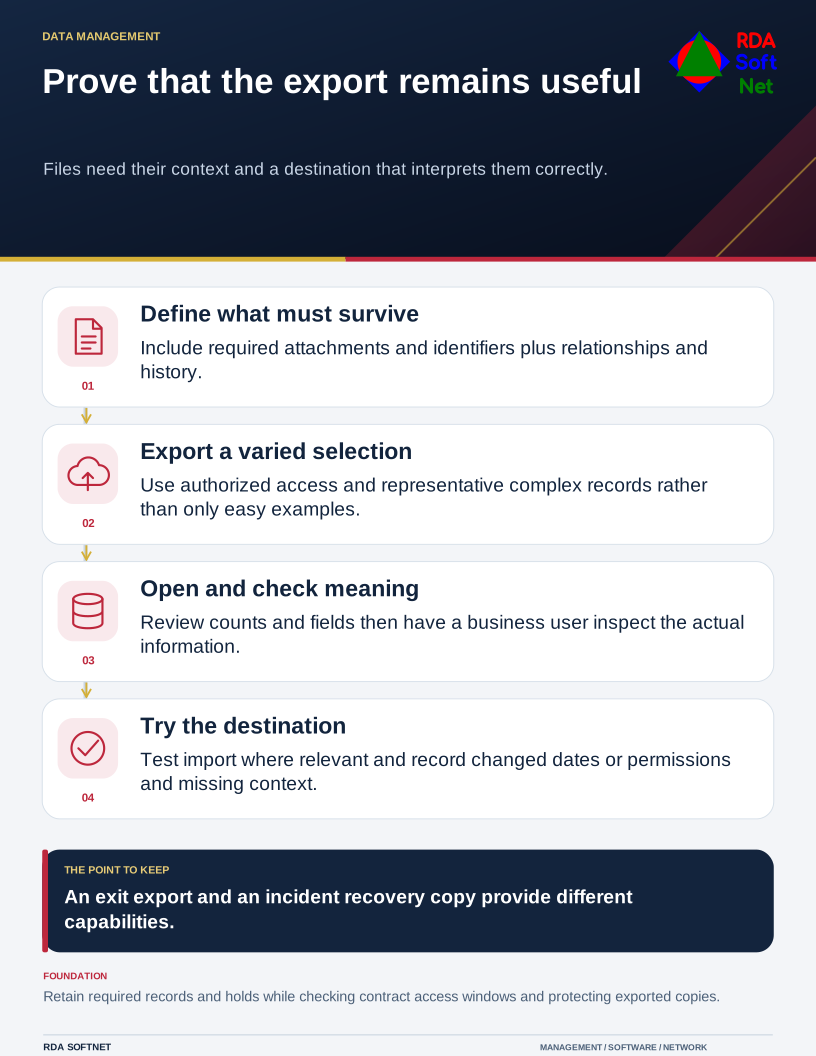
Test the export while the service is working and the supplier relationship is straightforward. The result should answer a practical question: could another authorized person find, understand, and use the information without depending on the original application?
Define what a useful exit includes
Ask the department and records owner which information must survive a move. Include required formats, readable attachments, date information, identifiers, and the ability to connect related records. Decide whether histories, approvals, or access records must also be preserved.
The data governance guide connects those requirements with retention, privacy, and access. Keep legal holds and records obligations in view before planning deletion. “We are changing vendors” does not itself authorize destroying records or making them less accessible.
NIST's public cloud security and privacy guidance provides a useful basis for considering outsourced data arrangements. The organization needs to understand the service terms and responsibilities, including the practical consequences of its dependency on the provider.
Run a small export and inspect it
Choose a representative selection, not just the easiest records. Include something with an attachment, a revised document, a complex relationship, and a record subject to special handling where applicable. Perform the export through an approved administrator or documented process.
Check record counts and important fields, open the files, and have a business user confirm their meaning. Identify what cannot be exported or reconstructed. For a proposed replacement, test an import as well; the destination may interpret dates, permissions, or identifiers differently.
Document the steps, credentials required, storage location, and effort involved. The cloud exit guide helps turn those findings into a transition plan. Include the provider's assistance, fees, rate limits, and access window where relevant. Verify the actual contract rather than relying on a generic assumption about how long data remains available.
Keep backup and portability separate
A recovery copy and an exit export solve different problems. A backup may restore information only into the same platform. A portable export may lack the configuration or point-in-time history needed to recover from an incident. Review both through the backup and recovery guide.
Secure the exported information as carefully as the source. Limit access, protect transfer and storage, and account for temporary copies used during testing. Do not create an unmanaged collection of sensitive files in the name of reducing vendor dependence.
Bring the findings to the vendor review and renewal discussion. Some limits may be acceptable when understood and approved. Others need a contractual change or a different service. A tested exit gives the organization a realistic choice and gives its computer department a procedure another person can carry out.