
A backup report can be green while the organization remains unprepared for ransomware. Recovery may need an unavailable administrator, a configuration nobody recorded, or an application provider who has never been included in a restore test. Prevention tools have similar gaps when nobody owns the exceptions or the alerts they produce.
Connect the parts of ransomware readiness
Tools become useful through owned access controls and tested recovery.
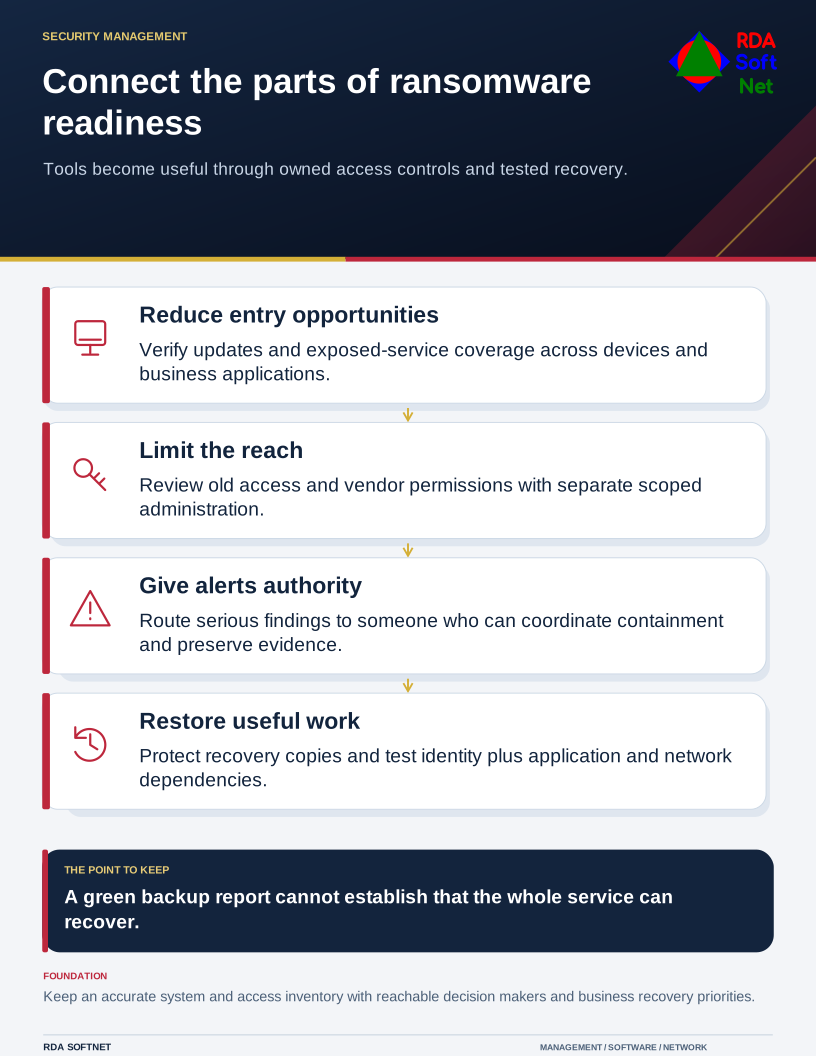
Readiness means those parts have been connected. RDA starts with the work the organization must preserve, then coordinates the people responsible for access, systems, records, communications, and recovery.
Reduce the opportunities to gain and expand access
Keep an accurate view of exposed services and supported devices. Check whether updates succeeded, including those for business applications and remote access equipment. The endpoint security guide covers the operating discipline behind a patching policy: inventory, prioritization, verification, and handling failures.
Protect user and administrative sign-ins, and use phishing-resistant methods where supported. Separate administrative accounts and limit the systems they can reach. Review old accounts, unnecessary remote access, and standing vendor permissions. The privileged access guide helps distinguish routine work from tasks that need elevated authority.
No single change guarantees prevention. The point is to remove avoidable access and limit what a compromised account or device could affect. An application account with write access can still damage the information it is permitted to change, even without local administrator rights.
Decide what an alert will cause
Ask who receives urgent security alerts and how they reach an authorized decision maker. Confirm what the responder can isolate, which operational systems need special coordination, and what happens if the normal contact is unavailable.
Write a short incident response plan that staff can find when email or the main network is unavailable. Preserve useful evidence and involve the appropriate response, legal, insurance, and operational contacts according to the incident. A panic-driven rebuild can remove information needed to understand the intrusion.
NIST's ransomware community profile addresses ransomware across risk governance, protection, detection, response, and recovery. It is a useful cross-check for a plan otherwise dominated by prevention purchases.
Prove that the organization can recover
Protect recovery copies from the same identities and pathways used for everyday administration. CISA's StopRansomware guide recommends offline, encrypted recovery copies and regular restore testing. Choose protection arrangements suitable for the systems involved and verify that the controls actually apply.
Test restoring a useful service, including its identity, application, network, and data dependencies. Record the time taken, the condition of the restored information, and what a business user verified. The backup and recovery guide connects that evidence with recovery priorities.
Finish the exercise by assigning the gaps. A plan becomes more credible when someone corrects an unsuccessful restore or an unanswered escalation call. Management can then review concrete limitations and fund the next improvement with a clearer understanding of what it protects.