
A list of security products tells you what has been purchased. It does not tell you whether an unmanaged laptop is visible, whether someone investigates a failed update, or whether a serious alert reaches a person authorized to act. Those questions live in the handoffs between tools and teams.
Follow one security event to its outcome
A suspicious sign-in or failed update can reveal the gaps between teams.
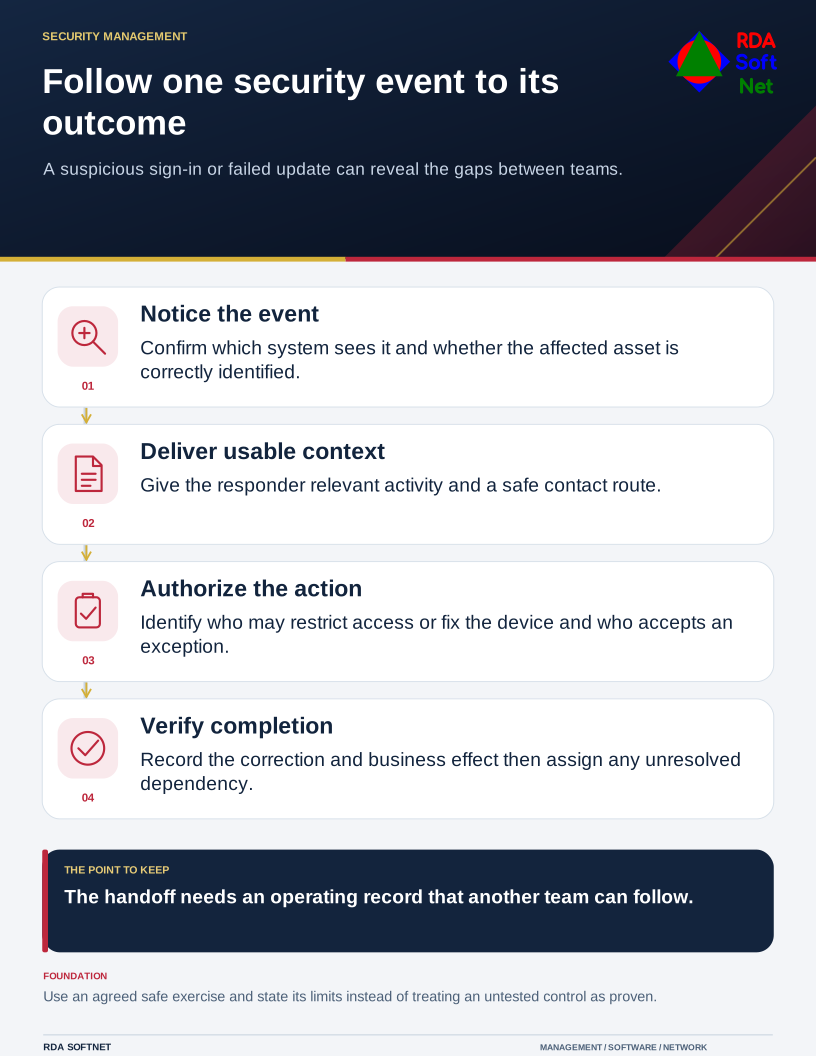
Start a coverage review by following a few realistic events. A suspicious sign-in, an exposed software weakness, and a failed backup will each reveal something different about how protection is actually operated.
Follow one issue to its conclusion
For a suspicious sign-in, identify which system notices it and what information the responder receives. Ask who decides whether to block access, how they contact the user safely, and which application activity is examined afterward. Then check who records the outcome and whether any related access needs correction.
Repeat the exercise for a failed update. Is the affected device correctly identified? Does the issue reach the team that can fix it? If the update cannot be installed, does an exception have an owner, an agreed risk decision, and a review date?
The security operations guide connects monitoring with investigation and follow-up. A dashboard full of alerts may indicate good visibility, unresolved work, or both. The distinction requires an operating record.
Review outcomes across the whole service
NIST's Cybersecurity Framework offers a way to consider risk management beyond individual protective tools. Use that broader view to discuss who makes decisions, what must be protected, how problems are recognized, and how operations are restored.
Avoid assuming an outside provider is responsible for every part of the environment. The application supplier may patch its service while internal IT manages user access and another provider operates endpoint protection. Write down the responsibilities and the path for resolving a gap between them.
A regular service review can examine evidence that matters: coverage exceptions, unresolved findings, important changes, and completed recovery exercises. Metrics should help answer an operating question. A high installation percentage is less reassuring if the missing devices are the ones handling the most sensitive work.
Test a handoff without creating an incident
Use an agreed exercise rather than introducing harmful software or disrupting production. Walk through a report, confirm the contact route, and verify that the right people can find the information they need. Make the limits of the exercise clear so nobody mistakes it for evidence that an untested control has worked.
Include incident response and backup recovery. A responder may be able to isolate a device, yet still depend on a department owner to decide how work continues. Restoration may require a supplier's participation as well as available backup data.
RDA's role is to help the organization connect these responsibilities with its computer department and providers. End the review with a short list of owned improvements and the evidence needed to close them. Better coordination can be the missing security layer even when the existing tools are capable.