
Removing a person's name from a document does not necessarily make the document safe to upload. A job title, unusual event, address, or combination of details may still identify them. Confidential business information may not contain a person's name at all.
Is this disclosure to the AI service approved?
Removing a name does not necessarily remove identity or business confidentiality.
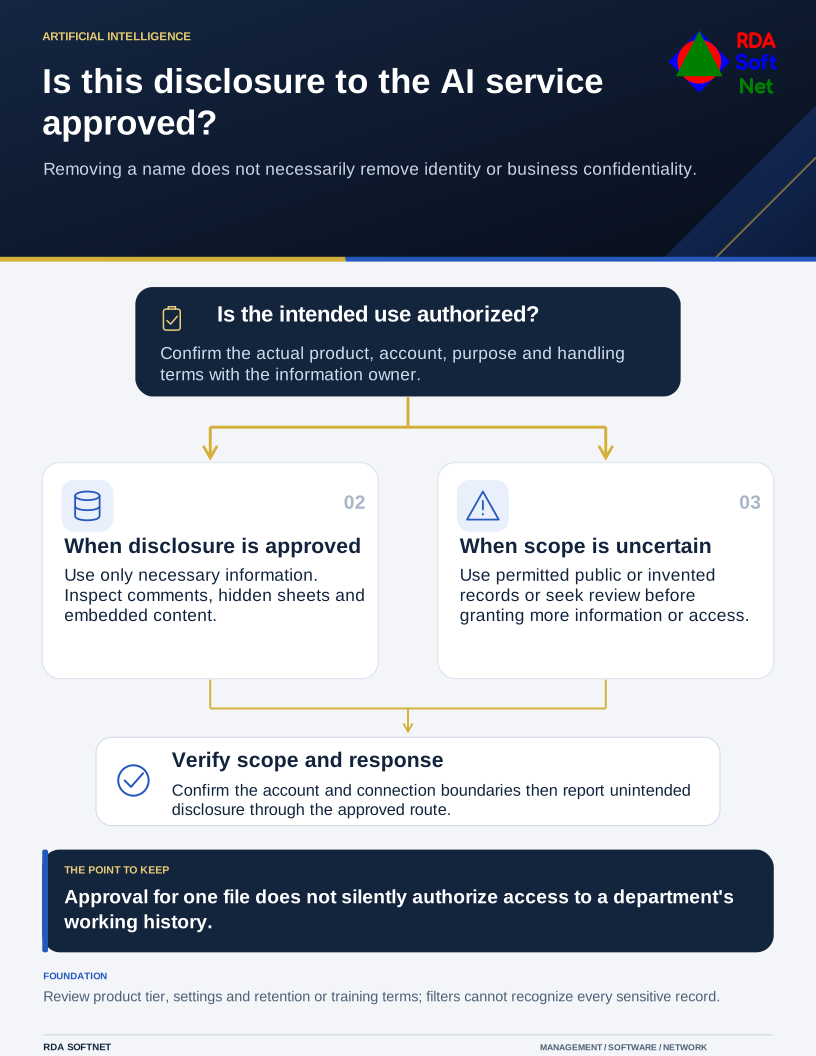
Before introducing a file to an AI service, ask whether the organization is authorized to disclose it to that service for the intended purpose. This is an information decision supported by technical review, not a question employees should have to answer from a product's reassuring interface.
Check the actual service arrangement
Data handling can differ between products, account types, settings, and optional features. Check the relevant terms for retention, model improvement, administrator visibility, subprocessors, deletion, and support access. Do not assume that every public tool uses every prompt for training, or that every paid account permits regulated information.
Identify whether the employee is in the approved organizational account. A familiar logo can appear in a personal account, an extension, or an unrelated connected service. Record the approved route clearly enough that staff can tell the difference.
NIST's AI Risk Management Framework includes resources for addressing risks associated with generative AI. Use a tailored risk review alongside the product's current terms and the organization's obligations. The AI governance guide explains how an approved use is established and reviewed.
Use less information where possible
For drafting a template or exploring an idea, use invented test records or approved public material. When live information is needed, have the information owner approve the minimum necessary dataset and the expected result. Keep the original record in its approved location.
Look beyond the visible paragraph. Attachments can contain comments, revision history, hidden sheets, embedded files, and other details that staff did not intend to share. A spreadsheet prepared for analysis needs a deliberate review of its contents before upload.
Use the information classification guide to define handling rules and the data governance guide for ownership, access, and retention. If the tool connects to files, mail, or another application, review those integration permissions separately. Approval to upload one document should not silently become approval to search a department's entire working history.
Give staff a safe response when something goes wrong
Provide a clear route to report an accidental upload or unexpected output. Ask for the time, tool, account, information involved, and any connected permissions, without encouraging further distribution of the material. The response team can then assess containment, provider assistance, contractual duties, and applicable notification requirements.
Technical controls may help identify or restrict sensitive information, but their coverage must be tested on the actual tool and workflow. Do not promise that a filter will recognize every confidential document.
Revisit the approved use when the product adds connections or changes its terms. Train staff with realistic test tasks and show how to get a timely answer. Useful AI adoption gives people a permitted way to do the work, with information handling they can understand and support.