
The cloud provider may operate the building, servers, and application. Your organization still decides who receives an account, which files they may open, what information belongs there, and when that information should be removed. Those decisions are often where compliance work becomes practical.
From a cloud claim to operating evidence
The relevant service model and actual use determine the responsibilities that remain.
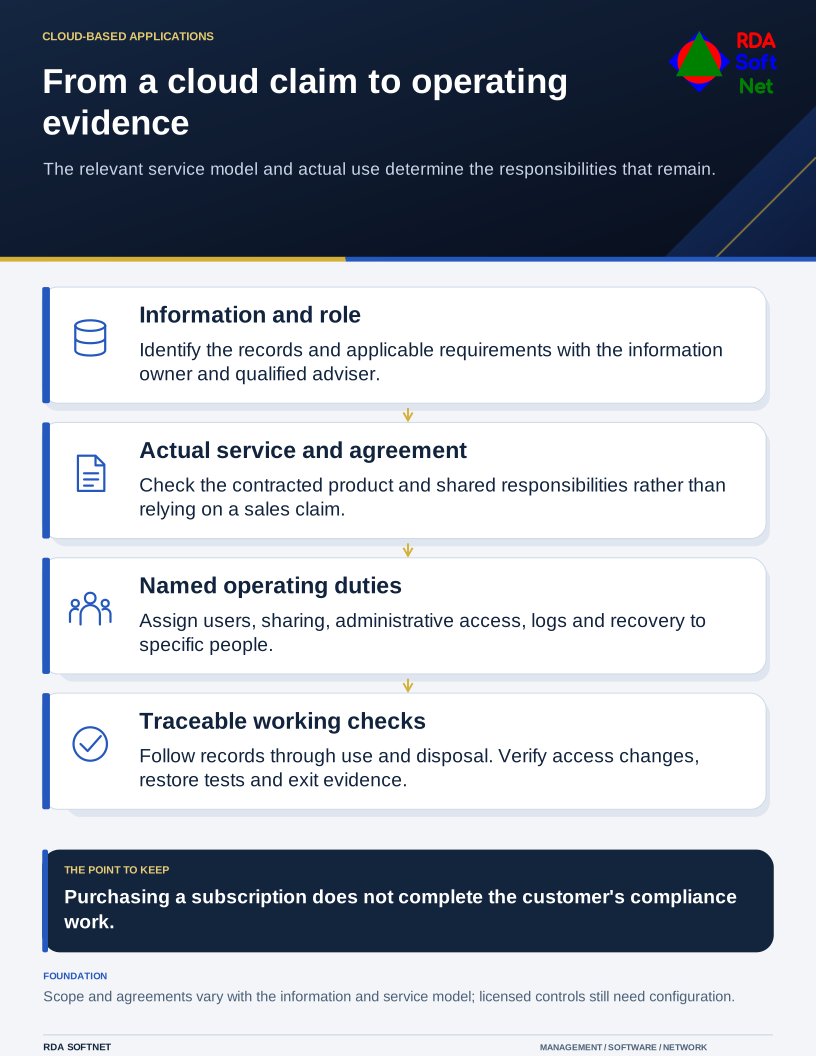
A sales page describing a compliant platform does not establish that every customer use of it meets every requirement. The service, contract, configuration, and actual workflow all matter. Begin with the information and the organization's role before choosing a checklist.
Match the obligation to the work
Ask what the service will hold and who will use it. Patient information, criminal justice information, payment records, personnel files, and public records raise different questions. Do not assume that all rules apply to every organization, or that a single certificate answers them all.
Where HIPAA applies, HHS explains that a cloud provider maintaining electronic protected health information on an organization's behalf can be a business associate even if it lacks the decryption key. The required agreement is part of that relationship, alongside the customer's own risk analysis and safeguards. See HHS cloud computing guidance.
Use the relevant information owner and compliance adviser to identify applicable requirements. Our HIPAA credentials guide addresses one part of that work, while data governance covers ownership, sharing, and retention more broadly.
Turn responsibility into named tasks
For the chosen service, record who manages users, administrative access, sharing settings, logs, backup arrangements, and incident contacts. Include the internal department and outside providers. Two contracts saying that each party will assist is not the same as assigning someone to perform a task.
Microsoft's shared responsibility guidance distinguishes responsibilities across cloud service models. A rented virtual server leaves different operating duties with the customer than a hosted application does. Review the actual service rather than applying one cloud rule to everything.
Check the settings against the intended use before introducing live information. Can an ordinary user share a file publicly? Can administrators obtain the evidence the organization expects? What happens when an employee leaves? Record exceptions and who accepted them.
Keep evidence that the process works
A practical review should follow a few records from creation through use and disposal. Confirm that access approvals, departures, restore tests, and important configuration changes can be traced. Keep evidence in an approved location with suitable access and retention, rather than spreading sensitive screenshots among personal inboxes.
The cloud governance guide connects these checks with licensing, ownership, and ongoing administration. Include an exit plan too: the organization needs to know how it will recover usable records if it changes providers.
RDA's role is to connect the technical settings with departmental responsibilities and verified requirements. The result should be an understandable operating process, with gaps assigned for action, rather than a declaration that purchasing a subscription completed compliance.