
A storage service can be easy to buy and difficult to unwind. By the time a department discovers an unsuitable sharing model, its files may already be linked from procedures, messages, applications, and other people's bookmarks.
Choose storage against the working file
Representative records reveal needs that a headline capacity or price can hide.
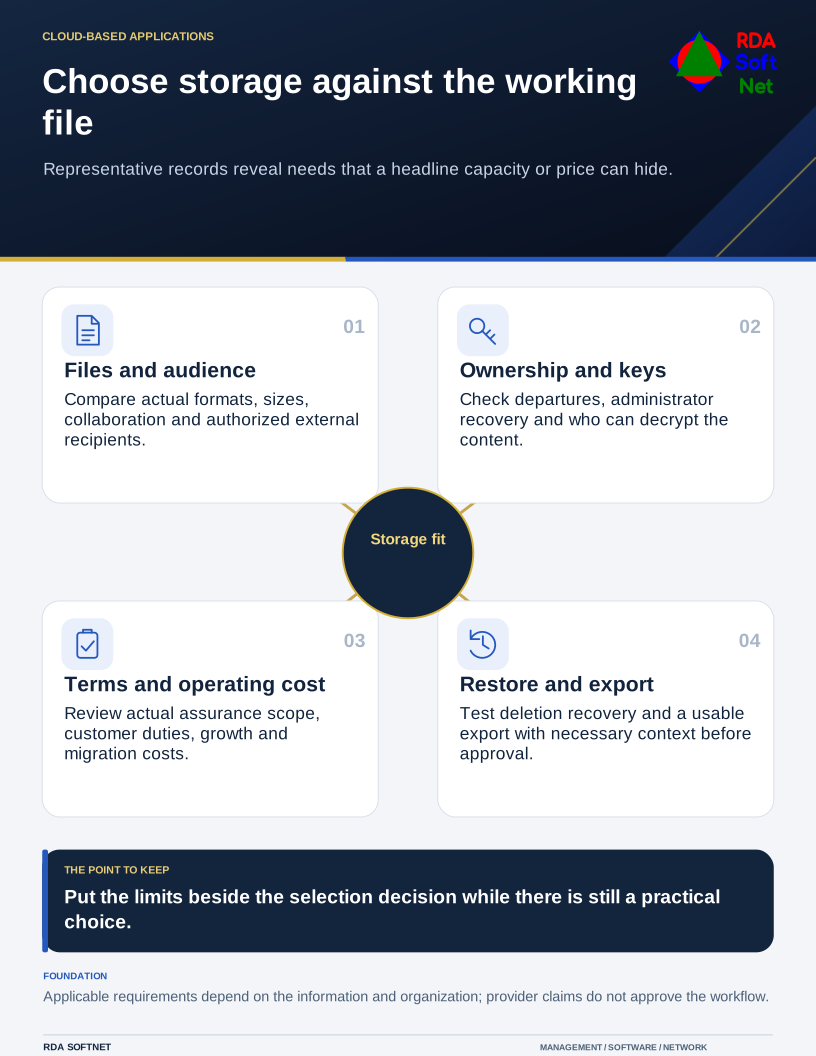
Choose against the work first. Gather representative file types, sizes, collaboration patterns, recipients, and retention needs. A team handling large design files may have different requirements from a group maintaining controlled procedures, even when both ask for more storage.
Decide who should own the information
Identify individual working material and information the department must retain independently of its author. Check how the service handles role changes and departures, administrator recovery, external guests, and sharing links. The file collaboration guide helps define the intended home and audience.
Ask the information owner which content may be shared outside the organization and what approval is needed. Do not choose an anonymous-link default simply because it makes a pilot convenient. Test access with representative ordinary users and an authorized outside recipient.
Review encryption accurately. Protection in transit and at rest is not automatically end-to-end encryption in which the provider cannot decrypt the content. Ask who controls keys, which functions can read information, and how authorized recovery works. The encryption guide explains those distinctions.
Check the responsibilities behind the product claim
Assurance reports and certifications can supply evidence, but their scope and the customer's responsibilities still need review. A provider's marketing claim does not establish that your workflow meets a regulation.
For example, HHS cloud computing guidance requires appropriate arrangements, including a business associate agreement where applicable, when regulated organizations use a provider for electronic protected health information. The customer must also address its own obligations. Use the vendor review to resolve the applicable contract, support, incident contact, and information-handling questions.
Inspect recovery features and limits separately from synchronization. Establish what happens after deletion, corruption, account compromise, or loss of administrator access. Determine whether the available recovery arrangements meet your needs and what additional backup is required.
Price and test the whole service
Include licenses, storage growth, history or retention, support, migration, integrations, and retrieval or transfer charges where relevant. Check what happens when a commitment renews or the organization needs fewer users. A low initial storage price is not the full operating cost.
Run a trial with permitted test data and the people who perform the work. Test opening, editing, sharing, offline behavior, and restoring a representative file. Include accessibility needs and common device types. Confirm what users see when access is denied.
Finally, perform a small export and verify that needed files and context remain usable. The cloud exit guide connects that test with retention and cancellation. Record the limits before approval, when the organization still has a practical choice.
Put those findings with the selection decision and handover record. The owners, audience, operating cost, and recovery path should remain understandable after the person who opened the original account moves on.