
A task that takes five minutes can be worth improving if it happens repeatedly. It can also take longer to automate and supervise than to complete manually. Start with the work and its frequency, then decide whether ordinary automation, AI assistance, or a clearer procedure is the useful answer.
Is the small handoff ready to automate?
Keep preparation separate from authority and give unfinished work somewhere to go.
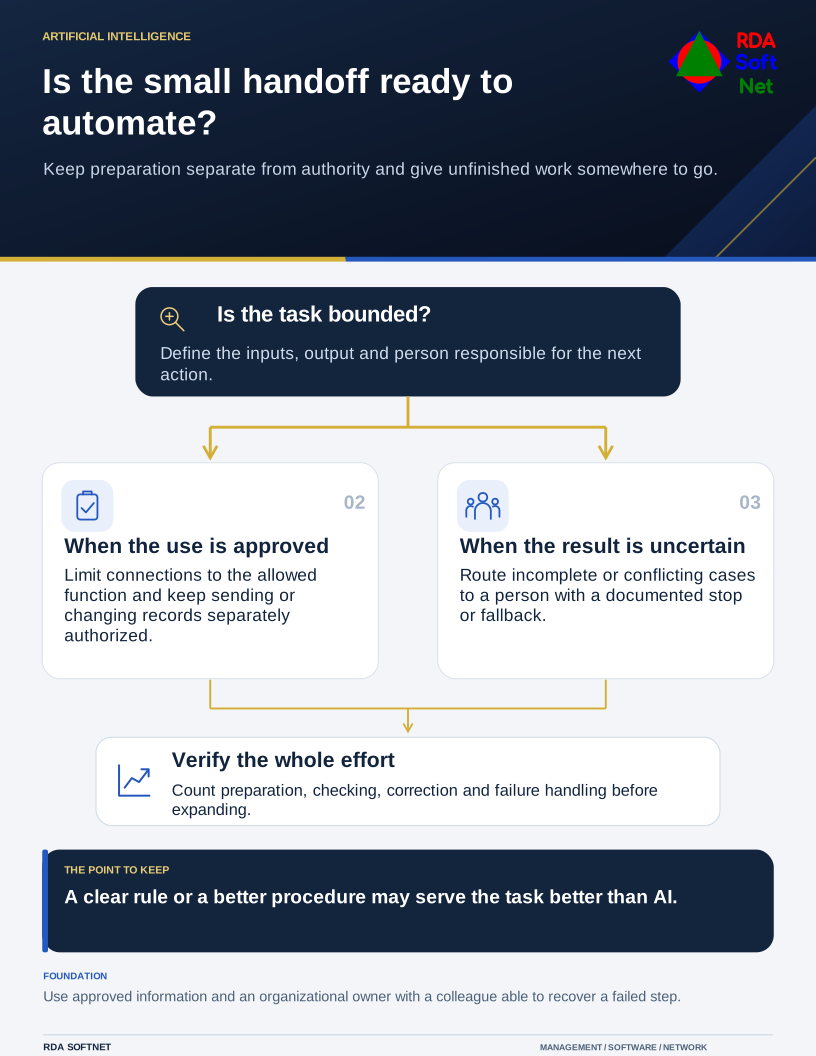
Take a simple handoff such as receiving a service request and preparing it for review. The inputs, desired output, and next responsible person should be understood before a tool receives access to the mailbox.
Separate preparation from authority
Reading approved material, proposing a category, and drafting a reply may be reasonable assistance. Sending that reply, changing an account, or approving a purchase are separate actions. The task owner should specify which are allowed and where a person must decide.
That distinction belongs in the AI use agreement. Record the information the tool may receive, who can see its output, and how an incorrect result is reported. A person reviewing a suggested action should be able to inspect the actual recipient and proposed change.
NIST's AI Risk Management Framework provides a structured way to consider risks in the context of an AI system's use. For a small pilot, use that principle to ask concrete questions about accuracy, information handling, and responsibility. A paid account or an impressive demonstration does not settle them.
Test the work people actually receive
Try representative, permitted examples, including an incomplete request, an unfamiliar abbreviation, conflicting details, and something outside the agreed scope. Ask the employee who normally handles the task to judge the result. A neatly formatted answer can still omit the detail needed to do the job.
Measure total effort. Count preparation, checking, correction, and handling failures, as well as the time the tool spends producing an answer. Record whether it improves the result or merely moves work to a different person.
Some tasks do not need AI. A rule can route a form or send a reminder when the decision is well defined. Use the automation planning guide to choose the simplest supportable process. Avoid adding a probabilistic decision where a clear rule and ordinary validation would serve better.
Keep the handoff maintainable
Review any application connection before extending the pilot to live systems. Limit permissions to the approved function, assign an organizational owner, and document how to stop or reverse the workflow. Do not leave an essential process dependent on one employee's personal account.
Agree what happens when the provider is unavailable or the tool produces an uncertain result. A person needs to receive the unfinished work rather than discover it after a missed deadline. Keep activity records appropriate to the information involved.
Keep the first improvement small enough for staff to explain and operate. Expand only when the pilot demonstrates useful results and the support arrangements are in place. At handover, have a colleague run the procedure and recover from a failed step without relying on the person who built it.