
A customer may appreciate paying with a contactless card or digital wallet. That does not mean the organization should eliminate every other payment route. Adding a convenient option and refusing cash are separate decisions with different operational and legal consequences.
A new payment option is not a cashless policy
Customer convenience needs a complete operating arrangement and a workable interruption plan.
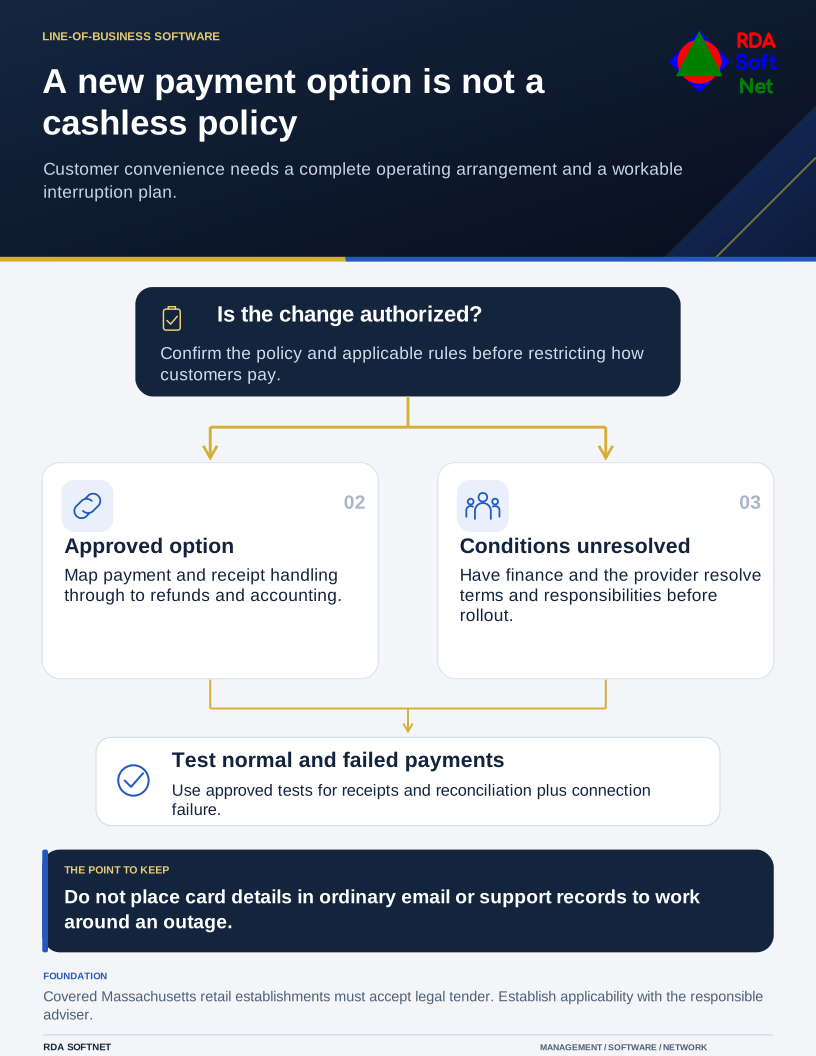
In Massachusetts, General Laws chapter 255D, section 10A requires covered retail establishments to accept legal tender. Have the responsible adviser establish how applicable rules affect the proposed service. A technology article recommending a cashless trend is not authority to change the organization's payment policy.
Follow the payment through the whole process
Bring finance, the department operating the service, the payment provider, and IT into the review. Identify how the customer pays, how approval is returned, where the receipt is stored, and how the amount reaches the accounting record.
Include refunds, disputed transactions, repeated attempts, partial failures, and end-of-day reconciliation. A terminal accepting a payment is only one stage of the workflow. Staff need a clear answer when the screen times out but the customer's account appears to have been charged.
Compare the complete cost: equipment, transaction and service charges, connectivity, integration, support, and transition effort. Confirm the agreement and any proposed surcharge or payment restriction with the appropriate finance and legal contacts rather than assuming a generic practice is permitted.
Our payment systems guide connects those responsibilities with information handling and support. The planning guide gives the change an approved scope and acceptance checks.
Keep card information out of unnecessary places
Ask the provider which systems handle payment account information and what responsibilities remain with the organization. The PCI Security Standards Council's merchant resources provide primary guidance for businesses accepting cards. Work with the processor or acquiring bank to establish the relevant validation and scope for the actual arrangement.
A hosted payment page or an approved terminal may reduce the systems handling card data, but outsourcing does not automatically remove every responsibility. Avoid collecting card details in ordinary email, support tickets, or spreadsheets to work around a problem.
Check terminal administration, remote support, software updates, network connections, and physical inspection. Use connected-device guidance where equipment joins the network. Finance should know who can change settlement or bank details and how those changes are independently verified.
Test the customer experience and the outage
Run representative transactions with the provider's approved test method. Verify receipts, accounting entries, refunds, and user permissions. Check that the customer can understand and operate the chosen interface, including accessible assistance where needed.
Plan what happens during an internet or processor outage. An offline feature can carry conditions and financial exposure; verify its terms rather than assuming the organization should enable it. The continuity guide helps establish authorized alternatives and reconciliation afterward.
Introduce the option with short staff instructions and a support contact. Review the first operating period with finance before expanding. A good payment change gives customers a workable choice while preserving accurate records and responsibilities the organization can manage.