
One customer request can produce an email, a form entry, a spreadsheet row, a service record, and a downloaded attachment. Managing the original document alone leaves most of that information journey unanswered.
Keep the purpose attached to every copy
A record's email and export versions still need an owner and an understood lifecycle.
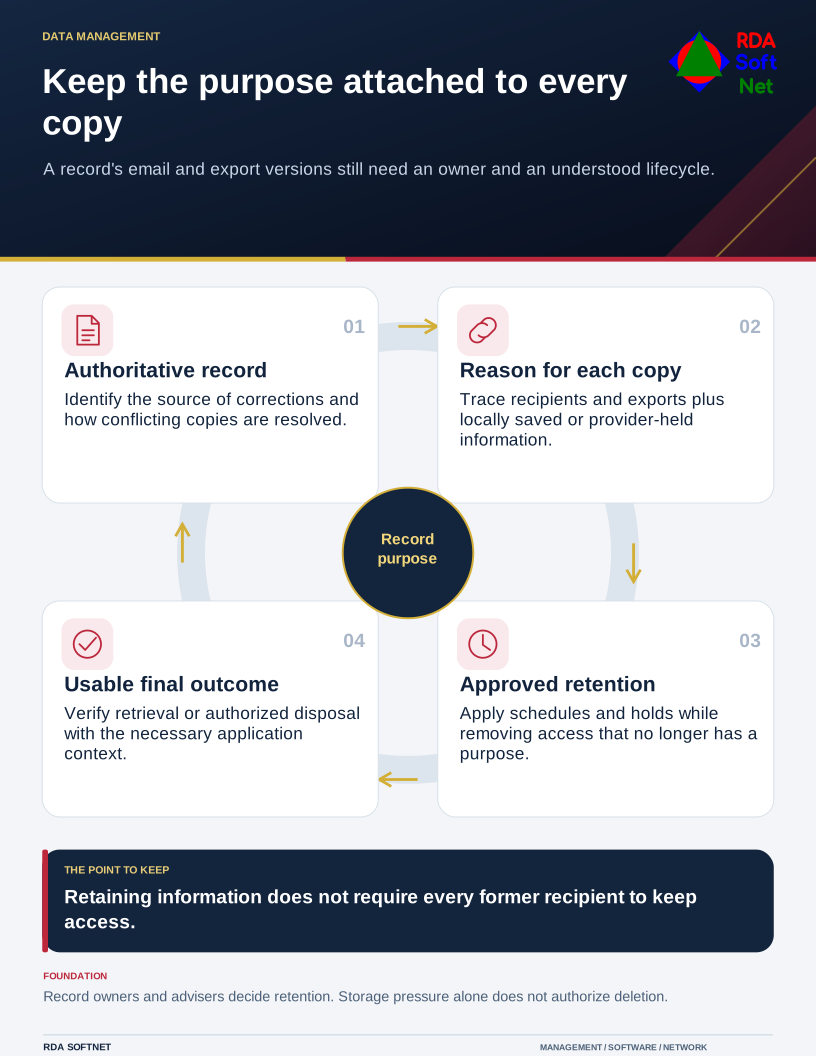
Data lifecycle management is the work of deciding how information should be created, used, shared, retained, and disposed of. The useful starting point is its purpose and owner. Storage capacity comes after understanding what belongs there.
Follow a representative record
Ask the department to trace one ordinary item from arrival to its final destination. Identify who creates or receives it, which systems hold it, who changes it, and where copies are exported. Include outside providers and locally saved files.
At each handoff, ask which copy is authoritative. A spreadsheet used for reporting may become an unofficial working database if nobody identifies where corrections should occur. When two systems disagree, staff need a process for resolving the difference without quietly rewriting history.
The data governance guide connects those questions with information ownership. For file-based work, the collaboration guide covers locations and permissions that survive an individual employee's departure.
Check information quality at entry and transfer. Agree required fields, useful validation, and how errors are corrected. Automating a transfer can repeat an incorrect value more efficiently, so include reconciliation in the design of an important integration.
Give each copy a reason to exist
The FTC's personal-information guide recommends understanding information holdings and limiting unnecessary collection and retention. Apply those principles alongside the organization's specific recordkeeping duties.
Use the approved records schedule, legal holds, contracts, and applicable requirements to determine retention. The department's records owner and responsible advisers establish those decisions; a storage administrator should not choose a deletion age merely to free space.
Our records retention guide covers that authorization. Include attachments, exports, logs where relevant, and provider-held copies. Record known limits where a service cannot remove a particular copy immediately, such as an item retained under a defined backup process.
Access should change when the work changes. Review broad links, former project groups, guests, and accounts that no longer have a business reason. Keeping a record for a required period does not mean every previous recipient should retain access throughout that period.
Verify the end as well as the beginning
Test whether an authorized person can retrieve a retained record in usable form. An old export may be unreadable without the application, field definitions, or supporting files needed to interpret it. Include those dependencies when replacing a system.
Before disposal, confirm approval, holds, scope, and the appropriate method. Keep suitable evidence without reproducing the sensitive information in the disposal record itself.
RDA can help coordinate these decisions across the department, technical administrators, and application providers. Begin with one important information flow, resolve its unclear handoffs, and carry the resulting rules into normal work. That produces a lifecycle people can operate and review instead of a diagram disconnected from where the copies actually live.