
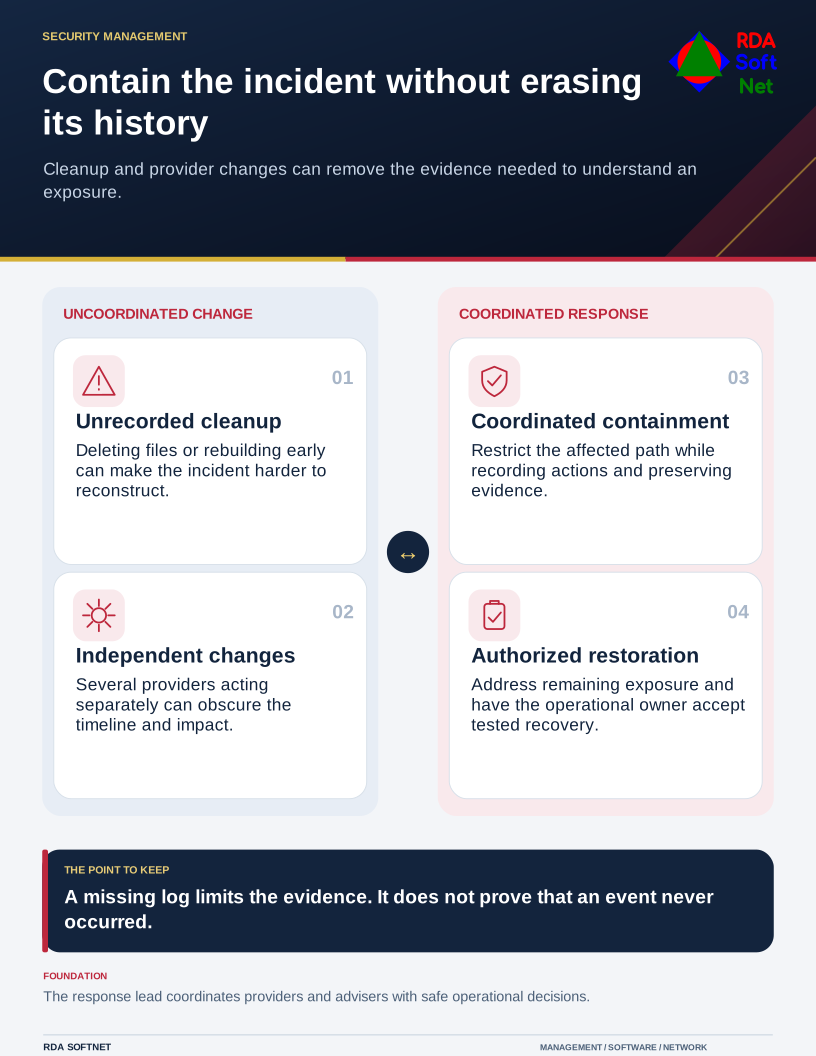
When a device displays an alarming warning, removing the warning can feel like progress. But deleting files, rebuilding the computer, or having several providers independently change settings may make the incident harder to understand. Recovery decisions need more than a clean-looking screen.
Contain the incident without erasing its history
Cleanup and provider changes can remove the evidence needed to understand an exposure.
Start the agreed incident process when the facts suggest compromise. Staff should report what they observed and what they already did. They do not need to establish the full cause before asking for help.
Name the person coordinating the response
Assign an incident lead and identify who can authorize technical containment, business interruption, outside assistance, and public communications. Include the application owner and relevant provider. Where safety or essential operations are involved, isolation must be coordinated with the person responsible for that service.
The FTC's data breach response guide recommends assembling the relevant response expertise, preserving evidence, and addressing legal and operational responsibilities. The exact team depends on the event and the organization.
Keep the incident response instructions and essential contacts available through an approved alternative if ordinary email is unavailable. Avoid discussing the response in a mailbox the attacker may control.
Containment and investigation can proceed together. The technical team may restrict an account, isolate equipment, or stop a connection, while recording the action and preserving the information needed to understand it. Staff should follow the response team's instructions rather than testing suspicious files themselves.
Separate confirmed facts from assumptions
Record the known timeline, affected services, information that may be involved, and questions still under investigation. An absence of a particular log is a limitation in the evidence, not proof that an action never occurred.
Have the responsible legal or privacy adviser assess applicable reporting and notification duties. Different information, contracts, organizations, and jurisdictions can produce different requirements. Do not apply a deadline remembered from another incident without checking its relevance.
Agree on a communications owner. Employees and affected people need accurate instructions about what to do, and a reliable time for the next update where appropriate. Avoid presenting an early theory as a completed investigation or promising that an exposure could not recur.
The data governance guide helps identify record owners, locations, and relevant handling requirements. Those details are much easier to use when documented before an event.
Make restoration an authorized step
Before returning a service, address the known entry path and remaining exposure. Test the proposed restoration and obtain acceptance from the operational owner. A restored file does not, by itself, establish that accounts, applications, and connected systems are ready for use.
Use backup and recovery planning to check dependencies, and the continuity arrangement to manage temporary work. Record what the recovery actually demonstrated and its limits.
Afterward, turn findings into assigned work with owners and verification. Include confusing procedures, missing records, provider handoffs, and controls that failed to operate. Closing the incident should leave a clear account of decisions and a practical plan for what still needs attention.