
An administrator is asked who changed a permission last month. The system has logs, but the relevant event was never enabled, the retention period has passed, or nobody has permission to retrieve it. Logging exists as a feature without providing the evidence people expected.
Can you retrieve the event you need?
Collection volume matters less than evidence that remains meaningful and available.
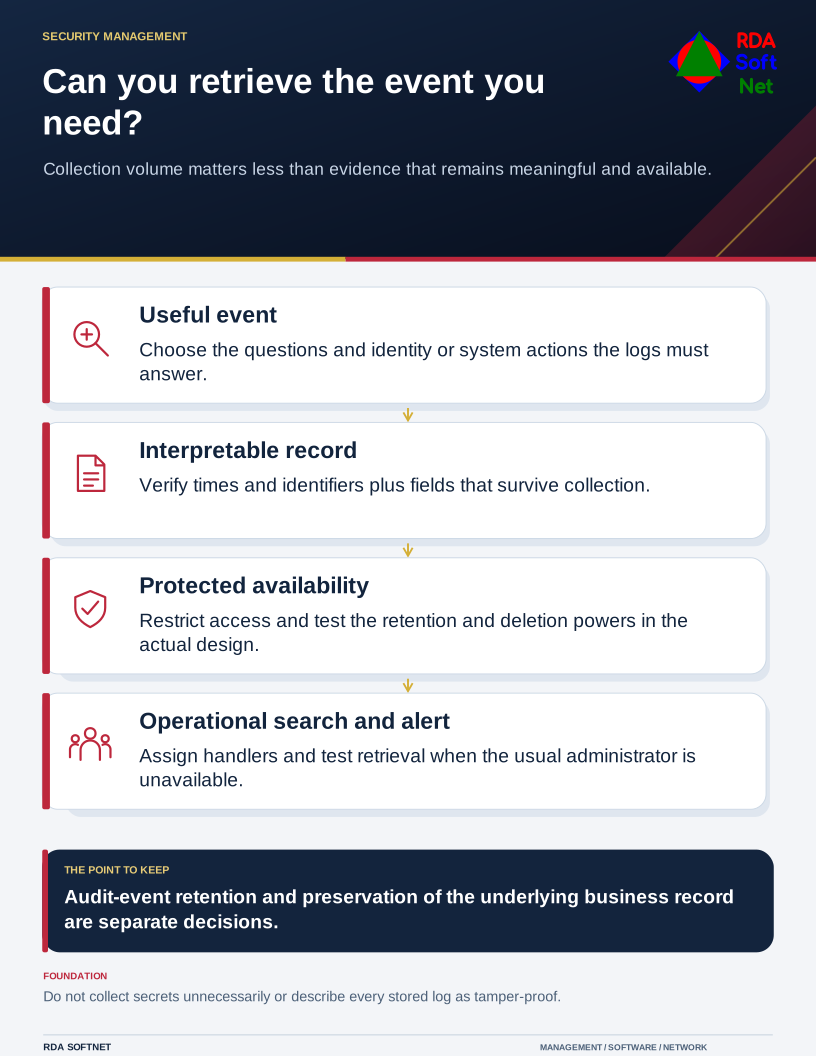
Start with the questions the organization needs to answer. Which account accessed a service? Who granted an application permission? What changed before a failure? The answers determine useful collection and retention more clearly than an instruction to log everything.
Agree on scope and quality
Identify important identity, device, application, network, and cloud events. Work with service owners and providers to establish what each platform can supply, which settings or licenses are needed, and what remains unavailable.
The joint event logging and threat detection guidance, developed by cybersecurity authorities including CISA and the FBI, covers logging policy, event quality, collection, protection, and detection. Use those considerations to design a proportionate arrangement for the actual services.
Consistent time, meaningful account and asset identifiers, and understandable event fields make records easier to correlate. Test a harmless known event and confirm it can be found. A collection count does not establish that the useful details survived transfer.
Keep secrets and unnecessary sensitive content out of logs. A troubleshooting setting that captures full request bodies can create a new information repository. The data governance guide applies to those records as well as ordinary business files.
Protect the evidence and its availability
Restrict collection and administrative access according to the design. Consider copies separated from the systems being monitored, protected transport, and appropriate storage controls. Encryption can protect confidentiality, but it does not by itself prevent an authorized account from deleting records.
Where immutable storage is used, verify the scope, retention configuration, and powers that remain with administrators. Record limitations instead of calling every stored log tamper-proof.
Set retention from investigation needs, applicable requirements, contracts, and available capacity. The records retention guide explains how those decisions are authorized. Audit events and the underlying business records can need different treatment; retaining one does not automatically preserve the other.
Give alerts and searches an operational owner
Decide which events need prompt attention, who receives them, and what the person is authorized to do. Separate a routine reporting task from escalation for a possible incident. The security operations guide connects that handoff with monitoring coverage and response.
Test alert delivery and an authorized search. Include the absence of the usual administrator and a period when the main service is unavailable. Record what the exercise demonstrates and where it falls short.
Revisit collection after an application move, provider change, or licensing adjustment. A working integration can stop supplying useful events without interrupting the business application itself. Bring those changes and recurring gaps into the service review, with a named action rather than another unread export. Logs are useful when people can retrieve, interpret, protect, and act on them.