
Visitors may need the internet without needing a route to office computers, backups, printers, cameras, or network administration. A guest wireless service should provide that limited purpose deliberately.
Test the paths from the guest device
Different kinds of isolation need separate decisions and evidence.
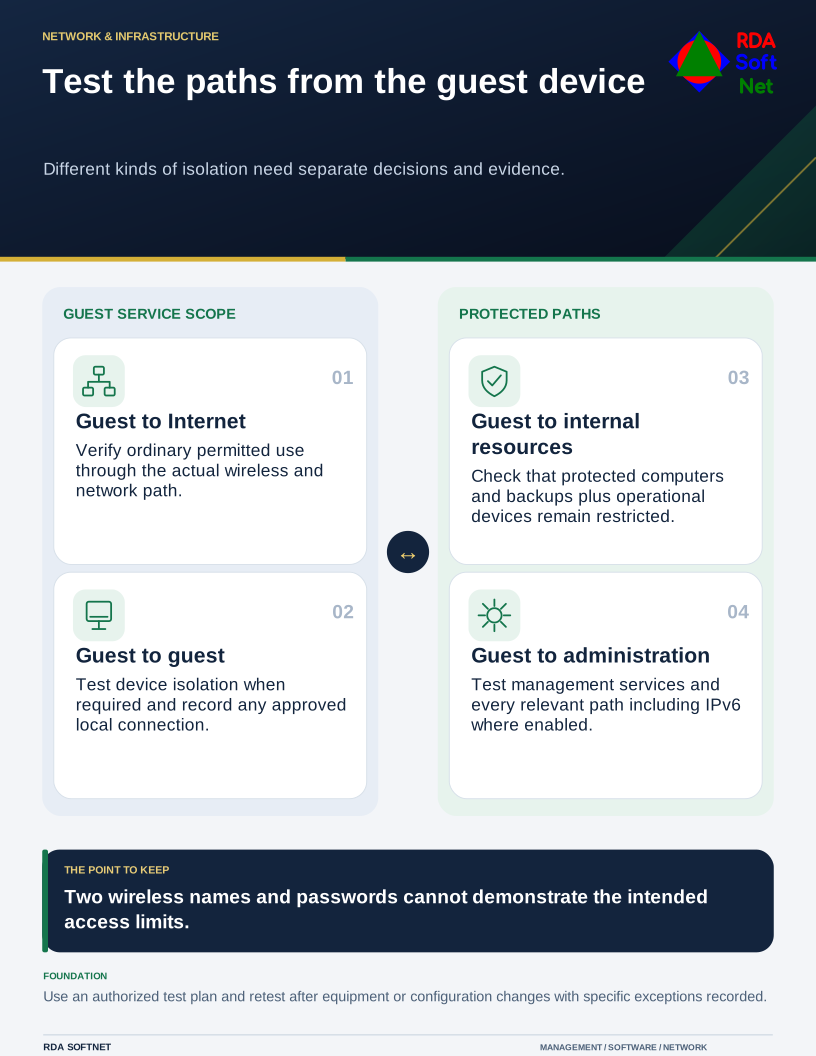
Two wireless names and two passwords do not establish that separation. The wireless equipment, switches, routing, and firewall rules determine where the traffic can go. The useful question is what a connected guest can reach, not what the network is called.
Agree on the permitted service
Write a short requirement for the guest network. Ordinarily, that means internet access with internal systems and management interfaces blocked. Decide whether guests also need to be isolated from one another. Device-to-device isolation and separation from the business network are related but different controls.
If visitor printing or presentation equipment is required, design a specific method for it. Opening broad internal access to solve one convenience request defeats the purpose of the separation. Record who approves the exception and how it will be tested.
CISA's communications infrastructure hardening guidance describes segmentation using access controls, firewalls, and logical separation. The applicable design depends on the environment. A VLAN by itself is not a complete statement of which traffic is allowed.
The network segmentation guide gives the wider planning context. Keep the public discussion at the service level while storing detailed diagrams and configuration securely for authorized staff.
Test from the guest side
Have the authorized network team connect a representative guest device and verify the intended access. Test access to known internal resources and management services as part of an approved test plan, alongside confirmation that ordinary guest internet use works.
Include both address families and every relevant connection path where applicable. A restriction that works in one test does not prove that another routing path, wireless bridge, or changed access point behaves identically. Record the configuration and the observed result.
Check whether a guest can contact another guest when isolation is intended. Some devices need a controlled local connection, so validate the business requirement rather than simply enabling every isolation option and waiting for complaints.
Keep other device decisions separate
An employee-owned laptop that needs business applications raises an access and information-handling question beyond guest internet. Use the remote work and device policy to define approved access. Being employed by the organization should not automatically place every personal device on an unrestricted internal network.
Cameras, displays, and building equipment may also need their own design. Identify their controllers, vendor support paths, and operational dependencies before moving them. A device that looks like an ordinary network endpoint may support a critical physical process.
Maintain the wireless and firewall equipment, protect administration, and review support status. Recheck separation after equipment replacement or a material configuration change. The asset lifecycle process should make that verification part of the handover.
RDA works with the organization and its network providers to turn a high-level requirement into an approved configuration and a recorded test. The result should be easy to explain: guests receive the access they need, and additional reach is a deliberate, reviewed exception.